

Getting coffee proportions right is essential for business owners aiming to offer high-quality French press coffee. The right coffee-to-water ratio not only influences the strength and flavor but also impacts customer satisfaction and repeat sales. This guide breaks down optimal brewing proportions, how to adjust them for personal taste, the importance of grind size, and best practices for measurement, ensuring consistent, delicious results that resonate with your clientele.
Balancing the Brew: A Cohesive Look at Proportions for French Press Mastery

What makes a great cup of French press coffee often comes down to one thing: proportion. The numbers matter because they translate into flavor, body, and clarity on the palate. Unlike drip brews where filter texture does a lot of the heavy lifting, the French press invites a direct conversation between coffee and water, a dialogue shaped by the exact ratio you choose. The starting point most roasters and brewers converge on sits in a flexible band, not a hard rule: about 1 gram of coffee to 12 to 16 grams of water. That range—1:12 to 1:16—provides a solid foundation for a cup that carries depth without tipping into bitterness or sourness. Within that range, the sweet spot that many find most reliable for general use tends to be 1:15. It is the kind of ratio that feels “right” to a broad audience: robust enough to carry the roast’s nuances, yet balanced enough to avoid overpowering the aroma with tannins or the palate with heaviness. Some sources still advocate a lighter 1:20, a ratio that produces a more diluted cup and can mute the full immersion benefits of the French press. The key insight, however, is that ratios are not sacred doctrines but starting points. What happens next is a dance with your beans, water, and taste buds. For deeper discussion on precise ratios, you can consult targeted guidance in a dedicated resource that compiles the practicalities of French press arithmetic: french-press-coffee-ratios-the-ultimate-guide.
Crafting Your Ideal Cup: Personalizing French Press Proportions for Flavor and Body

Coffee is as much a personal ritual as it is a chemistry experiment. When you pull water through coarse grounds in a French press, you’re not just extracting compounds; you’re shaping a sensory experience that reflects your mood, your palate, and the moment you brewed it. The conversation that matters most happens between you and the scale, between the grind and the cup. In this space, the coffee-to-water ratio is less a fixed decree than a starting instrument from which you improvise. A commonly cited starting point is 1:15, such as 30 grams of coffee for 450 grams of water. It offers a balanced, medium-strength cup that suits many, but it is not a rule carved in stone. The real art lies in using that baseline to discover what your taste buds declare as your ideal strength, body, and clarity. The precision of a scale helps you navigate that exploration, because small shifts in ratio lead to meaningful changes in flavor, mouthfeel, and overall impression of the brew.
If a batch tastes sour or thin, nudging the ratio toward a higher coffee load—toward 1:14, or perhaps even closer to 1:13—can deepen sweetness and extract more restorative flavors from the beans. Conversely, if a cup lands heavy or bitter, easing off the coffee slightly to 1:16 or 1:18 can brighten acidity and lift delicate aromatics. Some sources favor 1:20 as a general target, but that tends to yield a lighter, less full-bodied cup and is less commonly preferred by those seeking a robust profile. The key, again, is consistency. A kitchen scale makes precision approachable, and tiny adjustments—just a gram or two at a time—can transform the drink while keeping water volume constant. This is not about chasing a single perfect ratio; it is about mapping a personal preference across a grid of possibilities so you can reproduce your favorite cup reliably.
A practical way to begin this voyage is to adopt a routine of small, controlled experiments. Start with your standard ratio, brew a batch, and then adjust the coffee amount by ±2 grams while maintaining the same water volume. Taste both cups side by side and record what changes you notice: the way sweetness emerges or hides, how the body feels on the palate, and how the finish lingers or fades. With each trial, you tighten your sense of what you actually want from a morning brew, from a weekend treat, or from a late-night cup that should be comforting rather than brisk. This approach turns a simple formula into a personal protocol, a way to keep your routine fresh without sacrificing consistency.
One of the most important factors in this equation, beyond the numbers themselves, is grind size. A coarse grind is essential for the French press to prevent excessive sludge and to promote a cleaner extraction that still preserves the oil-rich body that the metal mesh filter helps deliver. A grind that is too fine can overextraction, making the cup bitter and heavy even at a moderate ratio. Conversely, too coarse a grind can underextract and yield a thin, sour cup. The interaction between grind size, contact time, and the coffee-to-water ratio is subtle but real. While you adjust ratios, you should keep in mind that a 4-minute steep is a reliable starting point for many beans, balancing extraction without dragging out unwanted bitterness or staling flavors. If your grinder offers variable settings, set it for a consistent coarse texture and resist the urge to chase a minute-for-minute adjustment by changing grind as your primary lever. The ratio, time, grind, and water quality all talk to each other in subtle ways, and you will learn to hear their conversation best by listening to how your palate responds to small, repeatable changes.
There is value in recognizing that no single ratio will universally satisfy all coffees or all drinkers. The flavor spectrum of coffee is wide, and the same beans can yield different impressions when brewed at 1:14 versus 1:16, or with a 4-minute steep versus 5 minutes. The beauty of the French press lies in this adaptability—the same device can deliver everything from bold, oil-rich mouthfeel to a more delicate, bright cup, simply by adjusting proportion and contact time. This flexibility is empowering, especially for those who enjoy experimenting with different beans, roast levels, and origin profiles. A soothing part of this inquiry is that you don’t need to abandon your current setup to test a new preference. You can run a small, controlled variation within your existing routine and listen for what your taste buds say.
If you want to ground your practice in a broader guide while you explore, you can consult a more detailed resource that compiles ratios and practical tips for this method. For a deeper dive into ratios and practical charts, this guide offers structured guidance and clear examples that help translate numbers into flavor. French press coffee ratios: the ultimate guide.
As you refine your method, you’ll notice that the consistency of your technique matters as much as the numbers themselves. Weighing water and coffee, maintaining a stable grind size, and keeping the water temperature steady all contribute to repeatable outcomes. Consistency builds confidence, especially when you want to compare results of different trials. If you record your ratios, you’ll begin to see patterns emerge: certain beans seem to respond best to slightly higher concentrations, while others reveal their best flavor with a lighter touch. The act of tasting, noting, and adjusting becomes a continuous loop of learning rather than a one-off experiment. In practice, you may find that your mornings become more efficient as you refine your method; you will know exactly how you like to start the day, and you will be able to reproduce that cup with confidence each time.
Another important consideration is the quality of water and its impact on perception. Water that tastes metallic or heavily chlorinated can obscure coffee flavors, making a precise ratio feel more critical than it should be. If your local water is hard or tastes odd, you may want to use filtered or bottled water for your trials so you can more accurately gauge how ratio and grind affect the cup without the water introducing confounding flavors. The ratio is the most visible dial you turn, but other variables—water quality, grind consistency, and even the cleanliness of your French press—shape the final profile just as much as the numbers do. When you finally settle on a preferred range, you’ll find it becomes easy to switch beans or roasts while preserving a recognizable level of strength and body, thus preserving your signature cup.
The exploration of proportion is also a conversation with time. Shorter steep times can offset a heavier dose in some beans, while longer steep times may require a lighter dose to avoid bitterness. But the most practical approach remains the simple one: keep water constant, vary coffee by small increments, and trust your palate to tell you when a preferred balance has been reached. The outcome you seek is not a single point on a chart but a quiet, familiar threshold where sweetness, acidity, aroma, and mouthfeel align in a way that feels true to your taste. In the end, your ideal cup is defined not by the most traditional ratio but by the proportion that makes the coffee taste like itself—rich, clear, and satisfying to you.
In writing about ratios, it would be remiss not to acknowledge the broader learning community that has tested and discussed these variables across countless cups. The consensus remains that a 1:15 baseline is a solid starting point for many drinkers, with the room to tilt toward stronger or lighter profiles through careful, incremental adjustments. The practice of brewing—the ritual of precision, patience, and repeated tasting—turns a straightforward set of measurements into a personal process of discovery. And as you continue, you may find that your palate becomes more adept at recognizing the subtle cues that indicate a need to nudge the ratio in one direction or another. The aim is not dogma but a well-tuned method that respects both science and preference, delivering a cup that is pleasing to your senses and reliable in its consistency.
As you move forward, keep the spirit of experimentation alive. If a particular adjustment resonates with you, note the circumstances: the bean’s roast level, the grind size, the water temperature, and the duration of immersion. Reproduce that exact setup and confirm the result. If it holds, you’ve found a personal sweet spot. If it doesn’t, you know what to alter next. The beauty of the French press, finally, is that it invites you to be both scientist and artist in your own kitchen. It rewards curiosity, discipline, and a willingness to taste often and honestly. And when you land on a ratio that feels right, you’ll recognize that moment—not because the numbers shouted at you, but because your cup spoke clearly through the senses you trust most.
External reference for further study on extraction and ratios can be found here: https://www.seriouseats.com/french-press-coffee-ratio-guide
Grind Size as the Silent Dial: Refining Proportions for a Truly French Press Cup
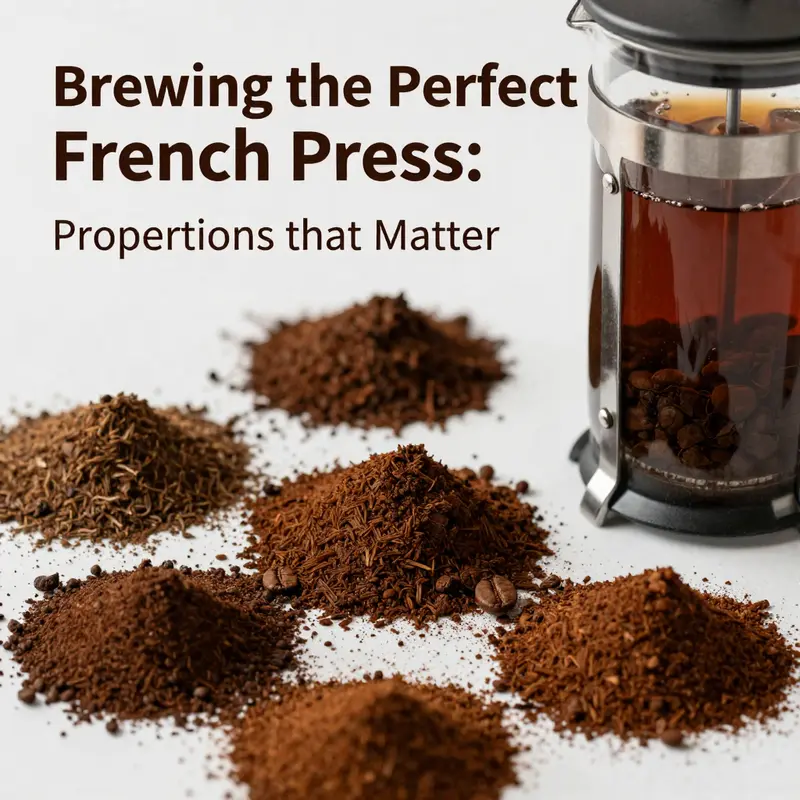
Brewing coffee with a French press is often presented as a straightforward ritual: measure some grounds, pour hot water, wait, press, and pour. Yet the process hides a subtle complexity that can make the difference between a pleasantly balanced cup and a disharmonious one. The quiet force behind that difference is grind size, not as a single switch you flip but as a nuanced dial that interacts with proportions to shape extraction, mouthfeel, and aroma. For most drinkers, the starting point remains the familiar proportion of coffee to water, commonly around 1:15. It is a balance that, when executed with a consistent grind and a mindful wait, yields a cup that sits in the middle of the flavor spectrum—neither sour nor overly heavy. But as the research around French press brewing makes clear, the exact balance you taste is not fixed. It shifts with grind texture, with the way the grounds interact with the water, and with the duration of immersion. In other words, grind size acts as an unseen conductor, guiding how the pre-measured coffee interacts with water to produce the cup that meets your preferences.
The baseline ratio of 1 gram of coffee to 15 grams (or milliliters) of water has earned broad acceptance because it creates a medium-bodied profile that carries typical coffee sweetness, acidity, and aroma without pushing too far toward bitterness or thinness. It works well for many palates and is especially reliable when you apply a coarse grind that resists over-extraction. But the key truth is that taste is dynamic. If your cup tastes sour or thin, the natural impulse may be to adjust the water or the grind. What the data emphasizes, however, is that you can achieve balance by nudging the coffee dose in concert with the grind size. In practice, small steps—such as adjusting from 1:15 to 1:14—can yield a perceptible shift toward a fuller, more robust sweetness without tipping into harshness. Conversely, if the brew leans toward bitterness or heaviness, reducing the dose slightly to a 1:16 ratio can help temper extraction while preserving body. This dialectic between grind texture and proportion is not a displacement of the baseline, but a refinement of it, a way to honor personal taste without abandoning the core principle of measured, repeatable brewing.
The research on grind size makes this refinement particularly tangible. A coarse grind—roughly the texture of sea salt or coarse breadcrumbs—serves a crucial purpose in immersion brewing. It keeps extraction measured, limiting the surface area exposed at once and thus controlling how quickly soluble compounds dissolve into the water. This approach helps prevent the overly bitter, harsh notes that can arise when extraction runs away. The opposite problem—under-extraction—also emerges if the grind is too coarse and the contact time remains constant. In that case, you may experience a brew that tastes weak or hollow, with diminished perceived sweetness and aroma. In both scenarios, the grind size alters the extraction dynamics so visibly that a mere 100-micron shift can swing the flavor from clean and vibrant to muddled and acrid. Dr. Andrea Allen, a coffee chemist and sensory analyst, has highlighted this sensitivity, underscoring how precise the relationship is between grind texture and perceived balance. Her observations reinforce the practical lesson: grind size is not a cosmetic detail but a core variable in achieving consistent flavor.
To translate these insights into a practical brewing approach, consider how the standard 1:15 starting point interacts with the grind you choose. If your grind is notably fine, you are effectively increasing the surface area exposed to water, accelerating extraction. In that case, a modest adjustment toward a finer coffee weight, or rather a tuned shift toward a more conservative ratio—such as 1:16—can help prevent the typical bitterness that follows over-extraction. It is not enough to simply steep longer or to pour more water; the margin of error shrinks with a finer grind. A slightly coarser grind, by contrast, can encourage a lighter extraction, which may translate to a flatter brew if the ratio remains unchanged. In such a scenario, a gentle nudge toward 1:14 can compensate by increasing the effective contact with water, preserving a sense of body and sweetness without tipping into sourness or thinness. The core idea is to view grind size and proportion as twin levers that must be adjusted in tandem to maintain balance.
That balance becomes even more nuanced when considering how the grounds interact with the binding force of the metal mesh filter common in French press equipment. The French press relies on a metal filter that preserves natural oils and some fines, producing a mouthfeel that readers often describe as rich and full. This attribute is precisely what makes grind size so consequential: a finer grind tends to create more fines that pass into the cup, contributing to a silty texture if the brew is allowed to accumulate. On the other hand, a coarser grind reduces sediment but can starve the brew of some aromatics and oils, resulting in a less lush mouthfeel. The result is a delicate balance between clarity and body—a balance that is achieved by combining a suitable grind texture with a proportion that supports the intended extraction profile. The guidance remains straightforward: maintain a coarse enough grind to avoid sludge, but adjust the ratio to keep the extraction aligned with your taste preferences. The goal is a grit-free cup with a clean and expressive flavor, where the oils bring depth without overwhelming texture.
A practical illustration of this principle is to start with a standard 1:15 ratio and a coarse grind, steeping for about four minutes. This combination is designed to yield a robust, well-rounded cup with a forgiving margin for taste variation. If the resulting brew leans toward sourness or thinness, try a modest adjustment toward a slightly higher coffee dose—perhaps moving to 1:14—while maintaining the coarse texture. This adjustment nudges the extraction toward a more complete profile without compromising the body. If instead the cup tastes overly bitter or heavy, ease off the coffee a touch or shift to a slightly coarser grind while maintaining the same steep time. In many cases, moving from 1:15 to 1:16 is enough to recover balance, so long as the grind remains consistent and the water remains at an appropriate temperature. The beauty of this approach lies in its simplicity: small, measured changes in grind texture and proportion can yield meaningful improvements in flavor and mouthfeel without requiring a complete overhaul of the brewing routine.
For those who want to dive deeper into the mechanics behind grind size, extraction, and proportional tuning, there is value in exploring how grind consistency from a reputable burr grinder influences predictability. A high-quality burr grinder, particularly a conical model, can deliver a more uniform grind with fewer fines. Fewer fines mean less sediment in the cup and a more transparent expression of the coffee’s aromatic compounds. This consistency matters because it reduces the variability that can come from unevenly sized particles, allowing brewers to anticipate how the cup will taste when they adjust either grind size or proportion. The smoother grind also supports a steadier extraction, which helps keep flavors in balance across a range of doses and brew times. The take-home message is clear: an investment in grind consistency pays dividends when you are attempting to fine-tune the interaction between grind texture and the coffee-to-water ratio.
In practice, this means approaching your brew as a conversation between texture and proportion. You begin with the baseline of 1:15 and a coarse grind, then listen to what the cup tells you. If the acidity feels bright but overshadowed by a thin body, a slight move toward 1:14 can bring up the sweetness and mid-palate weight without sacrificing clarity. If the body becomes too heavy or the finish turns bitter, retreat to 1:16 and consider dialing the grind to be just a touch coarser. The takeaway here is not to fixate on a single number but to adopt a disciplined sense of adjustment. The changes should be incremental, guided by taste, and executed with a consistent approach to measurement and timing. By treating grind size as a dynamic factor that interacts with the chosen ratio, you create a pathway to achieving the precise flavor profile you seek, every time you brew.
For readers who want a compact reference to anchor their experiments, you can explore a broader synthesis of these ideas in a dedicated guide to French press ratios. It offers a structured way to think about how grind texture and proportion intersect, without losing sight of the sensory outcomes that matter most—the balance of sweetness, acidity, body, and aroma. French press coffee ratios: the ultimate guide.
The overarching lesson, then, is practical and relational: grind size and proportion are not set in isolation. They are two parts of a single system that governs extraction. When you adjust one, you should anticipate how the other will respond, and you should test your adjustments with a mindful eye toward four minutes of immersion and a coarse grind texture that keeps the cup clean and expressive. The result is a cup that respects the natural oils and flavors your coffee offers, a cup that maintains clarity and depth without drifting into sludge or excessive turbidity. The interplay between grind texture and proportion is not merely a technical detail; it is the heart of the craft. It invites you to become a more attentive brewer, one who treats each variable as a collaborator in the pursuit of personal taste and consistency.
External resources can further illuminate how these variables interact under different conditions and with different coffee profiles. For a deeper external discussion of grind size and ratio, see the following resource: https://www.coffeemadesimple.com/french-press-grind-size-ratio/.
Brewing Balance: Mastering Proportions for a Rich French Press Cup

The delicate balance between extractable flavor and drinkable strength lives in the proportions you choose when you brew with a French press. The baseline most brewers rely on is a coffee-to-water ratio around 1:15 by weight. In practical terms, that often translates to about 30 grams of coffee for 450 grams of water. This standard is not a rigid law but a reliable starting point that yields a sturdy, well-rounded cup without tipping into harshness or weakness. Many coffee enthusiasts use that ratio as a core around which they experiment, adjusting up or down by a notch or two to suit the beans, the roast level, and their own palate. In this sense, the proportions act as a tune on a coaxial dial, allowing you to shape the cup without altering everything else at once.
Within the 1:15 to 1:17 range lies the sweet spot for most drinkers. If you lean toward a bolder, more assertive brew, a 1:15 ratio brings out more body and a deeper perception of sweetness, while a 1:16 edges toward a balanced middle ground. A 1:17 ratio tends to yield a lighter, cleaner cup where acidity and nuanced aromatics can shine through. Some explorations outside this corridor exist; a 1:20 approach can be useful when the beans are particularly robust and you desire a lighter overall impression. Still, over the long arc of practice, 1:15 to 1:17 remains the closest to a universal preference for full-bodied French press coffee. The key is consistency, because small shifts in ratio accumulate into noticeable differences in flavor, mouthfeel, and aftertaste.
To translate these numbers into reliable practice, a kitchen scale becomes your most trusted tool. Measuring by weight offers precision that volume measurements simply cannot deliver. When you scoop with a spoon, you invite variance: the density of the grounds, the grind size, and even how tightly you heap the scoop can swing your dose by several grams. Over time, that drift translates into a cup that tastes different from day to day, even if everything else stays the same. A scale, in contrast, makes a repeatable protocol. You can log a favorite 30 g of grounds to 450 g of water and return to it with the same beans, the same grind, and the same technique. The science behind this is straightforward: a stable ratio ensures consistent extraction balance, letting you dial in other variables with greater confidence.
In the same vein, it is worth acknowledging the common caveat about using volume measures. A tablespoon of ground coffee is not a universal measure. The weight can shift dramatically with grind size and density, rendering a tablespoon of finely ground coffee quite different from a tablespoon of coarser grounds. This discrepancy is more than a curiosities; it is a practical obstacle to reproducibility. When you insist on a precise ratio, you remove the guesswork that otherwise creeps into your brew. The outcome is not merely a better cup of coffee; it is a reliable baseline that you can adjust from with intention rather than intuition alone.
The living core of proportioning is extraction balance. Proper proportioning is foundational to extraction balance—without it, even the best grind or technique will fall short. That line comes from researchers who emphasize how ratios set the stage for the subsequent steps of brewing. The idea is simple: if the coffee dose is too low relative to water, the extraction can finish before the grounds release their deeper flavors, leaving you with a thin or sour cup. If the dose is too high, you crowd the water’s ability to extract the desirable compounds, producing a heavy, sometimes bitter brew. A stable ratio allows you to approach grind size, water temperature, and steep time with a clearer sense of how each adjustment will influence the final cup.
Coarse grind, four minutes, and a gentle press form the practical tripod that supports consistent extraction when using a French press. The coarse grind reduces the surface area available for quick extraction, allowing a slower, more even release of flavors as the water soaks through. Four minutes hit a balance: long enough to extract depth, short enough to avoid over-extraction notes that can turn bitter. The metal mesh filter plays a crucial role here as well. It preserves essential oils and some fine particles that contribute to a fuller mouthfeel. The result is a cup with body and texture that many other brew methods struggle to replicate. Yet the same positive elements become a trap if the proportions are off. Too little coffee yields a pale, insipid brew; too much can push the oils and fines into a crosshatch of muddiness that masks clarity.
As you refine your method, remember that the proportions are only one dimension of flavor. Water temperature sits alongside grind size and steep time as a pivotal factor. Most experienced brewers favor water in the range of about 195 to 205 degrees Fahrenheit. Hotter water can drive quicker extraction, intensifying bitterness and accentuating perceived astringency, especially if the grind is too fine. Cooler water may leave behind sleepy aromatics and a lighter body. When the water enters the grounds, it carries its energy into the cells of the coffee, pulling soluble compounds into solution at rates that are heavily influenced by the ratio you’ve set. If your dose is fixed and your temperature climbs, you may need to adjust the grind to restore balance; if the temperature stays constant, you may find that your preferred cup responds best to a slight alteration in grind size or a shift of a notch in the ratio.
Beyond the mechanics, there is a sensory dimension to this craft. A one-percent adjustment in the ratio can tilt the flavor toward sweetness, brightness, or earthiness. Your taste preferences, the beans’ origin, roast level, and even brewing vessel cleanliness will color how a given ratio translates to flavor. The beauty of the approach lies in its flexibility: you start with a solid baseline, then tune to your palate with care rather than guesswork. This is why the recommended range, rather than a fixed point, is often the best philosophy for home brewers. It invites exploration without surrendering control over your cup’s structure.
To deepen the conversation about ratios and how to apply them, many guides propose a practical framework you can adapt. The concept is simple: keep a steady dose, vary the water, and observe how the cup changes. If the coffee tastes sour or thin, you can raise the dose slightly toward 1:14. If it tastes overly bitter or heavy, ease back toward 1:16 or 1:17. Keep detailed notes of each trial—grind size, grind freshness, dose, water temperature, and steep time—so you can replicate successes and learn from missteps. This iterative method is the core of mastering any brew, but it is especially effective with a French press because the full immersion approach responds noticeably to even small changes.
One practical habit that supports this discipline is to pre-warm the carafe and equipment. A warm vessel minimizes heat loss and helps maintain a stable extraction environment once hot water meets grounds. After you add water, a short stir can help ensure even saturation of all grounds. Then, as the timer winds toward the four-minute mark, a gentle press should release the aromas and oils without pushing sediment into the cup. The goal is a clean, well-structured final drink that still carries the roasted character and body you expect from a French press.
If you are curious about how others implement these ideas, you can explore a dedicated guide that zooms in on French press ratios and the nuances of different bean profiles. The guide delves into how to calibrate the 1:15 to 1:17 range for your particular beans, as well as how to adjust for roast level and grind size. It emphasizes consistency through a scale, notes the limitations of volume-based measurements, and reinforces the concept that proportioning is the foundation for extraction quality. For readers who want to translate theory into a practical routine, this resource can be a useful companion as you build your own reproducible method. French press ratios guide
As you settle into your preferred protocol, you may notice that the perfect ratio is not a fixed number but a starting point in an ever-evolving conversation with your beans. Beans from different origins respond differently to the same dose. A bright, high-acid coffee might seem more vibrant at a slightly higher water content, while a chocolatey, low-acid bean may hold together better with a touch more grounds. The principle remains consistent: a stable ratio provides a dependable stage on which your other adjustments—grind, temperature, and time—can perform with precision. The practice rewards patience and attention. Small, repeatable changes produce meaningful, tangible improvements in sweetness, body, and aftertaste. In that sense, the art of measuring proportions becomes a quiet discipline of mindful brewing rather than a frantic chase for the perfect cup on the first try.
For readers who wish to cross-check the scientific grounding behind proportioning, researchers and culinary scientists point to balanced extraction as the goal. They emphasize that a robust, reproducible method reduces variables and lets you focus on the taste outcomes that matter most to you. This perspective aligns with the everyday experience of home brewers who seek consistency over casual experimentation. The recommended approach—maintain a reliable ratio, measure with a scale, and respect grind size and steep time—provides a practical framework you can apply tonight.
To continue exploring the topic beyond this chapter, you might consult external resources that synthesize laboratory findings with practical brewing tips. For a deeper, technical discussion of extraction balance and proportioning, see the detailed guide offered by Serious Eats. It frames the interplay between dose, water, temperature, and time in a way that complements the home brewer’s intuition with scientific clarity. Serious Eats French Press Coffee Guide.
Final thoughts
Understanding the optimal proportions for French press brewing is vital for creating a consistent, high-quality coffee experience that customers crave. Adjusting these ratios to personal taste and considering the grind size ensures that your offerings stand out. By following best practices for measuring, your coffee business will not only satisfy customers but also thrive through repeat business. Continuous experimentation and attention to detail will elevate your brand in the competitive coffee market.