

Understanding the nuances of coffee preparation is vital for any coffee business owner looking to stand out in a competitive market. Among various brewing methods, the French press is celebrated for its simplicity and ability to extract rich flavors from coffee. The key to unlocking the full potential of your French press lies in mastering the right coffee-to-water ratios. This article explores the widely accepted 1:15 ratio as the foundation for brewing a well-balanced cup, while also providing insights on how to adjust this ratio based on personal preferences. We will delve into practical measurements for coffee and water, emphasizing the importance of precision in your brewing process, and discuss why grind size plays a crucial role in achieving optimal flavor. Each chapter is designed to enhance your understanding of French press ratios and how they can impact the quality of your coffee, ultimately setting the stage for a profitable business venture in the coffee industry.
The 1:15 Benchmark: Crafting Balanced French Press Coffee

The texture of a well-made French press cup carries the memory of the beans themselves. The warmth, the depth, and the way the oils coat the palate all stem from a simple, reliable rule: the coffee-to-water ratio. The 1:15 baseline offers a practical starting point for both beginners and seasoned brewers, balancing extraction with predictability.
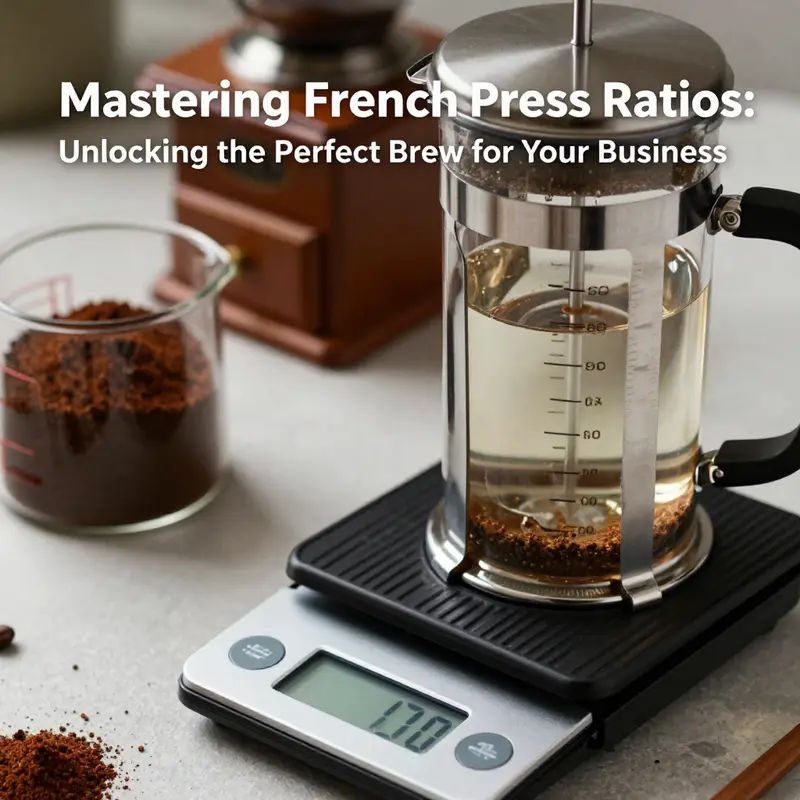
Practically, for every gram of coffee, add fifteen grams of water. Because water mass and volume align closely when measured precisely, many brewers use grams and milliliters interchangeably for French press brewing. For example, a 600-ml pot would pair with about 40 grams of coffee. The result sits in a comfortable balance: rich enough to reveal nuanced notes yet bright enough to avoid heaviness.
Grind size and equipment matter: a coarse grind akin to sea salt and a quality burr grinder help maintain an even bed and steady extraction. Weighing both coffee and water converts a ritual into a repeatable process, especially when scaling up to larger batches. When to adjust and how—if the brew tastes sour, you are likely underextracting; consider a touch more coffee or a minor adjustment toward 1:14. If the brew reads heavy or dull, ease off the coffee toward 1:16 or 1:17. Keep changes small to trace their effect on flavor.
Scaling and variables: the ratio remains proportional across batch sizes, but grind consistency across the bed becomes more important as you scale. The 1:15 ratio is a compass rather than a fixed destination, guiding you toward balanced extractions while leaving room for personal preference. Use a brewing log to compare aroma, body, and brightness across tweaks, then let your palate guide future adjustments.
In practice, the 1:15 baseline supports consistency across origins, roasts, and water qualities while still inviting experimentation. With a scale, a reliable grinder, and a patient approach to timing, you can make this simple proportion work as a flexible foundation for your best French press cups.
Dialing In: Personalizing French Press Ratios for a Rich, Custom Brew

Ratio matters less as a rule and more as a starting compass. The classic French press workflow begins with a reliable baseline: 1 gram of coffee for every 15 grams of water. This 1:15 ratio has earned its reputation for balance, body, and a forgiving margin for error. Yet coffee tastes are personal, and the body you crave may arrive with a different line in the sand. Whether you chase a slightly brighter cup with a touch more acidity or a heavier, oil-rich finish with more mouthfeel, the ratio is the first dial you turn. Using a digital scale to measure both coffee and water is not a luxury but a prerequisite for consistency. Volume estimates, even when measured with spoons, drift with grind density and bean origin. The goal is to treat the scale as your trusted compass, not as a toy. And because the French press invites oils and fines to pass through, the grind size becomes part of the tasting equation. The path to a personalized cup starts with measurement and ends in perception, guided by a routine you can repeat every morning.
To lean into a stronger cup, the adjustment is direct yet deliberate. A shift toward 1:13 or 1:12 concentrates the flavor and increases perceived body. You are not darkening the roast; you are increasing dissolved solids in the cup. With the press method, where oils remain in contact with the water longer than some other methods, this small change can feel dramatic. The aroma rises, and the finish is more resonant on the palate. If you prefer mid-day vigor or a brew that stands up to milk or cream, this subtle tilt toward greater concentration can feel like a revelation. The key is to proceed in small steps and to keep the rest of the parameters stable while you compare. Temperature, grind size, and steep time interact with ratio, so you want to isolate one lever at a time as you test. A few tenths of a gram difference on a large batch can alter the balance more than a tenth of a degree in water temperature, so precision matters. A trace of patience turns a good cup into a memorable one.
For a lighter cup, moving to 1:17 or 1:18 lightens the mouthfeel and lowers extraction intensity. The cup may reveal more nuanced aromatics, with the acidity perhaps brighter and less heavy. This is appealing when the bean origin or roast level already offers lively brightness. In this range the drink can feel cleaner and more transparent, especially if you are pairing your coffee with a morning ritual that benefits from clarity. But because the French press’s metal filter preserves oils and fines, a lighter ratio can also highlight under-extraction if the grind is too coarse or the brew time is too short. The trick is to maintain balance while letting the flavors unfold gently. It’s not about chasing bitterness away but about giving flavors room to breathe without crowding the cup with too much solubles at once. As with stronger variants, adjust in small increments and observe how each tweak changes aroma, sweetness, and finish. A measured pace keeps you close to the taste you know you want.
Grind size is the quiet partner in every ratio conversation. A coarse grind, somewhere between sea salt and rough breadcrumbs, reduces over-extraction and minimizes sediment. If you adjust your ratio but keep the grind constant, you risk tasting chalky bitterness with finer grounds or weak, hollow flavors with coarser ones. The burr grinder, with its steady bite and predictable particle size, is the ally you want when your goal is repeatable results. The grind and the ratio form a feedback loop: finer grounds expose more surface, so you can lower the ratio slightly to maintain balance; coarser grounds demand a higher ratio to reach similar extraction. This is why many brewers who chase consistency set both variables deliberately and log them for future batches. The result is not a rigid rule but a living profile you can tune as beans age, as the water changes, or as you want to highlight different flavors within the same roast.
Finding your sweet spot requires a method you can repeat without guesswork. Start with the canonical 1:15 and a moderate grind setting, then brew a batch and notice the overall balance: is the coffee too thin, too sour, or too bitter? If you taste sourness or lack of body, move toward 1:14 or 1:13 and maintain other conditions. If the cup seems heavy or bitter, shift to 1:16 or 1:17, or perhaps shorten the steep time slightly. Keep the water temperature in the narrower band of roughly 195 to 205 degrees Fahrenheit (90 to 96 Celsius). Even small temperature tweaks can tilt sweetness and acidity, especially with origin beans that carry distinct flavor profiles. Steep time in a French press is typically around four minutes, though you can shorten or lengthen this by thirty seconds in either direction. The idea is to find a rhythm that integrates the grind and the ratio into a coherent extraction. Stirring after addition of hot water helps saturate grounds evenly and reduces the likelihood of uneven extraction pockets. When you press, take care to let the coffee settle briefly in the carafe before pouring, which helps minimize fines in the final cup. The ritual becomes a dialogue between temperature, time, and texture, with the ratio acting as the compass that keeps you oriented toward flavor rather than distraction.
Documenting what you taste turns a simple routine into an evolving craft. Record the exact coffee-to-water ratio, the grind setting, the water temperature, and the steep time. Note the aroma, the body, the sweetness, and the aftertaste. Is there an edge of sharpness, or does the cup wash over with a smooth texture? Are the flavors lifting toward chocolate, citrus, berries, or earthy notes? How does the mouthfeel compare to what you expect from the roast level? Your palate develops a memory for these sensations, and over weeks you begin to recognize patterns tied to the origin, processing method, and roast. This is not about chasing a perfect, static recipe but about building a reliable brewing profile that yields your preferred cup with consistency. If you enjoy experimenting with different beans, you’ll find that your preferred ratio shifts with bean density and solubility. A bean with higher solubility may reveal more flavor at a lighter ratio, whereas denser beans can carry more complexity at a fuller ratio. The science behind this is about extraction dynamics and the physics of immersion: water pulls compounds from the grounds over time, but only up to a point before bitterness and astringency begin to dominate. The more you learn to watch those dynamics, the better you will be at choosing a ratio that honors the bean’s character.
Within your living profile, there will be a latitude of acceptable results. The sweet spot is not only a measure of strength but a balance of aroma, body, and finish. Some weeks you might crave a more vibrant, bright cup, while other days you will want a deeper, almost syrupy mouthfeel. The beauty of the French press lies in that flexibility, the possibility to adjust a single dial and observe a cascade of sensory changes. You can begin with 1:15, then nudge toward 1:14 for more intensity or 1:17 for lighter, depending on how the aroma unfolds as the coffee meets the water. The grain of the grind matters here as well; a grind coarser than your usual can mellow the cup even when the ratio remains the same, while a finer grind can transform a mild batch into something robust and layered. The combined effect of grind size and ratio is most visible when you taste side by side, not in isolation. Over time, you’ll notice how your equipment and your palate harmonize, and your notes will become a personal map you can rely on for future mornings. The crucial practice is to brew with intention, taste with honesty, and record what you learn so you can reproduce it or adjust it with confidence.
To deepen your understanding, consider consulting a structured guide that outlines how to approach ratios across brewing methods, and then apply those insights to your French press ritual. For a consolidated reference, our longer guide on French press ratios offers a practical framework you can translate into your kitchen routine. French press coffee ratios—the ultimate guide. Within that guide you’ll find sample profiles, recommended adjustment strategies, and a reminder that the core discipline is measurement and mindful tasting. While the ratio is a starting point, the real flavor emerges when you pair your measurements with precise temperature control and a consistent steep time. If you’d like to explore additional context about brewing guidelines, the Specialty Coffee Association’s official resource provides broader recommendations and emphasizes tailoring the method to bean origin, roast level, and personal taste. See https://www.sca.coffee/learn/article/brewing-guidelines for a reliable external reference.
null
null
Grind as the Silent Architect: How Size Shapes French Press Ratios and Brew Quality

The grind size of your coffee is not merely a detail on the counter; it is the quiet architect shaping every cup you brew in a French press. In immersion brewing, where the grounds steep fully in water, the texture of the coffee particles dictates how quickly and how thoroughly soluble compounds dissolve. Size matters because it governs surface area, extraction speed, and the flow of flavors through the metal mesh that separates brew from grounds. When you combine grind size with a water-to-coffee ratio, you set the stage for a brew that can be balanced and fragrant, or discordant and blunt. The baseline most baristas aim for is a 1:15 ratio, meaning one gram of coffee per 15 grams of water. This ratio tends to yield a full-bodied cup with a harmonious balance of sweetness, acidity, and bitterness. Yet the grind acts as the speed control on that ratio. A coarser grind slows extraction in a gentle, tactile way; a finer grind speeds up, and sometimes over-saturates, the extraction, pulling in bitter notes that mask the bean’s subtler flavors. The interaction between grind and ratio is why many home brewers move beyond a single recipe and learn to read their beans in real time, adjusting hands and parameters to coax the best available flavor from each batch. If you begin with a 1:15 baseline and you taste a brew that feels watery or sour, you are not just tasting ‘the coffee’ itself—you are tasting a grind that is too coarse for that water-to-coffee balance. A small adjustment toward a finer grind or a slightly longer steep can transform a thin cup into a drink with body and clarity. Conversely, if a cup tastes heavy or bitter, it could be the grind being too fine for the chosen ratio, or the steep time being longer than necessary. The balance is delicate, and it is here that modern grind technology gives the home barista a decisive advantage. A coarse grind, roughly the texture of sea salt, keeps fines from slipping through the brewing screen and reduces the chance of over-extraction during a typical four-minute steep. A burr grinder helps maintain that consistency. When particles are uniform, extraction proceeds more predictably, and the cup presents a cleaner, more nuanced spectrum of flavors. The science behind this is precise: even a tiny shift—about 100 microns—in grind size can dramatically tilt flavor. The impact is not an abstract concern; it translates into the sour brightness you might detect in a cup that’s under-extracted or the harsh bitterness that accompanies over-extraction. Dr. Andrea Allen, a coffee chemist and sensory analyst cited in research on immersion brewing, emphasizes that grind size is the most sensitive control point in this method. This sensitivity matters because the French press relies on an intentional, extended contact time between grounds and water. It gives you a longer window for extraction, but also a longer opportunity to pull out the bitter compounds if the grind is too fine or the temperature too high. Consistency is the friend of accuracy here. A high-quality burr grinder—especially one with conical burrs—produces a tighter distribution of particle sizes, reducing the number of fines that can pass through the screen. When the grind is erratic, you will notice a grittier mouthfeel and an inconsistent cup from one sip to the next. The relationship between grind size and the brew ratio becomes a three-way conversation with time and temperature. A finer grind may demand a slightly lower ratio to avoid over-extraction because those finer particles have more surface area exposed to water. In practice, this can mean adjusting toward 1:16 rather than pushing for 1:15 when your grind quality intensifies extraction. A coarser grind, by contrast, can tolerate or even benefit from a slightly higher ratio, such as 1:14, to enhance body and sweetness and to keep the brew from tasting thin as the extraction slows. While these adjustments feel subtle, they have tangible outcomes in aroma, mouthfeel, and aftertaste. In the end, mastering the French press is less about chasing a single magic number and more about balancing grind size with brew ratio and timing. The typical sweet spot for many beans sits somewhere between 1:12 and 1:16, with the precise position depending on the roast level, bean variety, and freshness. Lighter roasts may lean toward the higher end of that range to maintain brightness without sacrificing perceived body, while darker roasts can tolerate, or even benefit from, a touch more coffee to counterbalance the loss of sweetness that comes with deeper extraction. Even with a recommended interval, the personal palate and the bean’s character guide the dial-turned adjustments. As you refine your method, you will learn to treat grind size as a flexible lever. If you find a brew tasting sharp or bottle-bright with acidity, try coarsening the grind slightly and rechecking the ratio. If the cup lacks body or finishes flat, you may benefit from a finer grind or a slight increase in coffee grounds while maintaining the same water amount. The interplay with water temperature can further tune results. Water between 92 and 96 degrees Celsius is common for many French press brews; higher temperatures emphasize brightness and can push a fine grind toward bitterness, while cooler water may mitigate some harshness but extend the time needed to achieve full extraction. The four-minute steep is a typical target, but within that window your grind and ratio dictate the pace of extraction. It is here that discipline and measurement prove their worth. Using a precise digital scale to weigh both coffee and water helps translate a recipe into reliable practice. Volume measures, such as tablespoons, are imprecise and vary with grind size and bean density. The scale provides a repeatable baseline, while the grind size determines how that baseline evolves as the brewing variables change. The practical art of dialing in French press coffee lies in listening to the cup. A sour note often whispers that the grind is too coarse for the current ratio, or that the water temperature and steep time are not enough to unlock the natural sweetness of the beans. A minty sharpness or harsh bitterness often screams that extraction is dragging too far into the finished surface of the brew, likely due to a too-fine grind, or because the grind distribution includes too many fines that pass the filter. The sensory feedback guides you toward adjustments rather than a rigid recipe. When these adjustments are made with intention, the cup moves toward a well-rounded line—weighty but not heavy, bright but not abrasive, with a finish that lingers with the bean’s characteristic notes rather than finishing as a dry or astringent aftermath. Mastery, then, emerges from a dance between grind, ratio, and time, choreographed by taste and informed by measurement. The sweet spot—where grind size supports the chosen ratio without overpowering or underplaying the coffee’s natural profile—becomes a reproducible experience rather than a chance result of luck. In practice, you can anchor your method with the following approach: start with a 1:15 ratio and a coarse grind. brew for four minutes, then evaluate. If the cup tastes thin or sour, gradually move toward a finer grind or adjust the ratio toward 1:14 to intensify extraction. If the cup leans toward bitterness or a heavy mouthfeel, either coarse the grind, shorten the steep, or reduce the coffee slightly toward 1:16. The calibration should be incremental and directed by taste, not by a single numerical target. A reliable way to approach this is to link the physical changes of grind size to the sensory outcomes they produce, rather than treating grind as a mere backdrop to the recipe. For readers seeking a structured, practical path to dialing in their French press, a concise guide to coffee-to-water ratios is available in a detailed, accessible resource on the subject. The guide lays out steps for weighing using a digital scale, selecting a grind appropriate to the brew time, and adjusting the ratio in small increments while maintaining consistent water temperature and steep duration. You can explore that practical method here: French press coffee ratio guide. This anchor points to a broader, pragmatic treatment of the topic that complements the nuanced discussion of grind size and its impact on brew quality, tying together theory and practice for home brewers. The essential takeaway is that grind size is not a mere preparatory step but a central determinant of how your chosen ratio expresses itself in the cup. The grind translates the coffee’s chemistry into texture, aroma, and perceived sweetness, while the ratio sets the balance among those elements. The two must be tuned in concert to reveal the bean’s full potential, and the better you understand their relationship, the more reliably you can recreate a satisfying cup, day after day. As with many craft activities, repeatability comes from disciplined practice and mindful observation. The best French press brewers treat grind size as a living parameter, one that deserves adjustment whenever you change beans, roasts, or even the grind setting of your grinder. The science of grind size in immersion brewing supports this approach. Even minor variations in particle size influence extraction kinetics, and those kinetics are what determine how a coffee’s acidity, sweetness, and astringency present themselves in the cup. The goal is not to chase a single number but to cultivate a method that respects the delicate balance among grind, ratio, time, and temperature, all guided by taste and supported by precise measurement. In this light, the search for the perfect brew becomes a practical, iterative journey rather than a sterile recipe. The result is a technique that honors the bean’s character and the drinker’s preferences, delivering a cup that is at once familiar and alive with nuance. When you embrace grind as the silent architect of your French press practice, you begin to see that the most impactful changes are often the smallest: a 100-micron shift here, a minute added to the steep there, and a slight adjustment of water-to-coffee mass. These modest changes cumulatively redefine your experience, weaving flavor, body, and aroma into a coherent, enjoyable whole. As always, the science remains a guide rather than a tyrant. The joy of brewing French press coffee lies in the conversation between grind size and ratio, a dialogue that lets you tailor your cup to the moment—whether you crave a bright morning wake-up, a mid-afternoon comfort, or a thoughtful reflection on the craft itself. For readers who want to translate theory into action, a reliable external study confirms the complex influences of grind size on immersion brewing, including French press techniques. This peer-reviewed work provides deeper context on how grind size interacts with temperature and brewing ratio to shape extraction outcomes, supporting the practical guidance presented here: https://doi.org/10.1016/j.afres.2023.100334. By anchoring practice in science while keeping the process accessible, you can approach each brew with confidence, curiosity, and a sense of control over the coffee you drink. In the end, the grind is not just about particle size; it is about how size enables taste to express itself fully. When you get it right, the cup is not merely caffeine; it is a conversation with the bean—its origin, its roast, and the moment you decide to walk through the ritual of weighing, grinding, steeping, and savoring. The quiet act of adjusting grind size becomes a daily ritual that culminates in something you can taste and remember: a French press brew that resonates with balance, clarity, and quiet pleasure.
Final thoughts
Mastering the art of brewing with a French press is an essential skill for any coffee business owner aiming to deliver exceptional beverages. By understanding the optimal 1:15 coffee-to-water ratio, you can create a well-rounded and flavorful cup that appeals to your customers. Additionally, being aware of how to adjust this ratio to suit individual tastes will enhance customer satisfaction and loyalty. Measuring precisely and choosing the right grind size completes the brewing process, ensuring a consistently high-quality product. Elevate your café’s coffee experience by integrating these practices into your daily operations, driving both quality and profitability in your business.