

For business owners in the coffee industry, perfectly balancing flavor and strength in French press brewing can set your offerings apart. The right coffee-to-water ratio is crucial: using the widely recommended 1:15 ratio can elevate your brew’s quality and customer satisfaction. This guide explores the intricacies of the French press ratio, offers adjustments to suit personal taste, discusses the influence of grind size and water quality, and provides practical tips for achieving consistent results. Each chapter serves to deepen your understanding of how these elements work together, ensuring you can deliver an exceptional coffee experience.
Brewing Balance: Mastering the 1:15 Ratio for French Press Perfection

At the heart of a great French press cup lies a simple, often overlooked idea: the relationship between coffee and water sets the tone for every sip. The commonly recommended starting point is a 1:15 ratio by weight—1 gram of coffee for every 15 grams of water. In practical terms, that translates to a coffee dose and water quantity that together chart a path from aromatic bloom to a cup that sits in the middle of sweetness, acidity, and body. This ratio works as a baseline because it encourages a complete extraction without tipping into overpowering bitterness. It is not a rigid law but a reliable compass that helps coffee drinkers avoid the twin traps of under-extraction and over-extraction. The ratio becomes the quiet engine behind flavor, guiding you toward a cup that feels balanced from first inhale to lingering finish.
To begin, measure deliberately. The precision of a digital scale matters because small changes ripple through flavor. Volume measures—spoons and scoops—vary with grind size and bean density, making them a poor foundation for consistency. With a scale, you can set a target mass for both coffee and water and reproduce it with every brew. A consistent 1:15 ratio, paired with a coarse grind and an even water temperature, yields a cup that is full-bodied yet clean, with a gentle sweetness and a soft chocolate-nutty finish. The habit of weighing grounds and water is the practical discipline that keeps your brew honest when beans shift roast, origin, or moisture.
Grind size is not cosmetic; it dictates the rate of extraction. For French press, choose a coarse grind, roughly the texture of sea salt. This coarse geometry slows extraction just enough to keep fines from sliding through the metal filter and into the cup. If the grind is too fine, sediment increases and extraction accelerates, often resulting in a bitter edge. Conversely, too coarse a grind will starve the brew of soluble compounds, leaving the cup flat and thin. The rule of thumb is simple: let the water meet the coffee, not the other way around. A consistent grind also helps maintain the 1:15 math across a range of batch sizes. When grind uniformity improves, your flavor profile becomes more predictable, and the journey from aroma to aftertaste feels less like guesswork and more like craft.
Beyond grind, temperature and time complete the triad that governs extraction. Water heated to between 195°F and 205°F (90°C–96°C) carries enough solubles without scorching the beans. A typical steep time of about four minutes supports this balance. The immersion method of the French press means every ground sits submerged, soaking up water and releasing flavors in tandem. This is where precision matters: if you let the coffee steep too long, or if the water is too hot, tannins and bitter compounds can overwhelm the cup. If the brew is too short or the water too cool, bright acids and floral notes may disappear, leaving a beverage that tastes hollow. The interaction between grind size, temperature, and time creates a flavor curve that many home brewers chase with varying degrees of success. In practice, this trio behaves like a tightly choreographed trio: change one element, and the others adjust in response, often for better or worse.
Adjustment is a matter of personal preference, but the 1:15 starting point provides a sturdy frame from which to explore. If the cup tastes sour or under-extracted, nudging toward a higher coffee dose—say toward 1:14—can bring more solubles into the mix and restore balance. On the other hand, a brew that feels overly bitter or heavy can be coaxed toward a calmer profile by dialing back the coffee toward 1:16. A further adjustment toward 1:20 is possible for a lighter cup when the roast is bright or when you want to suppress body while maintaining clarity of acidity. The idea is incremental tuning rather than a dramatic shift. It is the difference between a recipe and a ritual, where small refinements turn a good cup into a memorable one.
To maintain consistency while you experiment, rely on measurement rather than guesswork. The digital scale is your ally here. It allows you to isolate variables, such as changing the dose while leaving water mass constant, or altering steep time while keeping the ratio intact. A method I’ve found reliable is to prepare a single-batch brew with the same grind and water temperature, then vary the dose by a single gram and observe the impact in aroma, body, and finish. This approach helps reveal the subtle dialogue between solubility, extraction speed, and the sweetness coming from the coffee oils. It also minimizes the silt that can otherwise overwhelm a cup when the grind is inconsistent or when stirring disrupts the sediment. The goal is a cup that carries its own weight—rich enough to satisfy but not so dense that it muddies the palate.
Speaking of sediment, the container and filtration play supporting roles. A properly prepared coarse grind yields a smoother cup with less grit, but the metal mesh will never filter as cleanly as a paper filter. Expect a small amount of fine particulate in the bottom. That’s part of the charm of the French press—the presence of body and texture—yet it should not feel like a gritty paste. If you consistently see heavy sediment, check your grind size and milling uniformity. A more uniform grind reduces channels of over-extraction and can help keep the cup bright while preserving the richness you expect from a 1:15 brew. Stirring briefly after pouring can also help saturate all grounds evenly, ensuring the ratio translates into consistent flavor across cups. If you notice a sudden shift in mouthfeel after a roast change, it is often a signal to revisit grind size, water temperature, and time rather than reconfiguring the core ratio.
Beyond equipment and technique, water quality matters. The mineral content of water subtly shapes taste. A well-balanced water profile helps deliver the intended sweetness and acidity without masking those delicate notes. Because a French press is a full-immersion method, water interacts with grounds longer, so the mineral balance can tilt flavor toward clarity or impart a faint metallic edge if it is out of balance. In practice, this means small adjustments to ratio should be complemented by careful choice of water temperature and steep time. The aim remains a cup that feels balanced on the tongue, with a clean aftertaste that invites the next sip rather than forcing you to reset your palate. The interplay among water quality, grind, and temperature becomes part of the overall ritual rather than a mere technical step.
While the science behind extraction is valuable, the practical path to a reliable cup is iterative. The 1:15 baseline gives you a starting line, not a finish. Read the cup, note how it evolves as it cools, and adjust accordingly. If you find the brew too light when you want more body, increase the coffee fraction slightly and re-balance the grind and water. If the bloom tastes flat, consider a tweak in the grind size to slightly finer, while checking water temperature. These micro-adjustments accumulate into a taste memory you can call upon when you switch roasts or adjust grind sizes for different beans. The beauty of this approach lies in its flexibility: you can bounce between a bold, full-bodied cup and a lighter, more delicate profile without abandoning the core ratio. This is where taste becomes a personal map rather than a fixed chart.
From a reader’s viewpoint, the value of a precise ratio lies not in dogma but in repeatability. The equipment and the variables are accessible to most home brewers: scale, kettle, French press. With them, you have a reproducible method that yields consistently satisfying results. The language of ratio becomes the language of taste, guiding you toward predictable outcomes across different batches and roasts. For those who crave even deeper understanding, a comprehensive guide to French press ratios offers a broader view of the techniques, variations, and context behind this essential brew method. French press coffee ratios—the ultimate guide.
Very often, refinement happens not in a single dramatic change but in a series of small experiments. A few days of practice with the same grind, water, and vessel can reveal how temperature, timing, and agitation influence the body and finish. Some days call for a longer steep, a slightly more coarse grind, or a tap of stirring to awaken the phenolics and oils that carry sweetness. Others benefit from a shorter contact and warmer water to emphasize acidity and clarity. The rhythm of these adjustments builds confidence, turning the initial 1:15 ratio into a modular toolkit you can apply to beans of varying origins, roast levels, and moisture content. The end result is not only a preferred cup but a more confident approach to coffee as a daily ritual. This approach also opens doors to exploring different beans and roast profiles, inviting curiosity rather than routine.
For those seeking a more science-forward explanation, the ratio’s role in extraction is linked to mass transfer, diffusion, and the interplay of soluble solids with water during immersion. When grounds are evenly saturated and evenly exposed to water, the mass transfer proceeds smoothly, and the cup remains balanced. Too dense a bed or too rapid a rise in temperature can cause preferential extraction of bitter compounds, while insufficient contact yields sweeter but weaker flavors. The 1:15 ratio provides a rhythm that allows sufficient time for sugars, acids, and oils to dissolve, while avoiding the harsh tannins that often emerge when extraction goes off script. The practical upshot is a coffee experience that carries clear aromatics and a lingering, pleasant aftertaste. It is a testament to how small, well-understood choices—measured grams, controlled heat, patient steeping—can yield a cup that feels both precise and deeply satisfying.
To close this exploration with a nod to broader reading, consider the science-backed perspectives on brew ratios and their impact on flavor, such as the comprehensive guide on French press ratios. It ties together the practical steps with the underlying chemistry, giving readers a framework to reason about every brew rather than relying on trial and error alone. The method is approachable, infusing daily coffee with intentional practice rather than routine guesswork. By embracing a measured 1:15 baseline and then adjusting with purpose, you can unlock a spectrum of profiles—from bright and crisp to deep and velvety—without reinventing the wheel for each new bean. The journey is as much about taste memory as it is about technique, and it invites you to brew with curiosity as much as with accuracy.
External resource: Mastering The French Press Perfect Ratios For Grit Free Coffee — https://www.seriouseats.com/french-press-coffee-ratio-guide
Finding Your Perfect Pour: Tuning the French Press Ratio to Match Your Taste
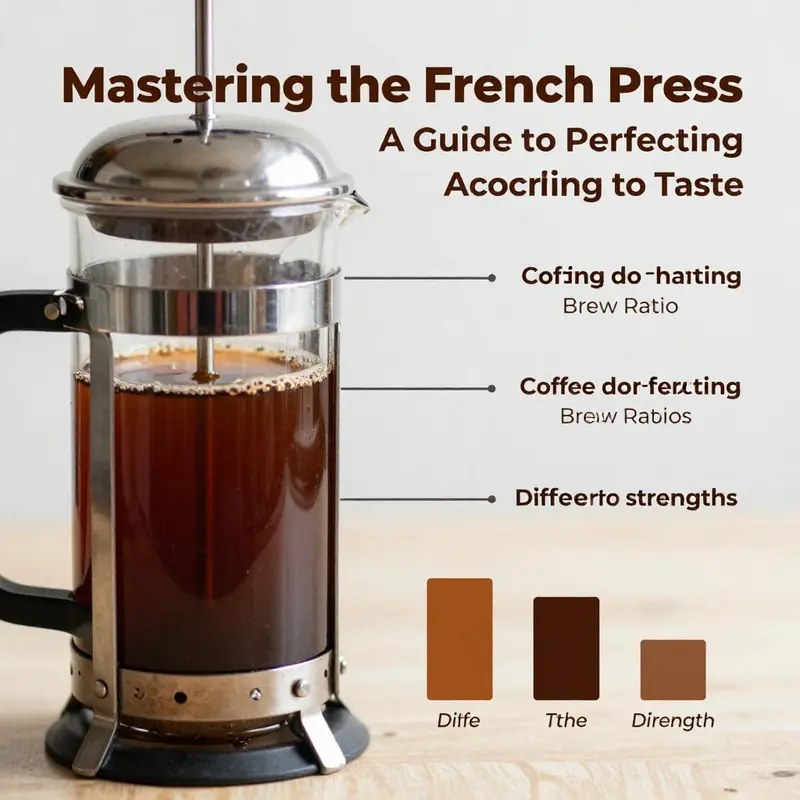
A sound approach to dialing in a French press is to treat the coffee-to-water ratio as a dial you can turn rather than a fixed prescription. A common starting point is 1:15, which tends to deliver a cup with body and clarity while avoiding excessive bitterness. Use a digital scale to measure both coffee and water, for example 20 grams of coffee with 300 grams of water. This baseline gives you a reliable reference for comparison across days, roasts, and grind settings.
To tune taste, adjust one variable at a time. If you want more body and intensity, move toward 1:14 or even 1:13, bearing in mind that higher extraction can introduce bitterness if grind size, temperature, or brew time are not aligned. If you prefer a lighter, brighter cup, try 1:16 or 1:18. These are not absolutes; they are levers you can pull to reveal different aspects of the same beans. The key is to change only one variable at a time and evaluate the result with a clear palate.
Remember that grind size, water temperature, and brew time interact with the ratio. A coarser grind can tolerate a slightly stronger ratio, while a finer grind may require a gentler touch to avoid over-extraction. As you brew more, keep notes: the date, grind setting, ratio, bloom time, and your tasting impressions. Over time, the pattern will emerge that matches your preferences across beans and moods.
Practical steps:
1) Start at 1:15 with 20 g coffee and 300 g water. Brew as you normally would.
2) Try 1:14 for a bolder profile and 1:16 for a cleaner one, documenting each result.
3) When changing grind or temp, adjust the brew time slightly to preserve balance.
The journey is about listening to the cup and letting your palate guide you. The right ratio is the one that makes your coffee sing to you on your best mornings.
null
null
Water as the Quiet Architect of the French Press Ratio: Balancing Minerals, Clarity, and Flavor

In a French press, the ratio of coffee to water is only half the story. The other half is water itself, its minerals, and even the tiny impurities that ride along with it. The familiar starting point of 1:15—a gram of coffee for every fifteen grams of water—has earned its place because it reliably yields a cup with balance: sufficient body to carry flavor, enough clarity to avoid a muddy texture, and a manageable degree of complexity without tipping into overpowering bitterness. Yet that ratio is not a rigid law etched in stone. It rests on top of a foundation laid by the water you use, and that foundation can tilt the entire brew. When you hear that water quality matters, you’re hearing a truth that ripples through every stage of extraction, from how quickly solubles dissolve to how trace minerals interact with the coffee oils and aromatic compounds. In this sense, water becomes a silent co-brewer, shaping the final cup as much as the grind, the temperature, and the immersion time do.
What makes water so influential is not just its cleanliness, but its composition. Minerals like calcium and magnesium act as catalysts in the extraction process. They can enhance the solubility of certain compounds, smooth the perceived body, and help suppress premature acidity that might otherwise shout through a lighter brew. But there is a counterbalance. Too much mineral content, particularly in hard water, can lead to a chalky aftertaste, scale buildup in the pot and filter, and a tendency toward a less transparent cup where flavors feel heavier and less nuanced. Conversely, water that is too soft or nearly devoid of minerals can leave the cup tasting flat or insipid, with underdeveloped sweetness and a brittle mouthfeel that makes the coffee’s character feel faint. In short, the water you pour is not a backdrop; it is an active partner that can amplify or mute the impact of your chosen ratio.
Subtle as these interactions are, they become audible when you listen for them in the cup. The minerals that color the perception of acidity and sweetness also influence how the coffee’s aromatic oils volatilize during the long immersion. When the water carries a balanced mineral profile, it can unlock a chorus of flavors—the bright citrus or floral notes, the deeper chocolate or nutty undertones—without letting any single element dominate. But if the water’s hardness shifts toward the chalky end, that same chorus can become a murmur, with a texture that seems heavy and a finish that trails with a mineral echo. If the water veers toward soft, the cup risks tasting washed out, where the perceived strength of the brew declines even if the same quantity of coffee is used. The result is a brew whose body and clarity don’t line up with the chosen ratio, reminding us that extraction is a dance between grind size, time, temperature, and water quality.
Across the spectrum of water profiles, one constant remains: a practical target for mineral content can stabilize outcomes. Industry guidance often points toward a balanced total dissolved solids (TDS) range, roughly between 50 and 150 parts per million, as a practical zone for consistency. Within that range, the interaction between coffee and water becomes predictable enough to support a starting point like 1:15, while still allowing for personal preference. The idea is not to chase a single perfect number, but to establish a drift-free baseline where you can taste how the water’s mineral balance interacts with the coffee’s natural acidity, sweetness, and body. When you bring a water filter into the process, you aren’t simply removing impurities; you are shaping the mineral profile to better suit your preferred roast and grind. And when you measure both coffee and water with a digital scale, you ensure that the ratio remains precise even as your water’s mineral load shifts illumination in the cup.
The interplay becomes especially clear when you consider how to respond to tasting notes in the cup. If the brew tastes sour or thin, it can be a signal that either the grind is too coarse for the water’s mineral balance or the coffee is under-extracted in the context of the water’s chemistry. In practice, a gentle adjustment toward more coffee—say moving toward a 1:14 ratio—can help bring out the coffee’s inherent sweetness and reduce perceived acidity. On the flip side, if the cup lands heavy or bitter, it may reflect over-extraction driven by overly aggressive mineral catalysis or a water profile that exaggerates tannins. In that case, dialing back the coffee to a 1:16 ratio can help restore equilibrium, allowing the rounded flavors to emerge without pushing the cup into harshness. These adjustments are not a substitution for better water; they are a calibrated response to the water’s influence on extraction.
A key discipline in this balancing act is measurement. Volume estimates—tablespoons and splash measurements—vary with grind density and bean origin, and they can mislead when the goal is consistency. A digital scale keeps the numbers honest, ensuring that a given recipe translates across different batches and different water profiles. Alongside scale use, the grind should remain coarse enough to avoid fine particles slipping through the plunger and over-extracting, yet consistent enough to yield a uniform extraction. The goal is not to force a one-size-fits-all approach but to harmonize two forces: the precise ratio and the water’s chemistry. When both are aligned, the cup is capable of sustaining a balanced aroma, a clean cup that reveals the bean’s terroir, and a finish that lingers without bitterness.
To connect these ideas to actionable guidance, the ratio remains the starting line, not the finish line. For a succinct overview of how the ratio functions within the broader context of French press brewing, you can consult the in-depth guide on coffee ratio for the French press. The discussion there illuminates how 1:14 to 1:16 can work in practice, depending on taste and water quality. See coffee-ratio-french-press for a focused exploration of dialing in the balance. That resource reinforces the core principle: water quality and mineral content are not ancillary concerns but active levers in achieving the intended cup profile.
In sum, water quality is the quiet architect of the French press ratio. It shapes how the coffee’s solubles dissolve, how the oils carry aroma, and how the final cup presents its body and clarity. A robust water profile—balanced minerals within the 50–150 ppm range—supports the traditional 1:15 starting point, while offering enough room to adjust the ratio to 1:14 or 1:16 as needed. The practical path is clear: measure precisely, maintain a coarse grind, filter or treat water to achieve a stable mineral balance, and taste critically to decide whether to nudge the ratio. When you approach brewing with this holistic mindset, the water you pour becomes not a mere solvent but a collaborator in crafting a cup that is faithful to the bean’s character and faithful to your palate. For deeper scientific context on how water composition affects brewing, a detailed external resource provides an expanding view of water quality indicators and their brew-salient implications: https://www.sciencedirect.com/topics/engineering/water-quality-indicator
The Quiet Mathematics of Flavor: Mastering the French Press Ratio for Consistent, Rich Results

Ratio is the language through which immersion brewing speaks to flavor. When ground coffee meets hot water in a French press, extraction begins in earnest, but it progresses along a measured path. The numbers you choose—how much coffee, how much water, and how long they stay in contact—shape the perception of body, sweetness, acidity, and aftertaste. Among these variables, the coffee-to-water ratio acts as the compass. For many drinkers, a starting point of 1:15, meaning one gram of coffee for every 15 milliliters of water, provides a balanced foundation. It tends to yield a smooth, full-bodied cup with enough brightness to keep flavors clear without tipping into bitterness or thinness. The beauty of this ratio is its predictability: set the amount of coffee and the amount of water, and adjust only one other variable at a time to hear how the cup responds.
Example: consider 30 grams of coffee with 450 milliliters of water. This combination yields about two generous cups with a balanced profile when you maintain a coarse grind and a steady four-minute steep. The arithmetic is simple, but the impact on flavor is meaningful. Small deviations—one or two grams more or less coffee, or a slight change in water volume—can tilt the cup toward brighter acidity or deeper sweetness. This sensitivity explains why precision matters in the French press, where the metal mesh allows oils and fine particles to contribute to the cup’s texture, and where immersion time interacts with grind size to influence extraction.
There is another commonly cited ratio, 1:20, favored by some for a lighter, quicker brew. The practical effect is a leaner cup with less body and often a more pronounced brightness. While this can be desirable in certain contexts or for particular roasts, the 1:15 ratio remains the most reliable starting point for most drinkers seeking a well-rounded cup that preserves the coffee’s intrinsic character. Treat any ratio as a starting line, not a final destination. As you experiment, you’ll learn to hear the cup tell you when it has reached an optimal balance for your preferences. If the brew tastes sour or thin, that is a hint of under-extraction, and the remedy is a careful, incremental increase in the coffee dose toward a 1:14 ratio by small steps. If the cup tastes overly bitter or heavy, you might be over-extracting; dialing back toward a 1:16 ratio can restore balance. Remember, the difference of a few tenths in the ratio can ripple through the cup’s perception, so proceed slowly and taste deliberately.
Measuring accuracy matters as much as the ratio itself. The recommended practice is straightforward: use a digital scale for both coffee and water. Volume-based measures like spoons or scoops can mislead you because grind size and bean density affect the actual coffee mass you’re putting into the brew. When you measure by weight, you remove a layer of variability and gain repeatability. This repeatability is the backbone of consistency; consistency, in turn, is what allows you to tune flavor with confidence rather than guesswork. Alongside precise dosing, grind size plays an indispensable supporting role. A coarse, uniform grind — resembling sea salt — helps ensure that extraction proceeds evenly. A grind that’s too fine can invite over-extraction and a muddy sediment presence at the bottom of the carafe, while an overly coarse grind risks a weak, underdeveloped cup. The goal is a grind that resists rapid passage of water but still yields even extraction across the coffee bed.
Along with ratio and grind, temperature and time complete the triad that governs extraction in immersion brewing. For most French press sessions, aim for water around 195–205 F (90–96 C). This range sits just below the boil and provides enough heat to mobilize soluble compounds while avoiding harsh bitterness associated with overheating. The standard steep time sits at about four minutes. This is a reliable duration that grants the coffee the opportunity to release its flavors without surrendering too much of its delicate sweetness. However, lighter roasts may benefit from a touch longer—up to four and a half minutes—whereas darker roasts might settle into the four-minute mark more quickly, as their solubles are more readily extracted. The certainty of a four-minute window, though, helps sculpt a stable baseline from which you can begin to explore small, tasteful deviations.
Equally important is the preheating step. A preheated vessel minimizes heat loss during the brew and helps maintain a more stable extraction environment. Preheating is a simple, almost ceremonial, act: rinse the press with hot water and allow it to warm while you assemble the rest of your gear and measure out your coffee and water. When you approach the process with these small, deliberate routines, you begin to notice how temperature stability translates to flavor stability. The ritual of precision—measuring with a scale, grinding to a consistent size, preheating, and timing—becomes the quiet backbone of a coffee routine that tastes predictable and comforting, even as you experiment with subtle shifts in ratio and time.
The idea that “small changes, big differences” is especially true when you adjust the ratio. If you notice a sour note or a thin body, you are likely observing under-extraction. The remedy is a careful nudge toward more coffee, i.e., toward a 1:14 ratio, and perhaps a slight increase in steep time or a minor adjustment in grind density. Conversely, if your cup grows bitter and heavy, you are likely over-extracting. A measured retreat to a 1:16 ratio often resolves the issue, preserving the coffee’s inherent sweetness while keeping the cup balanced. The key is to move in small increments—one or two units at a time—then taste. A single cup can teach you what several pages of notes cannot: your palate’s reaction to specific changes, and how those reactions map onto a stable workflow.
If you want to explore the ratio in more depth, you can consult a detailed guide focused on the practical realities of French press measurements. For example, a thorough resource on coffee ratio for the French press outlines the logic behind the starting point and the practical implications of tweaks to dose, water, grind, and time. The article emphasizes that even incremental adjustments can have a substantial impact on flavor, which aligns with the real-world experience of home brewers who want consistency and control without sacrificing nuance. The broader takeaway is simple but powerful: start with a robust baseline, measure carefully, and refine with intention rather than impulse.
The path to consistency, then, is less about chasing a single perfect recipe and more about building a reproducible method. Begin with 1:15 as your anchor, use a digital scale to measure both coffee and water, and maintain a coarse grind. Pair these with steady water temperature and a four-minute steep, adjusting only one variable at a time when you taste. Over weeks of practice, you will notice a rhythm emerge—a sense of how your grinder, your kettle, and your palate respond to nuance. You will also discover that consistency is less about rigidity and more about trust in the process: trust that a given ratio, maintained in a controlled environment, will yield a familiar cup that you can tweak with confidence, not guesswork.
For readers who want an additional, scientifically grounded perspective on why ratio matters in immersion brewing, a concise external resource offers useful context. It explains the physical processes that underlie extraction and illustrates how minor shifts in the coffee-to-water balance ripple through the final cup, shaping sweetness, acidity, and mouthfeel. This deeper dive complements the practical steps above and can be a useful reference as you move from recipe to technique. See the science behind immersion brewing for a detailed look at how your chosen ratio interacts with time and temperature to influence flavor. The nuanced discussion helps connect the numbers on your scale with the sensory experience in your mug.
Final thoughts
Mastering the coffee-to-water ratio in French press brewing is vital for businesses aiming to impress coffee aficionados and casual drinkers alike. With a foundational understanding of the 1:15 ratio, adjustments according to personal taste, attention to grind size, and awareness of water quality, coffee shop owners can consistently deliver high-quality brews that enhance their reputations. Consistency is key, and with practice and the right techniques, your French press offerings can become a hallmark of your brand. Focus on honing these details, and maximize your potential for customer satisfaction.