

Understanding how much coffee to add to your French press can profoundly affect your brewing outcomes. Business owners in the coffee industry know that delivering quality beverages hinges not just on the beans themselves but also on the mastery of brewing techniques. By exploring the essential coffee-to-water ratios, precise measurements for different press sizes, and the influence of bean characteristics on flavor, you can refine your brewing process to meet customer preferences and elevate your brand. This guide provides comprehensive insights into achieving the ideal coffee measurements to enhance the French press experience.
null

null
Sizing the Brew: Calibrating Coffee Grounds for French Press Across Sizes
A good French press feels like a conversation between two partners—the coffee and the water—each shaping the final cup in dialogue with the other. The starting point for that dialogue is a simple, dependable rule: the amount of coffee you use should be measured against the amount of water you plan to brew. When you respect this balance, the coffee’s aroma, body, and nuanced flavors can bloom rather than retreat behind under-extraction or muddied bitterness. The journey from bean to cup is less an arc of mystery and more a careful choreography of weight, time, and grind. At the heart of this choreography lies a straightforward principle: a coffee-to-water ratio by weight, typically between 1:12 and 1:16. This means for every gram of coffee, you add 12 to 16 grams of water. It sounds simple, and in practice it is, but the beauty—and the challenge—is that your precise number within that range depends on a constellation of factors: the size of your press, your preferred strength, your roast, and even the quality of your water. The more you understand how these elements interact, the more you can tailor a cup that matches your taste and your equipment without guesswork.
To translate the ratio into something you can measure at the kitchen scale, think of water in milliliters and coffee in grams. Since one milliliter of water weighs one gram, the math becomes intuitive: you’re aiming for a weight of coffee that sits within a fixed proportion to the water you intend to pour through the grounds. If you like a brighter, more delicate cup, you’ll lean toward the 1:16 end of the spectrum; for a fuller, more robust cup, you’ll push toward 1:12. The real-world effect is not just about strength. It’s about extraction balance. Too little coffee and the water runs through quickly, leaving the cup thin and insipid. Too much coffee, and you can end up with a heavy, resinous note that masks subtler flavors. The goal is to dial the ratio to yield a brew with clarity, sweetness, and the right degree of bitter finish.
When you begin to apply this ratio to different French press sizes, the numbers start to feel practical and almost obvious, yet they still reward precise weighing. A standard 12-ounce press, which holds roughly 350 milliliters of water, typically welcomes about 20 to 24 grams of coffee. That puts you near the middle of the 1:15 to 1:17 range, depending on your taste. If you’re working with a larger 34-ounce press—about 1 liter of water—the coffee needed climbs to roughly 60 to 70 grams. That range still sits within the 1:14 to 1:16 or so, ensuring a strong, balanced cup that carries through the larger volume without losing the delicate notes you crave.
For an intermediate size, such as a 20-ounce (about 600 milliliters) press, you’re looking at roughly 35 to 40 grams of coffee. The logic here aligns with the same ratio band, just scaled to the vessel. These concrete numbers demystify the process, turning a vague sense of “more coffee” or “less coffee” into a precise target you can weigh and trust. And even beyond these standard sizes, the same principle holds. If you own a nonstandard carafe, measure how much water you’ll end up with, and pull the coffee weight into the same harmonic range, adjusting only for taste preferences and grind freshness.
The alternate way to think about the relationship between coffee and water is through the more granular lens of a universal rule that some brewers find helpful: about 1 gram of coffee for every 15 to 18 milliliters of water. This formulation foregrounds the direct link between weight and volume and sometimes feels more intuitive when you’re staring at a glass carafe and a pile of beans. When you apply this rule, the numbers align with the prior guidance across press sizes, but with slightly different rigidity. For a liter of water, you’ll be in the neighborhood of 60 to 70 grams of coffee. For 350 milliliters, around 23 to 23 grams. For 600 milliliters, roughly 40 grams. You can see how the two ways of thinking converge toward the same practical targets, with the difference lying mainly in the way you frame the calculation.
Regardless of which framing you adopt, the key is consistency. A kitchen scale makes this possible, and it matters more than you might expect. Scoops, even well-designed ones, can vary by a gram or two here and there, and that margin compounds across a full press. A precise scale removes those small, cumulative discrepancies. It also makes it possible to reproduce a successful brew with remarkable fidelity. When you weigh both coffee and water, you learn to predict the outcome with a confidence that scooping rarely delivers. You’ll notice that the difference between a 60-gram and a 65-gram dose, for example, can translate into a perceptible uptick in body and perceived sweetness or a shift toward a more pronounced finish. The precision becomes a tool for taste as much as measurement.
In the practical rhythm of home brewing, you’ll likely settle into a routine. Measure your water first, then the coffee. Grind to a coarse consistency that resembles sea salt in texture, designed to resist sieve-train extraction and to prevent fine particles from slipping through the screen and into the final cup. The fine point here is that grind size, though separate from dose, amplifies or dampens the effect of your chosen ratio. A too-fine grind in a French press can slow down extraction and create a muddied, over-extracted cup even at a well-chosen ratio. A grind that is too coarse can yield under-extraction, with weak flavors and thin mouthfeel. Striking the right middle ground—a coarse, even texture—helps the water contact more surface area of the coffee evenly, maximizing extraction within the four-minute window typical for a press.
Temperature is another subtle but significant variable. Water that’s too hot accelerates extraction and can push the cup toward bitterness, especially with longer steep times. Water that’s not hot enough risks under-extraction, with a sour or flat profile. A practical target range is around 195 to 205 degrees Fahrenheit (about 90 to 96 degrees Celsius). If you don’t have a thermometer, a gentle boil followed by a minute of resting can approximate the sweet spot, particularly for medium to dark roasts that tolerate a touch more heat. The roast level interacts with the ratio as well. Darker roasts perform well with the lower end of the ratio, since they can taste more pronounced at a slightly heavier dose. Lighter roasts, with brighter acidity and more delicate aromatics, often respond better to the middle or upper end of the ratio so that their subtleties don’t vanish behind a wall of strength.
To bring together measurement, grind, and technique into a smooth workflow, many brewers adopt a standard procedure that begins with preheating the press and carafe. Preheating keeps the brewing temperature stable and prevents the vessels from drawing heat away from the water as it starts to interact with the grounds. Then measure the coffee by weight into the carafe or into the brewing chamber, depending on your model, and set your water to the target temperature. Add water in a controlled pour that evenly wets all the grounds, allowing a gentle bloom that encourages larger flavor compounds to emerge. After a brief bloom—often around 30 seconds—stir once to ensure even saturation, then add the remaining water and start the timer. The standard steep time for many brews is four minutes, though some taste preferences favor a slightly longer or shorter immersion. When the timer finishes, press slowly and steadily, and pour promptly. Freshly ground coffee reaches its peak aromatics about a minute or two after the pour. Waiting too long before drinking can dim those fragrances, while serving immediately helps reveal the coffee’s vitality.
These practical steps aren’t only about following a formula; they’re about tuning to your own sensory impressions. The numbers give you a reliable framework, but your palate is the final judge. If your cup is too strong or too weak, adjust within the same size and weight framework rather than abandoning the method altogether. Start with the mid-range values—the middle of the 1:12 to 1:16 band or a 1:15 target—and then edge toward the extremes depending on whether you crave more intensity or more clarity. A slight nudge toward 1:12 can deepen body and sweetness, but it will also magnify any over-extraction notes if your grind or pour timing isn’t on point. A shift toward 1:16 or 1:17 often yields a cleaner cup with brighter acidity and a lighter mouthfeel, though you may need to compensate with a touch longer bloom or a slightly coarser grind to keep extraction balanced.
If you’re curious about deeper explorations of ratios and their practical implications, you can explore a dedicated guide that walks through a range of press sizes and taste outcomes. For a deeper dive into ratios and their practical application, see French-press-coffee-ratios-the-ultimate-guide. This resource expands on the concept of ratios with more examples, helping you translate the math into reliable results on busy mornings or leisurely weekends. It’s a companion piece to the core practice described here, designed to give you confidence whether you’re adjusting for a small single-serve press or a larger family-sized carafe. French-press-coffee-ratios-the-ultimate-guide.
Beyond the numbers, the quality of your water and the freshness of your beans remain pivotal. Freshly ground beans deliver a sharper aroma and more defined flavor notes, while stale coffee loses the brightness that can make a well-measured brew sing. Freshness interacts with grind size and water quality in nuanced ways; a slight variance in any one of these factors can shift the character of your cup. The importance of using a coarse grind, in particular, cannot be overstated. A coarse grind resists over-extraction and sediment in the final cup, allowing the water to pass through the grounds more evenly and leaving behind a cleaner aftertaste. If you ever notice grit in your cup, assess whether your grind is too fine or if the press’s metal mesh is worn or insufficiently rounded. A well-calibrated grind, combined with a precise dose, will keep the sediment to a comfortable minimum and preserve the clarity of the cup’s aroma and flavor.
The journey toward your ideal brew is iterative, not conspiratorial. It rewards structured experimentation: change one variable at a time, note the result, and adjust in small increments. The beauty of the French press lies in its forgiving, tactile nature. You can see the plunger press through the glass, hear the dry whisper of the grounds as the water seals in, and measure the difference with your senses as well as with your scale. By consistently weighing your coffee and water, you create a reliable baseline. From there you can compare results across a few trial runs, refining your target ratio toward the exact shade of flavor you want—bright and clean, or rich and velvety. The difference between a cup that’s merely drinkable and a cup that lingers in memory often turns on the careful alignment of dose, grind, and time. And while the vanilla rule of 1:12 to 1:16 provides universal guidance, your personal preference narrows the field to a single, satisfying choice.
For readers seeking a compact, end-to-end reference that foregrounds practical measurements, the key takeaway remains simple: choose a size, pick a target within the 1:12 to 1:16 range, and measure precisely. Then adjust to taste with small, deliberate changes to dose or grind until the cup aligns with your preference. The more faithfully you measure, the closer you come to your own peak extraction across the various press sizes you use. The best cup is the one that emerges from your kitchen with familiar comfort and the sense that you coaxed the flavor forward rather than chasing it down. If you ever doubt the value of weighing your coffee, try a side-by-side comparison: the difference in body and aroma between a weighed dose and a loosely measured scoop will be striking and educational, reinforcing how precision threads through every sip.
External resource for further technical context: https://www.seriouseats.com/french-press-coffee-guide
Dose to Define the Cup: Navigating Strength and Flavor in French Press Coffee

The question of how much coffee to add to a French press is more than a simple measurement. It is the fundamental decision that sets the tone for the cup in your hands. Too little and the brew tastes wan, tart, and underwhelming. Too much and the cup can crest into bitterness, heavy and cloying. The balance rests on a dose that respects the water you use, the grind you grind, and the moment you want to capture in aroma and texture. When you approach this dose with intention, you start to see how small changes in coffee weight can unlock a much broader range of flavors and sensations in a single press.
The core of the conversation is the coffee–water ratio. There is no one perfect number for every palate or every batch, but most seasoned brewers settle into a window that serves as a reliable compass. The practical range that repeatedly yields satisfying results sits around 1:12 to 1:16, coffee to water by weight. That means for every gram of coffee, you pair 12 to 16 grams of water. This range is wide enough to accommodate taste preferences while narrowing the field enough to deliver a balanced extraction rather than a chaotic flood of variables. For example, if you start with 30 grams of coffee, you would pair it with 360 to 480 grams of water. At the 1:12 end, the cup comes through with more presence and body; at 1:16, it reveals lighter acidity and a more nuanced finish. Between these two poles lies the spectrum of what you can taste or tolerate in a morning brew. This is where your palate takes over, guided by the roast, origin notes, and water quality.
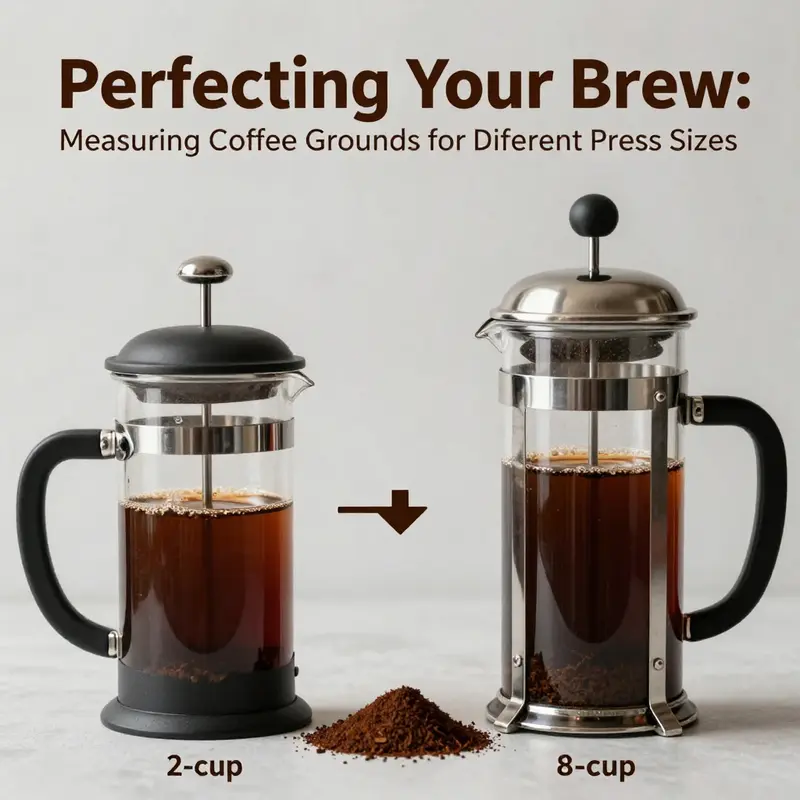
For those just beginning to dial in a French press, some pragmatic baselines help translate the ratio into something tangible. A standard 2-cup press, about 12 ounces, is commonly brewed with roughly 20 grams of coffee. A larger 8-cup press, around 32 ounces, typically calls for about 50 to 60 grams. These are not hard rules carved in stone; they are practical defaults that align with the typical capacity and the way these presses interact with grind and brew time. If you adjust these doses, you automatically tilt toward stronger or milder cups. A little more coffee within the same water volume amplifies weight and presence; a touch less reveals brightness and clarity. These examples give you a starting map so you can navigate away from guesswork toward a measured, repeatable method.
The relationship between dose and extraction is the invisible thread running through every cup. If the dose is too scant for the water amount, the grounds do not release enough solubles. The result is under-extraction: sour notes, a weak finish, and a sense that the cup is missing structure. On the other hand, too much coffee for the water pulls out more compounds than the filter can manage cleanly, leading to over-extraction and a bitter, harsh finish. The aim is to hit a sweet spot where the coffee’s origin flavors, roast character, and body shine without devolving into bitterness or sameness. Your preferred roast depth, whether light, medium, or dark, will nudge this balance in subtle ways. A lighter roast often wants a slightly higher dose to maximize aroma and complexity, while a darker roast may tolerate or even benefit from a touch less coffee, letting chocolatey and caramel notes breathe without becoming scorching.
Beyond the dose itself, several interacting factors shape how that dose translates into flavor. Grind size is the first of these. The grind for a French press should be coarse, roughly the texture of sea salt, to prevent fine particles from sliding through the mesh and into the cup. If the grind is too fine, you risk a muddy, almost gritty texture and a palate-dulling bitterness as fines over-extract. If it’s too coarse, extraction can stall, leaving the cup underdeveloped and flat. The water temperature plays a complementary role. The ideal range falls around 195 to 205 degrees Fahrenheit (90 to 96 degrees Celsius). Water that runs hotter can scorch the grounds, muting delicate notes and throwing the brew into a harsh edge. Water that’s too cool may fail to pull out sweetness and body, leaving the cup thin and insipid. The brew time itself, typically around four minutes, is also a critical lever. Extending the time can invite unwanted bitter compounds to surface, while shaving a minute off may yield a more vibrant but less full cup. The trick lies in treating time, temperature, and grind as a trio that must be tuned to the dose you’ve chosen.
The quality of the beans, their roast level, and their origin contribute another layer of influence. Freshly roasted beans bring a spectrum of aromatics that are most evident when the dose and other variables allow them to bloom in the heat of extraction. The origin notes—whether they hint at fruit, chocolate, spice, or earth—become more discernible when the water extraction aligns with a well-calibrated dose. Water quality matters too. If your tap water is heavily mineralized or overly soft, it can dull or exaggerate certain flavors, shifting your cup’s perceived strength even when the dose remains constant. In other words, the same dose can taste quite different depending on where your water comes from and how clean or harsh the brewing environment is.
With all these interacting variables, the practical path forward is to start with a solid baseline and then adjust with purpose. Many home brewers find it easiest to begin at the mid-point of the recommended range and move outward from there. A practical approach is to measure your coffee and water by weight every time, because volume measurements are imprecise in a press, where the grounds sit in a fixed volume of water and the density can vary with grind and agitation. If you’re curious to explore the full spectrum of ratios, a broader guide offers deeper structure and step-by-step experiments to map your tastes. For a deeper dive into how ratios translate to practical brewing, see the detailed guide linked here: french-press-coffee-ratios-the-ultimate-guide.
In practice, a good starting point sits in the middle of the range. A dose of about 28 to 32 grams of coffee for a 420 to 480-gram water batch translates to a comfortable, balanced cup for many drinkers. This sits near a 1:15 ratio, which tends to deliver a clean, well-rounded profile with enough body to carry the aroma and a finish that lingers without turning gritty or bitter. If you find the result too intense or too weak, adjust the dose in small increments—by a gram or two at a time—and reassess. If the cup tastes flat, you might nudge up the dose or extend the brew time slightly, provided the grind remains consistent. If the cup has too much bite or a dry finish, consider dialing back the dose and ensuring the grind isn’t too fine or the water temperature too high. The key is to move with intention rather than guessing your way to flavor.
In this hands-on process, a scale becomes a trusted companion. Weighing both coffee and water removes guesswork and makes repeatability possible. Record your starting numbers, take notes on aroma and crema, and then iterate. Over several sessions, you’ll learn how subtle changes—say, a gram more coffee or a few degrees cooler water—alter the cup’s geometry: its body, its clarity, the way the acidity rings in the mid-palate. The goal isn’t to chase a single ideal brew, but to build a personal coffee craft that responds to your mood, time of day, and the beans you’ve chosen. A well-documented dial-in becomes your own personal recipe book, a map that helps you repeat what you love and refine what you don’t.
As you develop your practice, you may discover that the most satisfying sessions begin with a consistent grind size and water temperature, then let the dose be the flexible variable. This mindset respects the physics of extraction: dose sets the ceiling of available solubles, while grind, temperature, and time determine how those solubles are drawn into the cup. The result is more than a strong or weak cup; it is a flavor profile that reflects your attention to process and your willingness to experiment within a safe, enjoyable range. If you want a consolidated overview of the most reliable ranges and their sensory outcomes, the deeper resource suggested above offers structured experiments to help you map your preferences with precision.
As you continue to refine, remember that the journey is as important as the cup. The act of weighing, timing, and tasting brings a tactile mindfulness to brewing that other methods often miss. The dose you settle on for your favorite morning routine becomes more than a measurement; it becomes a ritual cue that signals readiness to engage with the day. And since every bean tells a different story, the dose that yields magic today may shift tomorrow as you switch origins, roasts, or water sources. The practice is never finished, only improved through curiosity and consistent attention.
External resource: https://www.thespruceeats.com/french-press-coffee-ratio-12-16-4771264
Brewing Precision: Tailoring French Press Coffee Amounts to Beans, Roasts, and Personal Taste

Pouring a cup from a French press is as much about intention as it is about technique. The practice starts with a simple principle: use a weight of coffee that corresponds to the water you’re brewing. In practical terms, that means a coffee-to-water ratio in the neighborhood of 1:12 to 1:16 by weight. It sounds straightforward, but those numbers represent a spectrum, not a single rule. The idea is to give the beans enough surface contact with the hot water to extract their flavors without pulling out too many bitter compounds. The starting point many baristas reach for is around 20 grams of coffee for a 12-ounce brew, which sits neatly at roughly 1:16. From there, the journey becomes a personal conversation with your beans, your grinder, and your taste buds. The measure is neither sacred nor static; it’s a flexible foundation that you adjust as you learn how your press and your beans want to behave together.
Consider the practical landscape of presses you might own. A standard 2-cup French press—roughly 12 ounces of water—aligns with that 20-gram baseline. If you’re working with a larger, 8-cup press, your water will be in the neighborhood of 32 ounces or more, and your coffee dose in the range of 50 to 60 grams. These numbers aren’t mere trivia; they map directly to the way extraction unfolds in the vessel. Water acts as the solvent, coffee grounds as the matrix releasing aroma compounds, oils, and flavors. The ratio acts as a brake and a leash, keeping the extraction from running away or stagnating. But the perfect balance is ultimately personal. Some people want a brighter, more delicate cup; others want a heavy, bold presence that lingers on the palate. The 1:12–1:16 window is a practical corridor that accommodates both ends of the spectrum, once you know where you sit inside it.
To be sure, those figures are a starting point, not a monopoly. The roast type you choose can nudge the ideal ratio toward the higher or lower end of the spectrum. Lighter roasts, which tend to carry more nuanced acidity and floral, fruity notes, can benefit from a slightly higher ratio—closer to 1:15—so the water has more coffee surface to draw out those delicate flavors without leaving them underdeveloped. The temptation with light roasts is to push too hard for brightness and end up with under-extracted, hollow flavors. Conversely, darker roasts, which bring bold cocoa, char, and toast notes, often do well with a slightly lower ratio, around 1:17. The goal is to balance strength with clarity, so the roast’s character doesn’t drown in bitterness or vanish in a murky, over-extracted finish.
Bean origin and individual Characteristics add another layer of nuance. Beans from different regions carry distinct density, oil content, and flavor profiles that respond differently to water flow and time. A bright Ethiopian micro-lot might demand a touch more coffee by weight to unlock its complexity, while a stout Sumatran bean could express itself more fully with a touch less. The rule of thumb—adjust by small steps—remains helpful here. If you’re testing a new origin, start with the baseline and nudge the dose by 2–3 grams per round of brewing. Those minor adjustments, applied over several trials, reveal how the cup’s aroma and body shift with each incremental change. It’s a gentle feedback loop: tweak, brew, sip, compare, and tweak again until the cup sings with the bean’s personality.
Grind size also plays a critical supporting role in how much coffee you should use. A finer grind increases the surface area exposed to water and speeds extraction, which can push a brew toward bitterness if the dose is too high or if the water remains in contact too long. In contrast, a coarser grind delays extraction and may require a bit more coffee to achieve the same intensity. The risk with a too-fine grind is a thick, gritty mouthfeel or an overly harsh finish; with too coarse a grind, the cup may taste thin and undersolved. The practical takeaway is simple: adjust not just the dose but also the grind with your roast and your vessel in mind. If you’ve changed grind size significantly, revisit the coffee-to-water ratio within the 1:12–1:16 range to recover balance.
The measurement itself deserves serious attention. The simplest way to preserve consistency is to weigh both coffee and water. A scale turns what could be a guess into a repeatable protocol. If you’re brewing a liter of coffee, the math is direct: at 1:16, you’ll use about 62.5 grams of coffee for 1,000 grams (roughly 1 liter) of water. If you prefer the brighter edge at 1:12, you’d move toward about 83 grams of coffee for the same liter of water. If you’re aiming for the middle of the corridor, around 1:14, you’d use roughly 71–72 grams. These aren’t hard absolutes; they’re anchor points that help you translate your taste into precise measurements. A helpful way to operate is to commit to a small set of standard batch sizes in your kitchen and stock the scale with those reference numbers, then adjust in 1–2 gram increments as you tune the cup to your liking. The discipline of weighing grounds removes the guesswork that often creeps in when people rely on scoops or rough volume estimates.
In practice, this translates into a simple, repeatable ritual. Decide your batch size first, then choose a starting ratio within the 1:12–1:16 spectrum. If you’re brewing around 350 milliliters for a morning cup, a 1:16 starting point would be close to 22 grams of coffee. If you’re craving a bolder cup, you could try 24 or 26 grams while keeping the water volume steady. If you’re aiming for a lighter touch, you might drop to 20 grams and sense how the cup opens up with a lighter hand on the grind and a touch shorter steep. The key is not to fixate on a single number but to listen to the coffee’s response when you change one element at a time. When you taste a brew, ask yourself what’s missing—body, aroma, or sweetness? Then make a measured adjustment rather than a sweeping change. The art lies in small, informed steps that lead to a cup you can recognize by its unmistakable character.
One of the most effective ways to refine your practice is to treat the baseline of 20 grams for 12 ounces as a flexible foundation rather than a rigid decree. This perspective aligns with the idea that the perfect dose depends on more than just the press size. It includes roast level, bean origin, and even water quality—the last of which can subtly shift a cup toward sweeter or more astringent notes. If you’re new to the discipline, you might walk through several sessions where you keep all other variables constant while varying the coffee amount by two or three grams. You’ll begin to perceive how those tiny adjustments alter sweetness, acidity, and body. In time, your memory becomes a reference point, guiding you toward the sweet spot that brings out a bean’s best qualities without losing the depth that a French press can deliver.
For a more structured, methodical exploration of these ratios and how they translate across different brew sizes and bean profiles, a deeper dive into the subject is available in a guide focused on French press coffee ratios. It presents a thorough framework for thinking about dose, water, and the interplay with roast and origin, helping you map your preferences onto a scale that remains anchored in measurable practice. French press coffee ratios—the ultimate guide.
Beyond the numbers, there is a quiet ritual that accompanies the act of dialing in your French press. The scale becomes a partner in the kitchen, the timer a reminder that patience is part of flavor. Steeping time, typically around four minutes for a standard press, interacts with your dose and grind to shape the final taste. A longer contact time can push the cup toward fuller body and deeper extraction, while a shorter time keeps it cleaner and more energetic. If you’ve tweaked the dose but kept the steep time constant, you’ll likely notice how the surface aroma and aftertaste shift. The same is true if you adjust grind size; even with the same dose and time, the cup will reveal different textures and layers of flavor. Understanding these interactions—dose, grind, water, time—turns brewing into a controlled experiment rather than a ritual of guesswork. And when the experiment yields a cup you truly enjoy, the evidence is in the lingering aroma and the way the first sip informs the next.
Finally, a note on the broader context. While the numbers and adjustments are useful, the goal is consistency that respects the bean’s integrity and your personal preferences. The French press excels when you bring intention to the process: weigh, measure, taste, adjust, and repeat. The baseline of 20 grams for a 12-ounce brew and the 1:12–1:16 ratio window give you a practical map. The map won’t tell you which beans to buy or which roast to chase, but it will guide you toward a cup that truly represents the qualities you value in coffee. If you’re looking to expand your exploration further, a well-rounded external resource offers broader context on extraction and immersion methods that complement the practical guidance outlined here. For a broader look at how to approach extraction and immersion, see this external resource: The Spruce Eats guide.
Final thoughts
Achieving the right balance of coffee in your French press directly impacts both flavor and customer satisfaction. By understanding the importance of coffee-to-water ratios and how various factors affect brewing strength, you can tailor your coffee offerings to meet diverse preferences. Experimenting with different measurements will not only enhance your expertise but also create memorable experiences for your customers. Ultimately, mastering coffee measurements in the French press can set your business apart in a competitive market.