

Brewing coffee in a French press is an art that combines precision and personal preference. For business owners in the coffee industry, understanding the right coffee-to-water ratios is crucial for delivering a product that meets customer expectations. This guide will illuminate three critical dimensions of French press brewing: the standard coffee-to-water ratio for a balanced brew, variations for bold and light flavors, and optimal techniques for achieving the best extraction results. Mastering these elements will not only enhance your product offering but also distinguish your business in a competitive marketplace.
Finding Balance in a French Press: Mastering the 1:15 Coffee-to-Water Baseline

The simplest changes can carry the most meaningful flavor in a French press, and the starting point for those changes is striking in its clarity: the coffee-to-water ratio. A balanced cup rests on a precise, weight-based proportion rather than a rough guess. The standard guideline trusted by specialty coffee experts—and endorsed by leading organizations in the field—places one gram of coffee against fifteen grams, or milliliters, of water. In practical terms, that means a 40-gram dose of coffee to 600 milliliters of water yields a brew that reveals acidity and sweetness with enough body to carry aroma and mouthfeel without tipping into bitterness or muddiness. This 1:15 ratio is often described as the goldilocks zone for a rigorous, clean cup that preserves the coffee’s origin character while still presenting a full sensory profile. The same ratio is not sacred stone; it is a reliable baseline from which you can tune toward your personal preferences. For those who prefer a punchier cup, a 1:13 ratio can lean into boldness and intensity, while a 1:17 ratio tends to soften the cup into a smoother, gentler finish. And, as a precaution, many pragmatic baristas lean toward a broader but practical rule of thumb: a 1:20 baseline can be adjusted upward when seeking a bolder profile without sacrificing much clarity, so long as the grind remains appropriately coarse for the press and the total brew time stays under control. The discipline of measurement—weight over volume—transforms this concept from a general idea into a repeatable craft. The numbers themselves are a language; what they express is consistency, which is the lifeblood of any technique you want to rely on day after day.
To truly internalize the standard, imagine your kitchen scale and your grinder working in tandem to bring about a consistent extraction. Take a cup that represents the average caffeine and aroma profile you crave and reverse engineer it from the baseline. If you want a 600-milliliter brew at 1:15, you would weigh 40 grams of coffee and pour 600 grams of water through the grounds. The numbers are clean, but the results demand precision. The water doesn’t just rinse the grounds; it exerts a conversation with them, coaxing out flavor compounds at a pace that matches the grind size, the contact time, and the temperature at which you bathe the grounds. This interplay is why the same ratio can yield different experiences when any one variable shifts, and why understanding the baseline is the essential first step before any modification.
Within this framework, you can locate your own preference by adjusting a single, controllable variable at a time. A common, practical path is to keep the water quantity constant and vary the coffee dose. If you move from 40 grams to 46 grams while preserving 600 milliliters of water, you push the ratio toward 1:13, increasing the cup’s intensity and body without necessarily changing the overall balance of acidity and sweetness. Conversely, dialing down to 35 grams with the same 600 milliliters of water nudges you toward a 1:17 ratio, which tends to emphasize clarity and a lighter mouthfeel. These adjustments do not occur in a vacuum; they interact with the grind size and the extraction time in crucial ways. The deeper you understand this, the more the process resembles an orchestra where each instrument must stay in tune with the others for the composition to feel coherent.
This is where the role of measurement becomes undeniably important. The reason to weigh both coffee and water is not merely accuracy; it is a guardrail against the subtle distortions of volume-based measures. The density of coffee can vary, as can the grind’s density and the way finely ground coffee settles in the vessel. A tablespoon of coffee can represent a different mass depending on the bean type, roast level, and grind coarseness. When you rely on weight, you stabilize the variable landscape and ensure that your target ratio behaves consistently across different sessions. It also nudges you toward a more disciplined approach to flavor, because as you begin to notice the differences a couple of grams can make, you become more precise about your process and less reliant on guesswork.
The practical mechanics of getting to that standard ratio are straightforward, yet they demand a calm, deliberate rhythm. Heat the water to just below a boil—generally between 195 and 205 degrees Fahrenheit, or about 90 to 96 degrees Celsius. The range is not arbitrary; it reflects a point where the coffee’s aromatic compounds dissolve effectively without breaking down into harsh, acrid notes. With a French press, you typically rely on a coarse grind to prevent the finest particles from slipping through the mesh. The texture should resemble sea salt rather than table salt, a size that presents enough surface area for thorough extraction while minimizing the risk of a gritty, muddy finish. Once you combine the grounds with the hot water, a brief bloom helps the coffee release trapped gases—an initial agitation, if you will, that helps saturate the grounds evenly and invites a more uniform extraction. A four-minute total contact time is a practical anchor for this method. It is long enough to extract the nuanced flavors without encouraging over-extraction, which can yield a bitter, drying feel and obscure the coffee’s intrinsic sweetness.
As the clock ticks, you may choose to stir gently after the bloom, ensuring that all grounds see water and that floating clumps do not form a barrier to continued extraction. Then comes the moment of pressing. The metal filter of a French press will always let some finer particles through; this is part of the characteristic body and mouthfeel but also a reason to embrace the coarse grind. A longer contact time with the press can produce a richer body; a shorter time can preserve more delicate floral notes. The trick is to start with the baseline and then refine in small increments, always returning to weight-based measurements to preserve consistency as you explore your taste preferences.
Flavor is never a contest of extremes but a dialogue among balance, clarity, and body. The 1:15 baseline offers a canvas where acidity remains appreciable but not overpowering, sweetness shines through, and the aroma can envelope the palate without becoming muddled by excessive tannins or particulate matter. This balanced cup is not bland; it is a sophisticated equilibrium that invites you to notice nuances—fruity, citrusy, or floral notes—and then decide how much of that character you want to accentuate with proportional changes. If you crave a more robust experience without losing poise, lean toward the 1:13 side and keep a watchful eye on the grind size. If you value elegance and a silky finish, move toward 1:17 with a careful check on extraction time. Whatever path you pursue, maintain the discipline of weighing your inputs and tracking the outcome so that your rituals become reproducible rather than unpredictable.
The standard itself is also a compass for when you begin to experiment. The scientific basis behind the 1:15 ratio lies in optimizing solubility and diffusion of coffee solubles within the water. The larger the surface area of coffee exposed to hot water, the more quickly you extract compounds that contribute to aroma and flavor. In a French press, where filtration is not as tight as in paper-filter brewers, there is a trade-off: more solubles and a fuller body come with a higher risk of over-extraction if the ratio is too low or if the brew time drifts long. The 1:15 ratio reaches a careful balance between extracting enough solubles to deliver sweetness and aroma while avoiding an overpowering bite or a heavy, muddy mouthfeel. This balancing act explains why a standard has endured as a baseline across countless home setups and professional test kitchens alike.
To help anchor these ideas in practice, consider a simple calculation you can apply in the moment. If you have 40 grams of coffee and 600 milliliters of water, you are at the 1:15 baseline. If you decide to adjust to 1:13 for a stronger cup, you could move to 46 grams of coffee while keeping the water constant at 600 milliliters. If, instead, you want a lighter brew at 1:17, you could use 35 grams of coffee with the same 600 milliliters of water. In all cases, remember that the goal is not to force a specific taste into a rigid formula but to give the brewer a predictable starting point from which to explore. The real tasting note here is not simply the flavor outcome. It is the ability to reproduce that outcome day after day by maintaining the same ratio, the same grind, the same water temperature, and the same contact time with minute adjustments as you chase a particular sensory profile.
Within this framework, a wider principle emerges: consistency is the most important variable you control. You might adjust your ratio to suit a particular coffee’s character—some coffees bloom and reveal sweetness more readily, others drink with a sharper acidity that benefits from slightly more water to mellow the punch. But the crucial step remains the same: measure by weight, use the appropriate grind size, keep the water within the recommended temperature band, and manage your steep time with care. If you adopt this discipline, you will find that flavors become more reliable and more expressive, not more mysterious. You will begin to notice that coffee, at its core, is a conversation between coffee bean chemistry and water dynamics, and the baseline ratio is the language through which that conversation is held.
For readers who want to explore beyond the numbers and into the broader landscape of technique, there is a rich, accessible resource that maps out the landscape of French press ratios and their practical implications. The guide linked here distills many of the same ideas into an extended, nuanced discussion of how to approach ratios with flexibility while preserving the core virtue of consistency. It can be a helpful companion as you refine your own practice: French press coffee ratios: the ultimate guide.
In summarizing this baseline, the core truth remains simple yet profound: a well-chosen baseline supports both repeatability and discovery. It provides confidence when you scale up for multiple cups, adjust for different roasts, and calibrate your grinder to deliver uniform particle size. It invites curiosity about where your preferences lie and how far you can push flavor while preserving balance. As you move forward in your practice, you will learn to read the cup not as a verdict but as a message from your method—the method that begins, most reliably, with a measured 1:15 and grows more personal as you learn to tune around it.
External resources from the broader coffee community reinforce this approach. For authoritative confirmation and further detail about standardized guidelines, the Specialty Coffee Association offers a wealth of information on brewing principles and ratios that many practitioners reference as a baseline. Their guidelines serve as a reliable reference point for anyone seeking to understand why the 1:15 ratio is so widely recommended and how it interacts with grind size, water temperature, and brew time. You can explore their materials at the external resource linked here: https://sca.coffee/.
Between Bold and Light: Mastering French Press Ratios for Every Strength
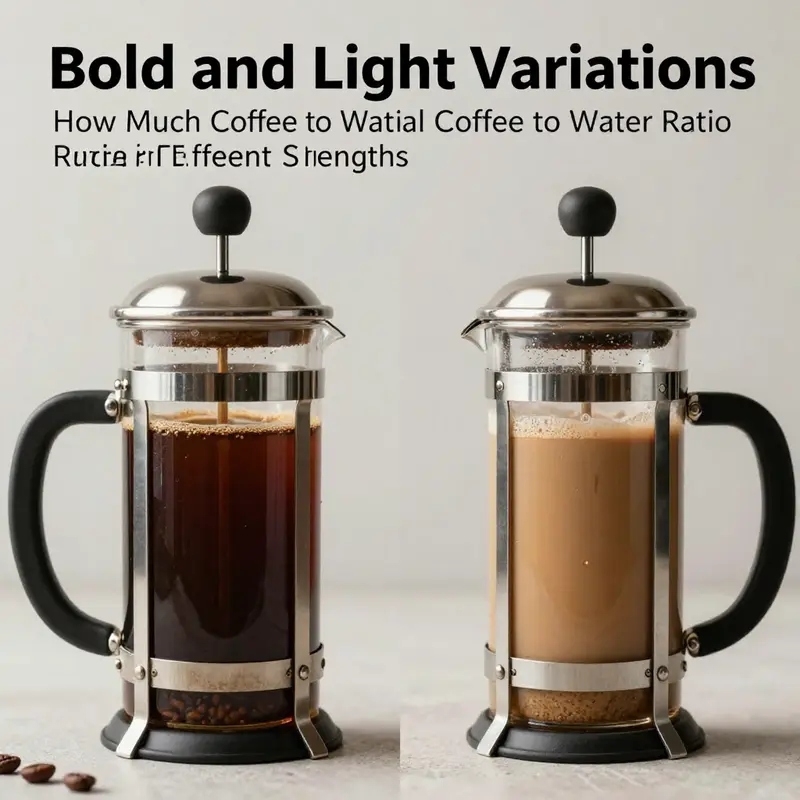
The French press invites a simple, almost tactile approach to coffee: steep, press, pour. Yet the ratio of coffee to water acts as the quiet conductor of flavor, guiding aroma, body, and clarity through a single immersion. It is a parameter you can feel as much as measure, because it shapes how extraction unfolds in the cup. The most common starting point, often cited as a balanced baseline, sits around 1:15. That means about 40 grams of coffee to 600 milliliters of water for a standard brew. This ratio has comfort in its familiarity: it leans toward harmony, delivering a cup with a reasonable body and a clear, approachable profile. But taste is personal, and strength is a spectrum rather than a single mark on a dial. The journey from bold to light, from rich and creamy to bright and clean, hinges on how you calibrate those few grams of coffee against the same volume of water. The science behind it is straightforward, but the artistry lies in how you translate preference into practice, in the moment of grinding and pouring, in the duration of the steep, and in the careful move of the plunger that ends the extraction at just the right moment.
When you pursue a bolder outcome in a French press, the instinct is to concentrate the flavor, not by squeezing every drop of coffee from the grounds, but by increasing the coffee-to-water ratio and adjusting the grind and the timing to favor richer oils and a thicker suspension of solids. A bold cup can emerge from a ratio around 1:8 to 1:10, a range that pushes more coffee into the same amount of water. In practical terms, that translates to ideas like 40 grams of coffee for 320 to 400 grams of water. The logic is simple: more coffee relative to water means more solubles available to dissolve, more oils released from the bean, and a heavier mouthfeel that clings to the palate. To support this, many baristas also recommend a coarser grind when you want boldness in a French press, because the larger particles resist rapid extraction and release oils more gradually. The coarse grind slows the rate at which the grounds interact with water, which helps preserve a cancer of over-extraction while still delivering depth. The result is a cup that carries weight without becoming bitter or muddy, a sometimes hard-won balance that rewards deliberate technique and attentive tasting.
On the other side of the spectrum lies the light or bright variation, a profile prized for clarity and the delicate music of origin notes. A lighter approach uses a lower concentration—typically a 1:12 to 1:15 ratio—with roughly 40 grams of coffee to 480 to 600 grams of water. This range favors a finer grind than the bold method but not so fine as to invite excessive extraction during the four-minute steep. The goal is a cup that feels cleaner on the palate, where floral or fruity notes can arrive with a sharper edge and a cleaner finish. The lighter method also invites a longer or steadier extraction of nuanced flavors, allowing the cup to reveal what the beans have to say about their terroir, roast, and processing method. A typical light-brew protocol might nudge the steep toward four to five minutes and emphasizes a careful pour that wets the grounds evenly, followed by a smooth plunge. The equipment remains the same; the variables shift around you like a set of knobs you know how to tweak with confidence.
These two directions—bold and light—sit along a continuum that many pros use as a practical map. A widely accepted, more general guideline often cited in professional contexts is a 1:20 ratio, a canonical choice for a straightforward, easygoing cup that remains forgiving if you’re juggling morning tasks or a larger crowd. Some people want to lean into the experience of a fuller cup without sacrificing clarity, and for them the range can be extended upward, toward 1:18, 1:17, or even 1:16 depending on the grind, temperature, and the specific coffee’s behavior during extraction. It’s a reminder that a ratio is not a law but a compass. You can follow it, adjust around it, or deviate with intent to suit a roast level, a bean’s origin, or a mood.
If you want a reliable touchstone, many in the field still regard the Gold Cup standard as roughly 1:15 to 1:17. It’s a zone that tends to balance sweetness and acidity while delivering a body that isn’t too heavy or too thin. The Specialty Coffee Association’s brewing guidelines point toward these general targets for standard profile development, including for light roasts where clarity of flavor takes center stage. Within this framework, you’ll hear different counts and formulas, but the principle remains: begin with a measured ratio, then let your own palate guide the final tweaks. A good way to anchor your practice is to note how your coffee behaves when you fix the water at a precise temperature and measure the grounds with a scale. Precision makes it easier to recognize when a brew lacks sweetness, or when it becomes too bitter or flat. It also helps you compare outcomes across different beans or roast levels without guessing.
Temperature, grind, and timing form the trifecta that underpins any French press experiment. Consistent water at about 90°C–96°C (194°F–205°F) is ideal for extracting the full spectrum of aromas without scorching the delicate compounds that carry acidity and perfume. A pre-warmed vessel keeps the temperature from plummeting as you introduce the hot water, maintaining a steady environment for extraction. A coarse grind is typically preferred for the press because it slows down the extraction and reduces the amount of fines that contribute to an overly muddy cup. The steep time of around four minutes is a useful benchmark, but you’ll want to adjust that interval if your goal is a brighter result or a heavier cup. Shorter times tend to favor brightness and acidity, while longer times—paired with a higher coffee-to-water ratio—lean toward deeper, more resinous flavors. The plunger’s smooth motion is the final act that stops extraction; a deliberate press, rather than a hurried bang, preserves the integrity of the oils and particulates you want in the cup.
All of this rides on the quality of your water and how you handle the grounds before and during contact. Water quality matters as much as the coffee’s origin, roast, and grind. Even small changes in mineral content or temperature can tilt a brew from balanced to flat. In practice, that means using filtered or clean tap water, avoiding extreme mineral content, and ensuring the grounds are evenly saturated. For the bold method, you want the initial pour to saturate the bean particles thoroughly, a quick stir after the grounds are fully wetted can help ensure even extraction. For the light method, you’ll want a careful, consistent pour that introduces water gradually and keeps the bath from becoming overheated or unevenly saturated. In both cases, the goal is even extraction across the surface layer of grounds, not to rush the process or leave parts of the bed underextracted.
One of the subtler but essential choices you make is timing how long your coffee sits before the press. Four minutes is a widely recommended interval because it provides a practical balance between a robust extraction and a manageable workflow. If you’re chasing boldness, you might watch the clock a touch closer to four minutes, perhaps aiming for a touch longer if the grounds are coarse and the water is on the hotter side. If you want a brighter cup, four minutes remains a sound baseline, but you can experiment with a slightly shorter time while reducing the coffee quantity in the same water volume to preserve the water-to-coffee balance that favors lighter notes. And while some cooks in coffee circles speak about a bloom in immersion brews, the French press treats the grounds as an undisturbed bed rather than a porous cake. A light stir at the start helps saturate all the particles evenly, followed by a quiet, consistent plunge at the end to capture the suspension you want in the cup.
In practice, the math of these ratios is surprisingly forgiving once you use a scale. Consider a 600 ml batch. If you’re chasing boldness, you could pull the coffee to a 1:8 to 1:10 range. That means 75 g of coffee for a 600 ml brew at 1:8, or 60 g at 1:10. The same 600 ml batch could deliver a lighter profile at 1:12 to 1:15, meaning 50 g (for a 1:12) or 40 g (for a 1:15). You can see how the same water mass becomes a spectrum of outcomes simply by adjusting the coffee mass and the grind. These calculations are not rigid laws but operational guidelines that help you steer toward a desired mouthfeel. As you experiment, you’ll begin to notice that a slightly finer grind in the bold range can compensate for a smaller coffee amount by increasing surface contact, while a coarser grind in the lighter range can help preserve clarity when using a larger water mass. The essential skill is to keep the water temperature stable, pour with even coverage, and allow the grounds to meet the water for a sufficient, but not excessive, duration.
A useful way to navigate these choices is to think about flavor as a conversation between three voices: the sweetness that reveals origin and roast level, the acidity that lifts brightness and balance, and the body that carries the mouthfeel and fullness of texture. The ratio you choose shifts the emphasis among these voices. A bolder 1:8 to 1:10 brew tends to amplify body and mouthfeel, encouraging cocoa, caramel, or roasted-nut notes to emerge with gravity. A lighter 1:12 to 1:15 brew tends to heighten brightness, with grape-like or citrus-like acidity and a cleaner finish that lets origin notes breathe. The central task is not to chase a single flavor profile but to set up a framework where your taste preferences can find a home in the cup. This is where a small but meaningful decision—the ratio—becomes a tool for expression. If you want a concise, reliable starting point that also remains flexible, consider keeping a notebook for your experiments. Record the water temperature, grind size, steep time, coffee weight, water weight, and your impressions of body, aroma, and aftertaste. Over time, patterns emerge and your ability to reproduce a preferred result sharpens.
For readers who want a compact reference that ties the practice to a broader body of technique, consider exploring additional guidance on French press ratios—the ultimate guide to the method—as a helpful companion resource. French press coffee ratios—the ultimate guide. This resource consolidates the practical math with tasting notes and technique tips, offering a bridge between personal experimentation and shared standards. It reinforces a core habit: start with a measured ratio, then calibrate toward your own palate through small, deliberate adjustments. The aim is not a single perfect formula but the ability to adapt rapidly as your beans change with each harvest, as your grinder and kettle respond to your daily environment, and as your moods shift with the day. In this sense, the ratio becomes a language, a way to describe intensity, clarity, and texture in a single line of measurements.
As you build confidence with bold and light variations, you may notice how roast level interacts with ratio. Darker roasts often carry more solubility and can tolerate a slightly higher coffee-to-water ratio without tipping into heaviness, whereas lighter roasts may reveal their bright acidity more prominently and benefit from a more delicate balance. In other words, your beans’ character encourages you to adjust not only the ratio but also the grind and the temperature. The bold approach may be forgiving if you choose a coarser grind and a shorter steep, allowing oils to carry the cup without dragging in harsh notes. The lighter approach may demand an even, steady pour and careful saturation to keep those delicate aromatics from dissipating too quickly. There is no single correct path; there is a spectrum of paths, each with its own trade-offs, and each accessible through patient observation and disciplined measurement.
If you are preparing coffee for a group, the same principles apply, but the balance between consistency and variation becomes practical management. A standard batch at 1:15 can be scaled up with the same ratios, but human tastes in a crowd vary. To accommodate this, you might brew a central standard, say a 1:15 batch, and then offer guests the option to adjust through a small, added pour of hot water for a lighter cup or a touch more grounds and a re-brew for a bolder sip. In such a setting, the ability to report back on the measured parameters—water temperature, time, and weights—becomes a practical courtesy, turning a simple brew into a shareable experience. You can also reference established guidelines from recognized sources to anchor your approach, ensuring your methods align with a broader consensus about how to achieve balance across robust and nuanced coffees alike. The practice of aligning with guidelines gives you a sturdy frame that supports your preferences rather than stifling them.
The joy of dialing in a French press beverage lies in its tactile rhythm: grind, weigh, heat, pour, steep, press, pour, sip, adjust. The tangible nature of the process makes it easy to experiment without needing a laboratory. You can begin with a widely comfortable baseline, such as 40 grams of coffee for 600 milliliters of water, with a four-minute steep at a robust yet controlled temperature. You can then bend the dial toward boldness by stepping down the water proportion and maybe stepping up the grind coarseness for a richer, deeper cup. Or you can push toward brightness by using a higher water mass for the same coffee, choosing a slightly finer grind, and extending the steep time to coax more delicate acidity into the cup. The point is to embrace the possibility of change while maintaining a consistent method: precise measurement, stable heat, gentle agitation, and a patient press. The more you tune, the more you will recognize how your preferred outcomes emerge from the synergy of these small decisions.
In closing this exploration of bold and light variations, it’s helpful to keep in mind that the coffee you brew is a living thing, responding to the environment, the beans, and your own senses. The ratio is not a verdict; it is a direction. The journey from bold to light is not a sacrifice of depth but a rebalancing of what you highlight—the same bean can reveal different facets simply by choosing a different degree of concentration. If you want to widen your perspective further, the official guidelines from professional organizations provide a dependable external reference for how to think about extraction and balance across varied roasts and origins. For ongoing learning, the resource linked above offers a consolidated framework, while the external standards from a recognized association remind us that good coffee, at scale and in personal moments, rests on careful measurement, thoughtful technique, and a willingness to taste and adapt. The cup you sip tomorrow can be a slightly different shade of the one you make today, not by luck but by an intentional, measured choice of coffee-to-water ratio, grind size, temperature, and steep time. The art and the science are one continuous practice, and the French press remains one of the most forgiving canvases for practicing that craft.
External resource: https://www.specialtycoffees.org/guidelines/brewing/
null

null
Final thoughts
Understanding the ideal coffee-to-water ratio for a French press is vital for business owners wanting to ensure a quality product. By mastering standard, bold, and light variations, and honing optimal brewing techniques, you can significantly enhance the taste of your coffee offerings. Educating your team on these practices not only leads to a better brew but also reinforces your commitment to quality—a key selling point in today’s coffee market.