

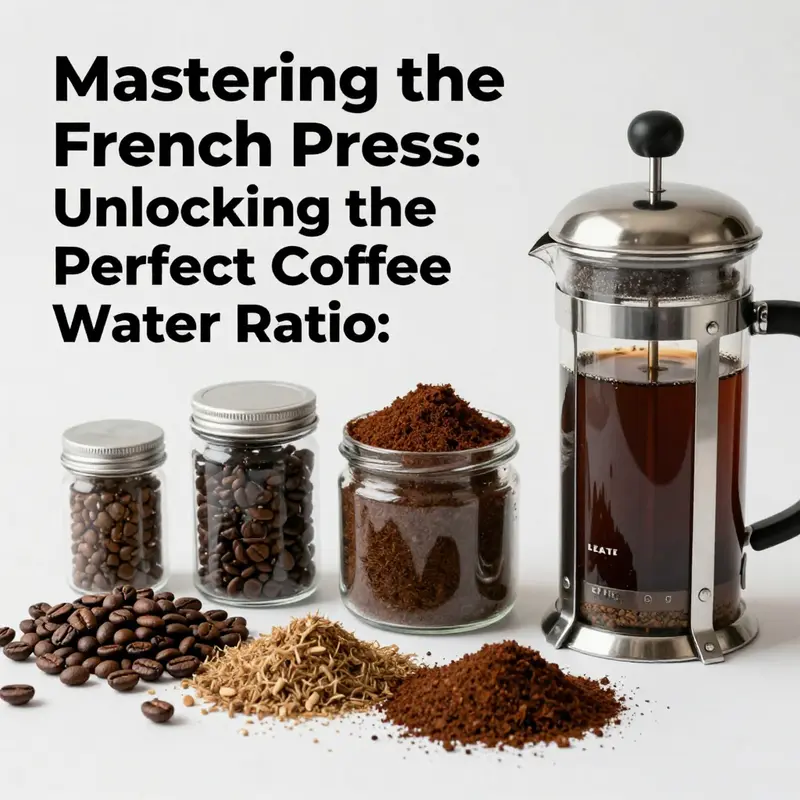
A precisely balanced water-to-coffee ratio is crucial for crafting the perfect French press coffee. For business owners in the coffee industry, understanding this ratio can significantly enhance product quality and customer satisfaction. This guide will explore the essentials of the French press coffee water ratio, guide you in making adjustments based on personal preferences, and delve into the impact this ratio has on extraction and flavor profile—all of which are essential for elevating your coffee offerings and optimizing your operations.
Finding Your Perfect French Press Ratio: Practical Rules, Simple Math, and Taste-First Adjustments

The ratio is your foundation. For French press brewing, that means the weight relationship between dry coffee and brewing water. Change the ratio and you change strength, flavor balance, and mouthfeel. Mastering this single variable unlocks predictable, repeatable results and makes further tweaks easier.
Most guides present a recommended range rather than a single fixed number. A common starting range sits between one part coffee to fourteen to sixteen parts water by weight. Other experienced brewers prefer a looser starting point—one to twenty—because it emphasizes clarity and a lighter mouthfeel. Both ranges are used widely because French press brewing tolerates variation. The ideal ratio for you depends on taste, beans, grind, and technique. Treat the published numbers as useful anchors, not rules set in stone.
Begin by weighing. Use a kitchen scale that reads grams. Measure the dry coffee and the water. For simplicity, grams and milliliters are interchangeable for water. If you grind forty grams of coffee, a 1:15 ratio requires 600 grams of water. A 1:16 ratio uses 640 grams. At 1:20, forty grams needs 800 grams of water. These hands-on numbers make the math simple and your results repeatable.
Why does the ratio matter? It governs extraction and concentration. Extraction is the percentage of soluble material dissolved from coffee into water. Concentration is how much dissolved material is present in the brewed cup. A coarse immersion method like the French press extracts differently from pour-over or espresso. Coarser grounds slow extraction, so many brewers offset that by using slightly stronger ratios. If you use a fine grind with a low ratio, you risk over-extraction and harsh bitterness. If you use a coarse grind with a high ratio, your cup can taste thin or sour.
Think in practical steps. Choose a starting ratio, grind coarse, time the steep, taste, and adjust. A reliable workflow looks like this:
- Pick a starting ratio. Many people begin at 1:15 for a full body. Those seeking more clarity begin at 1:18 to 1:20.
- Grind to coarse, similar to sea salt. Coarse grounds reduce sludge and harsh extraction.
- Use near-boiling water, allowed to cool about 30 seconds. Aim for roughly 93°C (200°F).
- Bloom briefly by saturating the grounds, then pour the remaining water.
- Steep four minutes as a baseline, then press gently and serve.
After tasting, decide how to adjust. If the coffee tastes too sour or weak, increase the dose, moving to a lower ratio like 1:17 or 1:16. If it tastes overly bitter or sticky, reduce the dose toward 1:18 to 1:20. Make only one variable change at a time. If you change dose, keep grind and steep time constant for at least one trial. That way you can link cause and effect.
Extraction and taste are also affected by grind size and time. Coarse grind slows extraction. To compensate, you can either increase steep time or increase dose. Increasing steep time beyond four minutes amplifies body and risk of over-extraction. Slightly increasing dose preserves clarity while boosting strength. Conversely, if your grind is finer than coarse, shorten steep time or lower the dose to avoid bitterness. Small adjustments matter. Move in increments of about 1 gram per 100 grams of water when dialing in.
Another practical factor is yield loss. Not all water ends up in your cup. Some remains trapped in the grounds and on the filter. A rough rule is that brewed coffee will be about 2 to 3 percent lighter by weight than the water you used, because the grounds retain water. This matters if you target a specific serving weight or strength. If you plan to pour a measured amount into a carafe, account for retained water by slightly increasing the water input.
Mouthfeel is a defining feature of French press coffee. The metal filter allows natural oils and fine particles into the final cup. That texture creates a rich, full-bodied experience. When dialing your ratio, consider mouthfeel as part of the flavor profile. A lower ratio increases viscosity and weight. If you enjoy a syrupy, heavy cup, a 1:14 or 1:15 ratio will deliver. If you prefer a cleaner, lighter experience, lean toward 1:18 to 1:20.
Bean origin and roast level change how a ratio tastes. Lighter roasts need more attention to dose because they extract differently. They can taste brighter and more acidic at the same ratio compared to darker roasts. To tame acidity without losing complexity, try increasing the ratio modestly or slightly increasing steep time. Darker roasts extract more quickly and release more soluble oils. They often benefit from a slightly higher water ratio to avoid bitterness. Always taste first, then adjust.
Water temperature interacts with ratio. Hotter water increases extraction rate. If your water is near boiling, extraction can accelerate enough that your usual ratio tastes over-extracted. Conversely, cooler water slows extraction and can leave the cup under-extracted. A consistent target temperature around 92–96°C (198–205°F) is reliable. If you lack a thermometer, bring water to a full boil and wait 30 seconds before pouring. Keep temperature stable between brews for consistent comparison.
If you pursue precision, you can measure Total Dissolved Solids (TDS) and Extraction Yield. TDS measures concentration. Extraction yield measures what percent of the coffee mass dissolved into the brew. For most home brewers, these metrics are unnecessary. Focus instead on repeatable weight measurements and tasting. However, if you wish to experiment scientifically, aim for a balanced extraction yield between 18 and 22 percent and a TDS that matches your taste. Higher strength with low extraction tastes syrupy and unbalanced. Higher extraction with low strength tastes hollow and over-bitter.
Consider brewing larger batches. Scaling the ratio is simple by weight. Multiply your chosen ratio by desired coffee dose. For example, if you want one liter of coffee and you use a 1:15 ratio, divide 1000 grams of target water by 15. That gives about 66.7 grams of coffee. Round sensibly and keep grind consistent. When scaling, remember larger masses retain and lose heat differently. Pre-warm your vessel to stabilize temperature. Stir gently during the steep to ensure even wetting of grounds.
Stirring and agitation affect extraction subtly. A brief, gentle stir after adding water and at the one-minute mark breaks the crust, equalizes temperature, and helps uniform extraction. Avoid vigorous agitation. Excessive stirring releases fines and accelerates extraction too much. A light stir gives you even flavor without over-extraction.
Timing matters. Four minutes is an excellent baseline for many recipes. Shorten to three and a half minutes for lighter roasts or when using a finer grind. Lengthen to five minutes for very coarse grinds or when you want maximum body. When you lengthen steep time, taste for bitterness. If bitterness increases, reduce dose next trial. If sourness appears, extend time a bit or reduce grind size.
Practical examples help embed the math. Here are quick references:
- For coffee lovers who prefer boldness, a 1:14 ratio: 30 g coffee, 420 g water.
- For everyday balance, a 1:15 ratio: 30 g coffee, 450 g water.
- For clarity and lightness, a 1:18 ratio: 30 g coffee, 540 g water.
- For large, gentle batches, a 1:20 ratio: 40 g coffee, 800 g water.
These examples make dialing in easier. Pick one, brew, taste, then shift a little. Taste after the coffee cools a bit, since temperature can mask acidity and bitterness. If you find consistent preferences, record them. A small brewing notebook or a notes app speeds up repeatability.
Grind distribution affects how the ratio tastes. A consistent coarse grind leads to more uniform extraction. Blade grinders produce uneven particle sizes, increasing the chance of both under- and over-extraction in the same cup. If you use a blade grinder, err toward a coarser setting and taste mindfully. If you use a burr grinder, you’ll get more predictable results and a cleaner path to your preferred ratio.
Cleanup and filtration choices can alter perceived strength. Leaving fine sediment in your cup adds weight and perceived intensity. Decanting into a carafe soon after pressing reduces sludge in your cup. If you dislike sediment, pour the brew through a fine cloth or a paper filter after pressing. That will lighten mouthfeel and alter perceived strength, so you may need to slightly lower your ratio.
Pair ratio with tasting goals. For single-origin light roasts, choose a ratio that highlights acidity and aroma, like 1:18 to 1:20. For blends or darker roasts meant for body, choose 1:14 to 1:16. For cold brew adapted to French press, use a higher ratio in the grounds to water relationship during a long cold steep and then dilute to taste after filtration.
If your goal is speed and simplicity, start with a single trusted recipe and stick to it for a week. Use the same beans, dose, and grind. Make small changes only after testing several brews. This method reduces variables and sharpens your ability to detect differences caused by ratio alone.
A final practical tip: when experimenting, change one variable at a time. If you adjust ratio, keep grind, time, and temperature constant. This habit prevents confusing results and helps you understand how ratio shapes flavor.
For more practical recipes and detailed ratio walkthroughs tailored to French press brewing, see this guide on coffee ratios for French press.
For additional technique and timing tips from an established coffee resource, consult this external French press guide: https://www.illy.com/en/using-french-press-for-perfect-coffee
Tuning the Brew: Personal Preferences and the Variables That Shape French Press Water Ratios
The morning ritual begins not with the first pour but with a quiet calculation: how much water should share the coffee to coax flavors from their hiding place. In the quiet morning light, the scale becomes a metronome, and the scale’s tiny display keeps score of what your palate might remember all day. This is where the water-to-coffee ratio becomes not a rigid rule but a supple dial you turn to fit your mood, your beans, and the set of variables that day offers.
Across the coffee world, a widely accepted starting range for French press brewing sits around 1:14 to 1:16. In weight terms, that means 1 gram of coffee for 14 to 16 grams of water. A common practical starting point is 1:15, a balance that many tasters describe as offering body with a clean enough edge to avoid heaviness. So, for example, 40 grams of coffee would meet roughly 560 to 640 grams of water. The math is simple, but the effect is real. The rule of thumb is a compass, not a cage, and it invites you to map your own palate rather than blindly follow a number.
This ratio acts as a bridge between two poles: extraction and composition. If you push toward 1:14 or 1:13, you invite a stronger cup with more pronounced flavors and a heavier mouthfeel, but you step closer to over-extraction if you push too far. If you slide toward 1:18 or 1:20, the cup becomes lighter and more delicate, but you risk under-extraction if the grind or temperature don’t compensate. The key is not fixing a single number but finding a starting point from which small, controlled shifts reveal the cup you prefer.
Yet the ratio does not act alone. It presses against other variables that determine how the coffee becomes drinkable: grind size, water temperature, and steep time. Grind size matters because it changes surface area; a finer grind exposes more surface to water quickly, while a coarser grind slows extraction. Temperature matters because a hotter water dissolves more solubles; if the water is at the lower end of the range, it will extract slower, leaving some flavors behind. Steep time matters because the longer the coffee sits, the more opportunity there is for extraction. For most French press brews, around four minutes of steep time is a good general target, but you will feel the difference when you nudge either the time or the grind, even if the ratio remains constant. To keep the experiment honest, measure by weight, not by volume, because density and scoops can lie.
Adjustments should be incremental. If you want more body, you might tilt toward a stronger ratio, but you should move in small steps rather than large leaps. A shift from 1:15 to 1:14 is enough to begin to taste a bolder result; moving from 1:14 to 1:13 is subtler yet noticeable. When seeking a lighter cup, test 1:18 or 1:20, again in small steps. The aim is not to swing wildly but to map your palate against the coffee’s origin, roast level, and grind. In this process, the coffee-to-water ratio reveals itself in the cup as a balance between sweetness, acidity, and body, rather than simply as strength.
Extraction physics meet sensory preference: over-extraction grows when too much coffee is combined with warm water and a long contact time; bitterness can overshadow delicate aromas. Under-extraction yields sour notes, thin texture, and incomplete sweetness. The ratio is a lever that gently tunes this balance, but it should always be tested with other controls intact. If you change the ratio alone while leaving grind size and temperature constant, you can watch the taste shift in precise, trackable ways.
It is helpful to think of four interlocking variables that shape the final cup when you adjust the water ratio. First, grind size: keep it consistent. A too-fine grind with a heavy ratio can over-extract quickly; a too-coarse grind with the same ratio can under-extract. Second, water temperature: maintain the ideal range of 195°F to 205°F (90°C to 96°C). Third, steep time: aim for about four minutes, adjusting slightly for taste. Fourth, measurement discipline: always weigh both coffee and water; avoid relying on volume because density varies. With these levers steady, you can chart how different ratios alter the perceived sweetness and acidity in relation to the body.
To illustrate the process, start with a familiar baseline: 40 grams of coffee and 600 grams of water (about 1:15). Brew, then taste and record impression: is the cup showing a solid body with clean edges, or is there a fleeting bitterness that lingers like a stubborn aftertaste? Then move to 1:14 by adjusting toward 560 grams of water while keeping the coffee constant. The result is typically a bolder, more forward cup. Next, try 1:16 with 640 grams of water to re-center the balance—this often yields a more balanced cup where sweetness and acidity coexist without one dominating. If curiosity tempts you toward a lighter profile, test 1:18 (and if needed 1:20). Each step should be slight enough to distinguish, yet meaningful enough to warrant note-taking.
As you refine, you can deepen the learning by comparing the same coffee across different ratios and documenting the sensory outcomes—notes on aroma, perceived acidity, sweetness, and mouthfeel. A practical habit is to log the exact weights, the grind setting, the water temperature you used, and how long the brew steeped. The goal is not to reach a single perfect number but to cultivate a language of taste that speaks to your preferences and to the characteristics of each batch of beans. You may even find that a particular origin with its natural sweetness responds best to a slightly leaner ratio, while a washed, brighter profile shines when allowed a touch more water.
If you want a deeper dive into how these numbers translate into flavor—particularly how small shifts in ratio interact with grind size and brew time—consider the French Press Ratios Guide as a useful companion. It provides a structured exploration of ratios and how they map to taste, helping you translate abstract numbers into concrete sensory outcomes. french-press-ratios-the-ultimate-guide.
In discussing ratios, it is also worth acknowledging the practical realities of water quality and equipment. Hard water can alter extraction dynamics by changing how minerals interact with the coffee solubles, while a dirty or poorly cleaned press can introduce off-flavors that confound the impact of ratio alone. A routine of preheating the vessel and ensuring clean filtration helps isolate the effect of the ratio itself, letting you hear the true voice of your chosen coffee through the cup. In this sense, the ratio becomes part of a disciplined ritual rather than a one-off adjustment.
The debate about exact numbers often misses a larger truth: your perception of strength is not a fixed attribute of the coffee but a consequence of how the ratio interacts with your mouthfeel, your palate’s sensitivity to acidity, and the roast’s inherent balance. For some, a 1:15 brew may feel perfectly balanced, while others crave a 1:13 or 1:18 to align with their taste memory or breakfast mood. The beauty of this approach is its adaptability. It invites you to tune your method to the day, the bean, and your preferences without discarding technique as you go.
As you continue, remember that the journey isn’t about chasing a single holy ratio but about building a practice of careful, repeatable adjustments. The strongest thread running through successful tuning is consistency: use the same grind size, same water temperature, and same steep time whenever you test a new ratio. The moment one variable drifts, the comparison becomes blurred, and the lesson may be harder to read. In practice, many home brewers find it helpful to declare a dedicated pour for each trial, to avoid cross-over with other experiments. A quiet notebook or a simple app log keeps your observations organized and makes future revisits easier.
Ultimately, the point of adjusting the water ratio is to empower you to shape flavor with intention. You can coax the sweetness forward when you want a forgiving cup for a busy morning, or you can lean into brightness for a cup that wakes your palate and your senses. You can do this with just a scale, a timer, a kettle, and a press—no special gadgets required—yet the results can feel like a personal barista’s touch, tuned to your precise preferences.
For readers seeking a broader context on how ratio shapes the cup across different methods and bean profiles, the broader literature on brewing science offers useful patterns that help interpret these changes. External resources can illuminate how even subtle changes in contact time, particle size, and water chemistry sway extraction curves. A science-informed guide from Barista Hustle provides a rigorous, evidence-based perspective on French press brewing, emphasizing how variables weave together to create complexity in the cup: https://baristahustle.com/brewing/french-press-coffee-guide/.
How the French Press Ratio Shapes Extraction, Body, and Flavor

The coffee-to-water ratio in French press brewing defines much more than strength. It sets the stage for extraction chemistry, mouthfeel, and how individual flavors appear. At its core, the ratio controls the concentration of dissolved coffee solids. That concentration interacts with extraction yield, grind size, steep time, and temperature. Together they determine whether the cup tastes bright and clean, rich and round, or harsh and astringent.
Start with a baseline many experts prefer: a 1:15 ratio. That means one gram of coffee for every fifteen grams (or milliliters) of water. A 1:15 base produces a medium-strength cup with balanced body and clarity. For example, 30 grams of coffee to 450 milliliters of water yields a broadly appealing brew. Move to 1:14 and the cup becomes denser. Move to 1:16 and the brew lightens. These small shifts matter because French press brewing is immersion-based. Grounds stay in contact with water for several minutes. That prolonged contact amplifies the effect of ratio changes.
Think of ratio as the starting concentration in a chemical reaction. A higher concentration of coffee solids increases the potential for both desirable and undesirable extractions. More coffee relative to water raises the amount of soluble material available to dissolve. This can enhance sweetness, oils, and body. It can also raise the chance of extracting bitter compounds. Conversely, a lighter ratio reduces the intensity of all flavors. It can enhance perceived clarity and highlight delicate acidity, but it risks under-extraction if other variables are not adjusted.
The interplay between ratio and extraction yield matters. Extraction yield describes the percentage of soluble coffee mass that transfers into the cup. Most specialty coffee guidance aims for extraction yields between roughly 18 and 22 percent. That range balances the sugars, acids, and bitters found in coffee. Strength, measured as total dissolved solids (TDS), is separate. Ratio influences strength directly, while extraction yield influences flavor balance. For a fixed extraction yield, raising coffee mass increases brewed strength. For a fixed strength, raising extraction yield requires adjustments in ratio or brew technique.
Practical effects on taste follow predictable patterns. Under-extracted cups taste sour, thin, and bright. They lack sweetness and body. Over-extracted cups taste bitter, dry, or astringent. They can feel hollow despite heavy mouthfeel. The French press accentuates both extremes because its metal filter permits oils and fines into the cup. These components boost body and texture, but they also make bitterness more pronounced if over-extraction occurs. That is why keeping ratio within a sensible range is important.
When you increase coffee concentration, the cup’s body grows. Oils and suspended fines make a fuller mouthfeel. Richness intensifies, and chocolate or nutty notes can deepen. However, higher concentration means the same extraction yield will deliver stronger bitter and astringent compounds. To avoid this, you must change another variable. Grind coarser. Shorten steep time. Lower water temperature slightly. Adjust one variable at a time and taste.
If you reduce concentration, the cup becomes cleaner. Subtle floral or fruity notes appear more distinctly. Acidity may feel livelier. But too light a ratio risks a watery profile that lacks sweetness and satisfying texture. To compensate, you can extract more by using a slightly finer grind or increasing steep time. Again, make small changes and evaluate.
Examples make this concrete. Use 40 grams of coffee as a test case. At a 1:14 ratio, you need 560 grams of water. At 1:15 that becomes 600 grams. At 1:16 you use 640 grams. Those shifts change the cup noticeably. A brewer who prefers a bold morning cup might favor 1:13 to 1:14. That choice gives a heavy, syrupy body and deep flavor. A drinker focused on delicate origin characteristics might select 1:16 or 1:17 to allow nuanced acidity to come forward.
Never forget grind size. For French press, aim for a coarse grind similar to sea salt. Coarse particles slow extraction because they present less surface area per gram. If you move to a stronger ratio, coarsen the grind to avoid over-extraction. If you lighten the ratio and the cup tastes under-extracted, slightly finer grind will help. Because the French press filter allows fines and oils through, grind consistency matters. Fines accelerate extraction and increase sediment in the cup. A consistent coarse grind reduces harshness and produces a cleaner body.
Steep time also interacts with ratio. Four minutes is a common starting point. But it is not a rule. With a denser ratio, consider slightly shorter steep times, perhaps three to three and a half minutes, paired with coarser grind. For a lighter ratio, you might extend steeping to five minutes, while keeping the grind a touch coarser than drip settings. Remember the French press continues to extract as it sits. Decant the brew into a serving carafe when plunging if you will not serve immediately. Leaving grounds in the carafe will lead to continued extraction and bitterness.
Water temperature influences extraction rates too. Aim for water just off boil, roughly 93 to 96°C. Hotter water extracts faster and promotes bitterness in dense brews. Cooler water extracts slower and can intensify acidity. If you are brewing at a high ratio, reduce temperature slightly if you notice excessive bitterness. If your cup is thin and sour at a light ratio, raise temperature a few degrees or extract longer.
Taste cues guide adjustments. If the cup is excessively sour and lacks sweetness, raise the ratio or increase extraction. Raise the coffee dose by 1 to 2 grams per 250 milliliters and evaluate. Alternatively, use a finer grind or extend steep time in small steps. If the cup is bitter, reduce the ratio or lower extraction by coarsening grind, shortening steep time, or lowering temperature. If the cup is weak but balanced, increase the dose rather than extending steep time too far. Small, measured changes yield clearer lessons than sweeping alterations.
Because French press brewing invites more sediments, pour technique and filtration choices affect final clarity. Plunging should be gentle to avoid forcing extra fines through the mesh. Some brewers pour through an additional coarse strainer when decanting to remove the worst fines. This reduces grit and can make the same ratio taste cleaner. If you prefer a silky texture, adjust ratio downward slightly and decant quickly.
Consistency requires a scale. Volume measurements like tablespoons vary by grind and bean density. A kitchen scale removes guesswork. Weigh coffee and water in grams for reproducible results. Note weights and adjustments in a brewing log. Over time you will map how different ratios interact with specific beans and roast levels.
Roast profile also affects how ratio changes perceived flavors. Darker roasts extract more quickly and yield strong bitters at high extraction. For dark roasts, a slightly lighter ratio or shorter steep time often produces a more balanced cup. Lighter roasts benefit from slightly higher extraction to coax sugars and development. With light roasts, try 1:14 to 1:15 and a slightly finer coarse grind to let acidity and floral notes bloom without bitterness.
Bean origin and processing matter too. Natural process beans can taste fuller and fruitier. They may respond better to lighter ratios that emphasize acidity and fruit sweetness. Washed beans often yield clarity that pairs well with mid-range ratios. Single-origin delicate coffees demand careful dialing. Blend beans intended for strength and consistency can handle denser ratios.
A practical dialing method helps you tune the ratio to taste. Choose a baseline ratio, like 1:15. Use a coarse grind and water near 94°C. Brew 30 to 40 grams of coffee to the matching water weight. Taste and record. If you want more body and the cup is not bitter, move to 1:14 and retest. If the cup is bitter, try coarsening the grind first before lowering steep time. Repeat until the cup reaches your preferred balance. Change only one variable at a time.
Keep in mind the French press produces a living cup. As the brew cools, flavor perception changes. Acidity may rise, and bitterness can become more prominent. Serve within minutes of plunging for the intended balance. If you must keep coffee warm, decant to an insulated carafe to slow flavor shifts.
Measurements and examples clarify choices. For a single serving of 350 milliliters, 1:15 requires about 23 grams of coffee. For a bold 1:13, the dose rises to roughly 27 grams. For a lighter 1:17, the dose drops to about 20 grams. Multiply these numbers proportionally for larger quantities. Use the formula: coffee grams = water grams ÷ ratio. This relationship keeps adjustments predictable.
Watch out for extreme ratios. Below roughly 1:12 the risk of harsh over-extraction grows quickly. The metal filter design lets more bitter compounds remain in the cup. Above about 1:18 the cup can lose sweetness and feel thin. Staying between 1:14 and 1:16 often gives the widest margin for consistent, satisfying results. Within that window, you can tune toward body or clarity with minor changes.
Finally, make tasting the judge. Words like “balanced,” “bright,” “syrupy,” or “harsh” help map changes to outcomes. Keep a simple log: date, ratio, grind setting, temperature, steep time, and tasting notes. After a few sessions you will predict the effects of a 1-gram shift or a 30-second change. That confidence will let you dial to your preferred pocket of flavor quickly.
A French press is forgiving and expressive. The ratio is the lever you use to shape the cup. Learn to read the cup, measure precisely, and adjust one variable at a time. With a 1:15 baseline and awareness of grind, time, and temperature, you can coax a wide range of flavors from any coffee. For a deeper dive into brewing proportions and recipe ideas, see this detailed coffee ratio guide for French press.
For technical standards on extraction and strength, consult the Specialty Coffee Association guidance here: https://sca.coffee
Final thoughts
The journey of mastering the French press coffee water ratio is vital for any business aiming to deliver high-quality coffee. By understanding the basic principles, adjusting for personal preferences, and recognizing the impact of this ratio on flavor and extraction, business owners can significantly enhance the coffee experience for their customers. A commitment to perfection in brewing can set your brand apart in a competitive market, making it essential to invest time in mastering these techniques.