

For coffee lovers and business owners alike, mastering the art of French press brewing is essential for delivering high-quality beverages that satisfy your clientele. A pivotal aspect of this process is understanding the coffee-to-water ratio, which can significantly impact the flavor and strength of the cup you serve. The commonly recommended ratio of 1:15 provides a balanced brew; however, personal preferences and factors like the type of coffee beans and grind size can influence this standard. This article delves into the nuances of selecting the best ratio for your French press, ensuring you can craft exceptional coffee that resonates with your customers. Each chapter will explore a different angle, from understanding basic ratios to adjusting them based on bean type and grind size, ultimately guiding you toward the perfect cup.
The Fine Balance: Finding Your Ideal French Press Ratio

Brewing with a French press invites balance. A common starting point is a 1:15 ratio by weight. This baseline yields a cup that is robust yet clear. You can adjust toward a stronger brew with a 1:13 ratio or toward a lighter cup with a 1:17 ratio. The key is to change one variable at a time and taste as you go.
Grind size, water temperature (around 93-95 C / 200-203 F), and immersion time all interact with the ratio. For example, a medium-coarse grind with a 1:15 ratio and four minutes of steeping can produce a well-balanced cup. If the brew tastes sour, try a touch more coffee (move toward 1:14). If it tastes flat or bitter, reduce the coffee slightly or shorten the steep a bit. Keep notes and compare cups to learn how the ratio responds to bean and roast.
Treat the ratio as a dial that you adjust while you listen to the cup. Measure your grounds and water precisely, stay within a comfortable range (1:13–1:17), and let your palate guide the final choice. This approach helps you build a personal routine that consistently delivers flavors you love.
Brewing to Your Taste: Navigating French Press Ratios for Strength and Texture
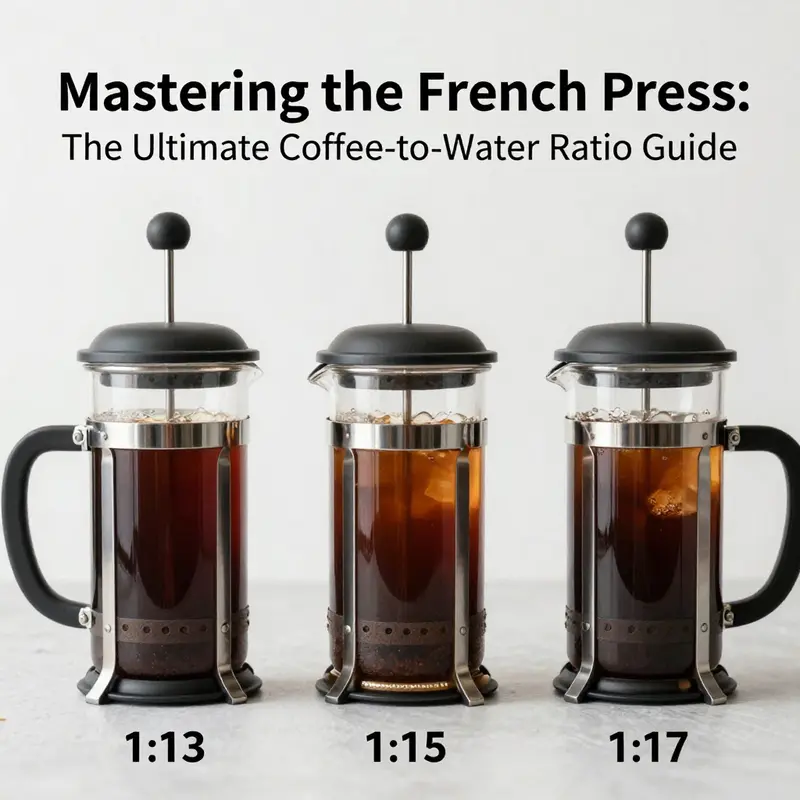
When coffee lovers look for a French press ratio, there is no single magic number; treat ratio as a starting point and a flexible guideline, since immersion and a metal filter carry more oils and fine particles that thickens the cup and shape sweetness and bitterness as you balance coffee and water. Begin with a baseline often cited by experts: 1:15 by weight, which for 600 ml of water is about 40 g of coffee, yielding a balanced cup; the same ratio will feel different depending on grind size, water temperature, and steep time, so view it as a moving target rather than a verdict. The Specialty Coffee Association notes a practical range around 1:15 to 1:17 for many methods, with French press tending toward the stronger end. A shift of a few grams can move the cup from brisk to velvety; for 600 ml water, 1:13 is about 46 g, and 1:17 is about 35 g. The practical takeaway is to weigh accurately and adjust gradually: if a batch tastes sour or thin, nudge toward 1:14 or 1:13; if it tastes bitter or dense, dial back toward 1:16 or 1:17. Grind size, temperature around 92 to 96 C (198 to 205 F), and a typical four minute steep help align strength with clarity; a morning routine might involve a four minute steep, a steady press, and tasting notes. For practice, start with 40 g of coffee and 600 ml of water, steep four minutes, then press; taste and note body, brightness, and finish, and try 36 g or 42 g to shift toward 1:16 or 1:14. If you want lighter notes, try 35 g for 600 ml and adjust. Keep a simple tasting log to track origin, roast, ratio, brew time, and temperature, so patterns emerge and you can refine toward a personal best. The best ratio is a spectrum you tune over time to your palate; let notes guide future tweaks and, if you want more guidance, consult additional resources on coffee ratios for French press.
Tuning the French Press Ratio: How Bean Types Shape Your Perfect Cup
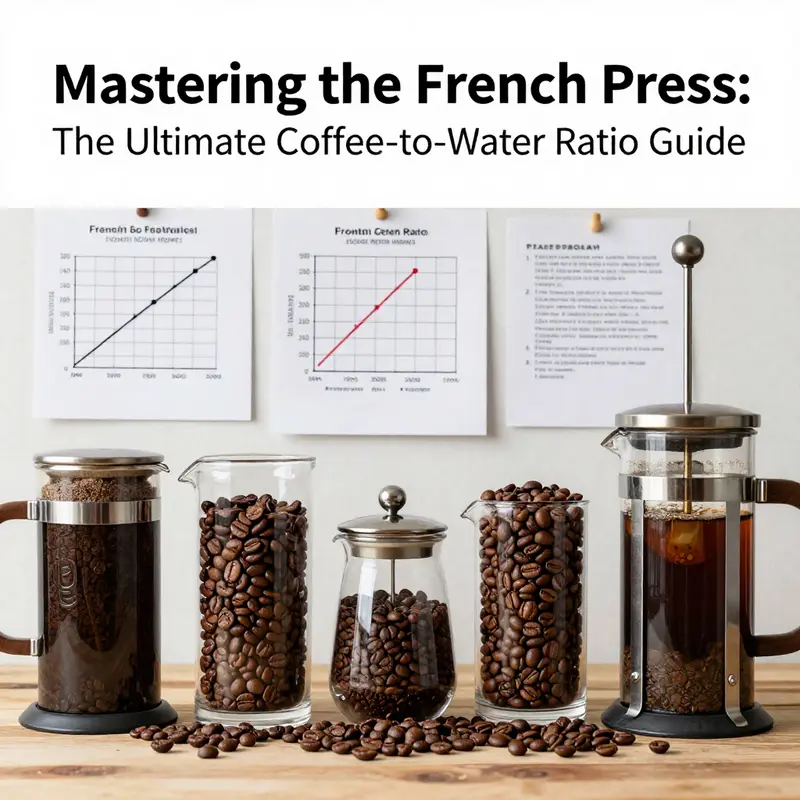
A starting point is a compass, not a cage. In the world of the French press, most coffee lovers begin with a widely accepted baseline: a 1:15 coffee-to-water ratio by weight. This gauge has proven reliable for a balanced, approachable cup, and it gives you a dependable launching pad for experimentation. But the truth about flavor is that it rarely lives in a fixed line drawn on a chart. Bean identity—the origin, the processing method, and even the roast level—pulls the brewing equation in different directions. The best ratio, then, becomes less about a universal number and more about a conversation between your beans and your palate. When you start with 1:15 and listen to what your cup is telling you, you unlock a practical method for dialing in flavor that feels personal, precise, and repeatable.
Arabica beans, celebrated for their nuanced sweetness and balanced acidity, invite a slightly bolder exploration of extraction if you want their subtleties to glow rather than fade. With these beans, tipping the scale toward a tad more coffee—toward 1:14 or even 1:13 for a test brew—can reveal a tapestry of berries, citrus, and floral notes that risk being muted at a lighter ratio. You’re not chasing more bitterness; you’re resisting the dulling of complexity. The idea is not to force strength but to encourage the oils and aromatics to express themselves fully. In practice, a small nudge toward 1:14, then 1:13 as you taste, can help you hit that moment when the sweetness rides the acidity rather than competing with it. The key is to pause after each brew and ask whether the cup feels balanced, or if the balance tilts toward a perceived thinness or a clammy edge that can arrive when extraction is incomplete.
On the other side of the spectrum lie robust and intense bean types—think darker roasts and bold, earthy profiles, sometimes from regions whose beans carry a heavier body and more pronounced bitter notes. For these, a lighter ratio can be a relief valve for the cup. A 1:16, and even closer to 1:17 in some cases, helps temper the body and keeps the cup from turning syrupy, which can overwhelm the inherent character and push you toward a dull, heavy mouthfeel. In practice, you might start with 1:15, then move to 1:16 as you test, and consider 1:17 if the cup begins to feel overly thick or the finish becomes persistently bitter. The point is not to strip weight from the cup but to maintain clarity so the roast’s roasted notes don’t drown out the foreground flavors of the bean.
Beyond roast level, the processing method casts a long shadow over how a given ratio behaves in the cup. Honey-processed beans, which retain some mucilage during drying, tend to emerge with a natural sweetness and a fuller mouthfeel. They can tolerate a slightly higher coffee concentration without losing balance, making a 1:14 or even 1:13 a viable option when you want a more dramatic, syrupy body that still carries bright notes. Honey processing can accentuate a smooth, expansive texture in the French press, and the extra body helps carry those tropical fruit or berry-like hints without tipping into heaviness.
Washed or naturally processed beans, meanwhile, often present a cleaner acidity and more defined clarity. They can reveal a sharper profile of citrus zest, red fruit brightness, or spice when the ratio is tuned to avoid overemphasis on body. In these cases, adjustments toward 1:14 or 1:15 can help preserve brightness while still delivering a satisfying mouthfeel. The key with processing methods is not to default to one ratio for all washed or natural beans but to observe how the cup’s acidity and sweetness interplay with body, and then adjust to keep the final cup balanced rather than orienting toward a single pinnacle of extraction.
As you begin to experiment, remember that a standard baseline of 1:15 remains a strong starting point. The goal of experimentation is not to chase a single magic number but to develop a responsive method: a recipe that starts at 1:15 and evolves with each batch of beans. Fine-tuning should be incremental and mindful. A practical approach is to adjust by roughly 0.5 grams of coffee per 100 milliliters of water, while keeping grind size, brew time, and water temperature constant. Such a measured shift lets you map the bean’s character to a tangible flavor change without destabilizing the brew. You’ll learn to recognize the moment when a small adjustment unlocks a new layer of sweetness or a cleaner aftertaste that doesn’t cling to the palate as a harsh bitterness or a hollow finish.
With Arabica, that 0.5-gram step toward 1:14 might reveal a richer berry aroma and a brighter but well-supported acidity. If the cup starts to feel thin or sour, you can return to 1:15 or slide to 1:14 again in a more conservative step. The goal is to coax the delicate notes forward while preserving a velvet mouthfeel. For more robust profiles, you may discover that you need to hold steady at 1:15 for a while, then shift toward 1:16 to lift the cup away from an overbearing body that can crowd the nuanced flavors.
Another factor worth acknowledging is origin and roast level. A light roast, which often preserves more unique aromatics and higher perceived acidity, can benefit from a more generous coffee portion to ensure robust extraction. A medium roast, which balances acidity and sweetness, may align closer to the baseline or a touch lighter. A dark roast, with its deeper oils and more forward bitterness, frequently benefits from a lighter ratio to avoid a cup that feels like a heavy blanket rather than a focused expression of flavor. The practical upshot is that bean origin and roast level guide how aggressively you adjust the ratio, but they do so in concert with your own taste preferences. Your palate is the final arbiter—though your observations will become more precise as you keep a simple brew log and compare notes across batches.
In addition to bean type and processing, the adjustment strategy can be framed with a simple, repeatable workflow. Start at 1:15 and brew as you normally would, noting the body, sweetness, acidity, and aftertaste. If the cup seems too sharp or sour, slide to 1:14 within the same general framework of grind and brew time. If it feels weak or thin, consider 1:14 to 1:13, paying attention to whether the extra body and sweetness come forward in a way that complements the acidity rather than competing with it. If the cup is too heavy or bitter, retreat to 1:16 or 1:17 and let the extraction settle into a smoother, more balanced profile. The incremental changes provide a map: you’re not chasing a single ideal, but building a compass that guides you toward a more personal, more satisfying cup.
For readers who want a broader framework beyond the immediate adjustments, the broader discussion of proportions and method can be explored in more detail through dedicated sources that compile practical guidance on the subject. A succinct, well-regarded overview can be found here: Proportions for French press. This resource helps connect bean-specific suggestions to a wider set of variables, including grind size, water temperature, and brewing time, ensuring you have a cohesive mental model as you experiment with different beans and processing methods. By integrating bean identity with a principled, incremental adjustment strategy, you can approach each brew with curiosity and structure rather than guesswork.
To further enrich your understanding of how ratios interact with the French press method, consider looking at external, expert-driven analyses that compare ratio strategies across brewing styles. A respected resource in the specialty coffee community frames the conversation around the practical consequences of ratio choices on flavor balance and mouthfeel, offering insights that complement the bean-centric approach described here. In practice, this means applying what you learn from bean types and processing to a ratio framework that remains adaptable and repeatable across roasts and origins. The result is a more reliable pathway to a cup that feels expressive rather than accidental.
In sum, the best ratio for your French press is less a fixed number than a fluid relationship between bean identity and your taste. Arabica’s nuanced sweetness might invite you toward 1:14 or 1:13 to reveal its full spectrum; robust, intense beans may reward a lighter ratio around 1:16 to prevent overpowering bitterness; honey-processed beans can thrive with fuller extraction that emphasizes mouthfeel, while washed and natural beans may demand a more precise balance to preserve brightness without sacrificing body. Begin with 1:15 as your anchor, adjust in small, documented steps of roughly 0.5 grams per 100 milliliters, and let the cup decide. In time, your palate will anticipate the precise relationship each bean desires, turning brewing into a practiced, almost instinctive process rather than a series of trial-and-error breaths. And as you fine-tune, you’ll discover not only how to coax more flavor from the beans but also how to enjoy the ritual of discovery that the French press so richly invites.
External resource: Sprudge’s French press ratio guide offers a trusted, complementary perspective on optimizing ratios across different beans and techniques: https://sprudge.com/french-press-coffee-ratio-guide
null

null
Perfecting the French Press Ratio: A Practical Path to Depth, Balance, and Personal Taste

The journey to a great cup begins with a simple, stubborn truth: the coffee-to-water ratio is not a rigid law but a starting line. For a French press, most experts agree on a baseline that feels both accessible and reliable: about 1 gram of coffee for every 15 grams of water, or 1:15 by weight. In everyday terms, that means a coffee bed that feels neither weak nor accusatorily bold, but capable of revealing the bean’s inherent character. If you weigh your water in grams, a 1:15 ratio translates neatly to 30 grams of coffee for 450 grams of water, or 40 grams for 600 grams of water. It’s a practical scaffold that keeps the brew from tipping into flatness or over-emphasis, offering a balanced cup that carries both strength and clarity. This starting point matters because it gives you a common reference from which to tune the cup toward your own preferences.
Yet taste is personal, and the science behind the ratio is only half the story. If you crave a bolder, more concentrated cup, dialing toward a 1:13 ratio—approximately 46 grams of coffee to 600 milliliters of water—can deliver a denser, more syrupy mouthfeel that highlights roast nuances and body. On the flip side, a lighter, more delicate profile tends to emerge at a 1:16 to 1:18 range, where the same water volume interacts with a smaller coffee bed to reduce intensity and emphasize brightness and nuanced notes. The beauty of this approach is that it keeps your options open: you begin with a dependable baseline, then fine‑tune in small, incremental steps until the cup sings to your palate.
The critical caveat is that any adjustment to the ratio should be paired with consistent brewing parameters. If you shift the grind size, the grind’s surface area changes the extraction rate; if you alter the brew time, you alter the window in which soluble compounds dissolve. Together, these variables create a delicate balance. The goal is to maintain equilibrium so that a change in one dimension doesn’t throw the entire cup off-kilter. It’s a practical reminder that coffee is a symphony of variables, and the ratio is the tempo that keeps the orchestra in tune.
From a practical standpoint, there are a few actionable habits that help keep your ratio honest and your brew repeatable. First, start with freshly ground coffee. A coarse, uniform grind is essential for a French press; the texture should feel like sea salt—grains large enough to avoid compacting into a dense plunger bed, yet consistent enough to promote even extraction. A fine grind, by contrast, tends to over-extract and can lead to a cup with bitterness and a gritty sediment that clings to the mouth. A grind that’s too coarse, meanwhile, can under-extract, producing a weak cup with flat aromatics and muted sweetness. The middle ground—coarse and uniform—strikes the balance between extraction rate and diffusion, ensuring the coffee’s oils and aromatics are carried into the cup without the harsh notes that a fine grind can unlock.
Second, pre-warm your French press. A quick rinse with hot water before you start the brew helps stabilize the temperature throughout infusion. Temperature stability matters because it affects extraction kinetics. If the vessel cools as you pour hot water in, the rate of extraction slows, potentially dulling aroma and body. A pre-warmed vessel reduces that risk, allowing your chosen ratio to express itself with more fidelity.
Third, give the infusion time its due. While the specific duration depends on grind size, coffee origin, and personal preference, a steady infusion that lasts a few minutes typically yields the best balance of body and clarity. Too short a contact time can leave the brew under-extracted, yielding a sour or thin cup. Too long, and you risk over-extraction, which can magnify bitterness and muddy delicate flavors. The art lies in letting the water and the coffee talk to each other long enough to extract desirable compounds while leaving behind the harsh ones.
A practical way to internalize these concepts is to treat the ratio as a dial you can tweak with confidence. Begin at 1:15 and prepare to judge with a few sensory cues. If the resulting cup tastes sour or thin, you’re likely on the right track but need slightly more coffee or a slight refinement of grind size to slow extraction just enough. You might nudge to 1:14 or, more cautiously, maintain 1:15 while adjusting grind from medium-coarse toward a change that tightens the bed’s porosity. If the cup comes through with bitterness or heaviness, you’ve probably extracted too aggressively for the given water amount; a move to 1:16 or 1:17 can restore balance. These incremental adjustments reflect the overarching principle: the ratio provides a stable scaffold, but the final flavor resides in how you execute the brew around it.
For readers who want to anchor their practice in tested guidance while still personalizing their routine, it helps to view the process as a dialogue between ratio, grind, and time. The ratio is the conversation’s tempo, the grind is the texture of the words, and the brew time is the cadence of delivery. When these elements harmonize, the French press can deliver a cup that is both comforting in its familiarity and compelling in its nuance. A reliable starting point—1:15—gives you a platform from which to experiment with confidence, rather than chasing an ideal that may be impossible to lock down in one morning.
If you’re curious to explore a deeper, more structured approach to French press ratios, a detailed resource that maps out variations and their sensory outcomes is worth consulting. It offers a clear framework for moving beyond guesswork into methodical refinement. French-press-coffee-ratios-the-ultimate-guide can serve as a companion as you experiment with 1:12 to 1:14 for a bolder cup, or 1:16 to 1:18 for a lighter one. The guide reinforces the idea that the ratio is a starting point rather than a fixed rule, and it emphasizes how grind size and brew time must be adjusted in tandem to preserve balance as you push the envelope.
In practice, the journey toward your best ratio is a quiet, repetitive ritual rather than a dramatic, one-off change. Measure meticulously, but taste comparatively. Brew two or three small batches side by side using adjacent ratios—say 1:15, 1:14, and 1:16—while keeping grind size and brew time consistent. Compare the mouthfeel, aroma, brightness, and aftertaste. Note which dimensions shift with each adjustment: does the body deepen or brighten? Do the aromatics remain expressive, or do they retreat behind the heavier mouthfeel? This iterative, mindful approach makes the quest tangible, turning a vague desire for “better coffee” into a practical playbook you can follow morning after morning.
The science of the ratio—when paired with disciplined technique—offers a reliable map for navigating the variability inherent in coffee. Origins differ, roast levels vary, and even the temperature of your tap water can subtly tilt the outcome. Yet the ratio remains a stable reference point, one that you can trust as you chart a course toward your own personal ideal. The more you treat ratio, grind, and time as a connected triad, the more consistent your results become across beans, roasts, and even equipment. And as you refine your palate, you’ll notice that the same 1:15 starting point serves not as a constraint but as a confident invitation to discover where your preferences lie on the spectrum from bold and robust to bright and delicate.
For readers who want a broader method to cross-check technique and results, an external resource that provides a practical, recipe-based approach to French press brewing can be a valuable addition to your library of references. The Spruce Eats offers a well-regarded guide to French press technique and a tested recipe that emphasizes steady extraction, proper grind size, and clean handling of the plunger. You can explore their approach here: The Spruce Eats French Press Coffee Recipe. This resource reinforces many of the same principles—the balance between body and clarity, the importance of grind size, and the need for a consistent infusion time—while presenting the information in a clear, recipe-driven format. It’s a useful companion to the more discussion-based guidance in this chapter and can help anchor your practice in widely shared techniques.
As you continue to refine your method, remember that your best ratio is ultimately the one that makes your cup sing to you. Start with 1:15, observe how adjustments toward 1:13 or 1:17 alter the cup’s character, and keep the other variables in check. The goal isn’t a universal standard but a personalized standard—one that respects the science of extraction while honoring your own taste. In the quiet minutes of a morning brew, that balance becomes less a formula and more a ritual: a reliable way to coax sweetness from the beans, to surface the cup’s aromatic notes, and to enjoy coffee on your own terms, every day.
Final thoughts
Understanding the best coffee-to-water ratio for your French press is essential in providing quality brews that meet diverse customer preferences. From exploring standard ratios to accommodating different coffee bean types and grind sizes, each adjustment can significantly enhance the coffee experience you offer. By applying the insights shared, you can ensure that your French press coffee is not only flavorful but also tailored to your business’s unique offerings. Remember, the journey to the perfect French press brew is iterative, requiring continual refinement based on feedback and personal taste. Embrace the process, and your customers will appreciate the rich, balanced flavors that can only come from a carefully crafted cup.