
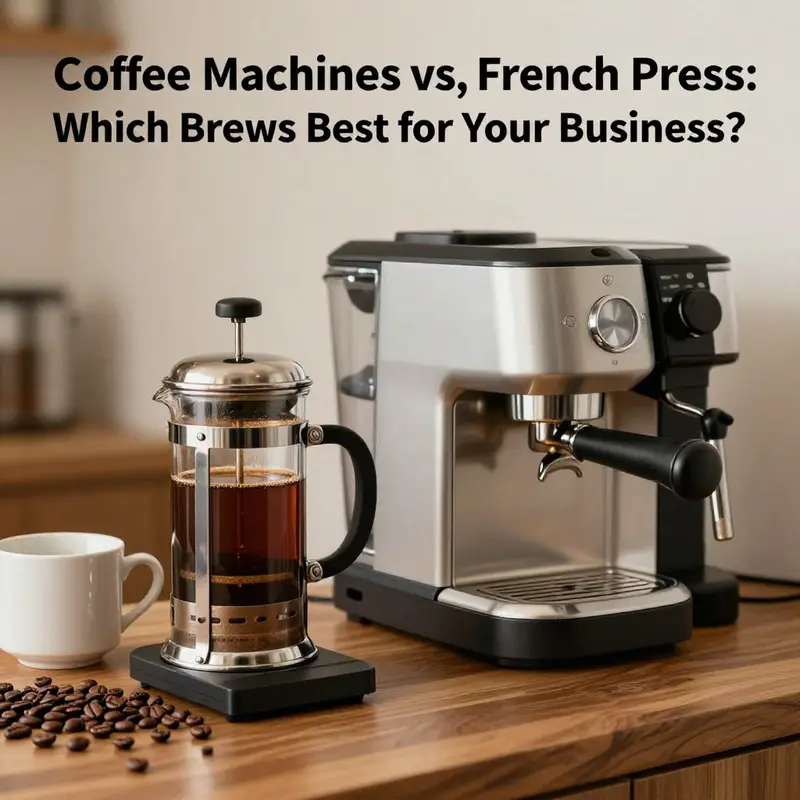
Selecting the right coffee brewing method is essential for boosting workplace morale and enhancing customer satisfaction. For business owners, understanding the intricacies of different brewing devices can lead to better quality coffee and, ultimately, a more productive environment. This article examines the key distinctions between coffee machines and French presses across four pivotal areas: flavor and mouthfeel, user experience, cost and sustainability, and suitable demographic users. By delving into these aspects, business owners can make informed decisions that align with their coffee service goals and customer expectations.
Richness Unleashed: How the French Press Elevates Flavor in the Coffee Machine Debate

The quest for a cup that feels alive in the mouth is as old as coffee itself, and it hinges on more than a simple measurement of strength or a quick jolt of caffeine. Flavor, in its richest sense, is a tapestry of aroma, body, sweetness, acidity, and the subtle afterglow left on the palate. When we weigh the French press against the more automated routes—the drip machines that rely on paper filters, the capsule systems that deliver convenience in a single capsule-sized package, and even the high-pressure espresso setups—the debate often returns to one core question: which method delivers the most authentic, richly textured expression of the bean? The argument, as many tasters tell it, is not about brightness versus depth alone but about how a brewing device handles the oils, the colloids, and the volatile aroma compounds that make coffee unique. In this regard, the French press has a distinctive strength rooted in its immersion-based extraction. It invites a slower, more intimate interaction with the coffee bed, and that patience pays off in a cup whose character is both robust and nuanced, where the line between bitterness and sweetness is more delicately drawn and where the cup carries a palpable sense of the bean’s origin and roast profile.
From the very first moment the hot water meets the grounds, the immersion process at the heart of the French press begins a quiet exchange. The coarse grind used for most French press preparations creates a relatively large surface area that allows flavors to diffuse steadily into the water while keeping most of the solids out of the finished beverage. The water, typically heated to around the near-boiling point, caresses the grounds and then rests, allowing the oils and colloidal particles that would otherwise be trapped behind a paper filter to mingle freely with the brew. This is where the French press earns its reputation for richness. Oils—the same components that give a cocoa-like mouthfeel or a nutty sweetness to a cup—are not stripped away by a paper filter. They ride through the brew with the tiny particles, contributing to body and a lingering mouthfeel that feels almost velvet on the tongue. The result is a cup that many describe as fuller, more textured, with a sense of liquidity that some readers might call “oil-laden” or “creamy,” though it lacks the dairy-crema layer of an espresso in appearance. In sensory terms, this translates into a perception of greater richness or “depth,” a term that encompasses both weight on the palate and an integrated aromatic profile that seems to unfold rather than simply arrive in a burst.
The scientific thinking behind this sensory effect is anchored in immersion extraction. When water stays in contact with coffee grounds for a sustained period, the solvent action is comprehensive. It draws out a broad spectrum of soluble compounds—from the bright acids that lend zing to fruit notes to the bitters and sweetness-bearing molecules that create a familiar chocolatey or nutty profile. Importantly, immersion preserves a significant portion of the volatile aromatics that define a coffee’s most expressive notes. Dr. Elena Ruiz, a scholar in beverage sensory science associated with respected research programs, has articulated that immersion approaches can capture more of the intrinsic oils and volatile aromatics than some rapid, high-pressure or filtered methods. The upshot in practical terms is that the cup has more aromatic layers to explore in every sip; the nose and the palate experience a longer, more interconnected release rather than a quick, segmented hit of flavor. For lovers of medium to dark roasts, where the chocolate, roasted nut, and earthy chairs of flavor are already well developed, this richness can feel particularly expansive.
Of course, the claim that the French press delivers superior richness is not an absolute verdict across all brewing contexts. The other methods in the landscape—drip coffee that uses paper filtration, capsule-driven systems that optimize convenience, and steam-pressured espresso machines that produce crema and a high-intensity sip—each have their own flavor languages. Drip coffee, with its paper filters, tends to filter a portion of the coffee oils and fine suspended solids. The result is a cup that often reads as cleaner and brighter, with a lighter mouthfeel and a more straightforward flavor arc. The oils that carry body and lasting sweetness in a French press are partly reduced in the drip process, a consequence not of poor extraction but of deliberate filtration chemistry. Capsule systems, which frequently rely on pre-ground, pre-packaged coffee and a compact brewing cycle, tend to emphasize consistency and convenience at the expense of depth. The short contact time and limited downtime of these systems can constrain flavor development, producing cups that may appear “clean” but sometimes feel less multi-dimensional. And espresso, with its rapid extraction under high pressure, excels at intensity and a certain creamy density, yet it can mask subtler notes of origin, especially when the grind is very fine and the dose is high. The crema and the boldness can overshadow delicate aromatics that are more visible in the slower, oil-preserving immersion approach. It’s not that one method is inherently superior in every dimension; rather, the French press excels in delivering a sense of flavor complexity that arises from unfiltered oils and a thorough, slower extraction, especially when the bean choice and grind are aligned with this method’s physiology.
If we anchor this discussion in the practicalities of brewing, the effectiveness of the French press for richness hinges on thoughtful parameter control. The coarse grind is essential; finer grinds can slip through the metal screen and end up in the cup as a murky texture and a rough bitterness. The water temperature, often near 93°C for this method, ensures a broad extraction without scorching the delicate aromas or driving bitter compounds too far. The steep time, often around four minutes, provides a generous window for diffusion and the dissolution of flavor-bearing molecules. It’s a rhythm that invites a moment of stillness: the user places grounds in the carafe, pours hot water, gives a gentle stir, and waits as the liquid begins to bloom with aroma. Then comes the press—the decisive act that sieges the grounds with pressure and seals the separation, sending a clean, edible signal to the palate that the conversation between water and coffee has reached its current, satisfying equilibrium. This ritual aspect—not merely the technique—contributes to the perception of “rightness” in the cup. There is a sense of participation that makes the final sip feel earned, a small ceremony that digital coffee vending cannot replicate.
Yet, there is a caveat that a mindful practitioner must heed. The richness of a French press cup is, in a subtle but real way, a function of balance. If the steep time drifts too long, or if the grind is pushed toward a finer texture, the extraction can overshoot. The result can turn the cup toward a heavy bitterness or a flattened brightness, and the oils that once contributed to mouthfeel can start to dominate in an oily, less desirable way. Conversely, under-extraction can leave the cup feeling hollow, with a perception of thinness where the true phenolics and aromatics have not fully released. The skill in achieving consistent richness lies not only in selecting the proper equipment but in cultivating a taste for the bean’s natural silhouette—its acidity, its sweetness, and its roast-driven oils—and then calibrating the variables to reveal that silhouette without smearing it into heaviness. This is where the debate intersects with the broader coffee machine versus French press conversation. The French press asks for nuance and attention; the other devices tend to offer layers of control and stability that can flatten the variables that make a given batch of coffee bright or smoky, lively or composed.
In considering the broader spectrum of devices, we can also appreciate how the French press can be tuned to align with a particular taste profile. For example, lighter or origin-focused roasts often display more delicate floral or citrus notes. In those cases, the oil-rich body of the French press can either amplify sweetness and mouthfeel in complementary ways or, if mismanaged, obscure those bright notes behind a heavier resistance. The mindful brewer might adjust grind size slightly coarser than the default, shorten the steep, or consider a pre-wet bloom to release aroma before the full immersion. These micro-adjustments reflect the art of parameter tuning, and they reveal a truth: the richness that makes French press coffee so compelling is sensitive to the bean’s character as much as to the technique. This is precisely why many aficionados view the French press as a living method, one that rewards experimentation and disciplined palate development. The richness is not a monolith; it is a spectrum that shifts with origin, roast, and even the water composition—the tiny differences that separate a cup that feels plush and velvet from one that reads as robust and focused.
For those who want a bridge between flavor richness and everyday practicality, a blended practice emerges. The French press can be used as the baseline method for savoring a bean’s deeper character, while a drip-based system or a capsule unit can serve as a fallback when time is tight or when the household needs a quick, reliable cup for several cups in a row. The trade-off is simple: flavor depth versus convenience and consistency. The strength of the immersion approach is evident in its ability to express a richer texture—body, mouthfeel, and aromatic complexity that feel integrated rather than segmented. The trade-off, of course, is a longer brew time and a learning curve that may deter casual users who prize speed more than depth. And yet, for those who crave a cup that can carry the memory of a single origin across the entire cup—the notes of cocoa, roasted nuts, a whisper of earthiness, and a final impression that lingers on the palate—the French press remains an enduring instrument for the exploration of flavor richness.
To those who wish to explore this further with a practical frame, consider the careful balancing act of grind, water, and time as a three-part conversation with the bean. The grind must be coarse enough to resist pass-through yet fine enough to support robust extraction. The water, near the boiling point, should not scorch the aromatic compounds; it should invite the oils to mingle rather than drive the brew toward a harsh end. The time, four minutes in many traditional methods, must be observed with a gentle patience that respects the bean’s temperament. When these elements align, the cup carries an aura of fullness that many other methods struggle to replicate. It is not merely that the flavor is stronger; it is that the flavor speaks in longer phrases, a narrative arc that makes a single cup feel like a small, complete tasting journey rather than a brief, sharp impression.
For readers who want to connect these ideas to a more structured, experiment-ready approach, a deeper dive into parameter tuning for the French press is available in a widely cited guide focused specifically on ratios and steep times. That resource provides practical, sensory-tested tips on achieving optimal extraction for different bean profiles, while also addressing common pitfalls that can undermine richness. The guide invites readers to experiment with confidence, to note how small changes in grind size or water temperature can produce noticeable shifts in mouthfeel and aroma, and to build a personal profile that aligns with one’s own palate. The emphasis remains on authenticity: the best cup is the one that expresses the bean’s true character with as little distortion as possible.
In reflecting on all these layers—the science of immersion, the sensory outcomes, and the human ritual—the French press looks less like a relic of the past and more like a deliberately simple, living instrument for depth. It eschews the all-too-common aim of maximizing efficiency at the expense of personality. Instead, it offers a path to taste that respects the coffee’s origin and its journey from farm to cup. It is not that other machines cannot deliver satisfying cups; it is that the French press has a distinctive voice in the chorus, one that emphasizes fullness, texture, and aromatic breadth. Those who value a cup that carries the mark of its ingredients, who want to taste the vegetable oil sweetness of the bean’s natural oils, and who enjoy the tactile engagement of brewing may find that richness is not just a byproduct but the central feature of the experience.
For readers seeking a practical, experience-driven starting point with clear directional cues, consider how best to apply this understanding in daily life. If time and intent permit, begin with a well-chosen origin and roast that you enjoy in its own right. Use a coarse grind and a standard four-minute steep, then press and serve promptly to preserve the integrity of the extraction. Assess the result, focusing not just on the immediate sip but on the lingering aroma and the aftertaste. Does the cup reveal a chocolatey warmth or a nutty sweetness that lingers into the finish? Does the texture feel substantial without crossing into heaviness? These questions guide you toward the flavor personality you find most compelling in this method.
To connect this exploration with the broader landscape of coffee preparation, remember that the choice between a French press and a machine-driven approach is not only about flavor but about rhythm, ritual, and the kind of relationship you want with your daily cup. The immersion method respects the bean’s integrity and invites a patient, attentive approach to brewing, while machines optimized for speed and consistency can empower a household to share reliable coffee quickly. Both paths have value, depending on the moment and the mood. The key is to understand what you’re trading off when you choose one route over the other and to design a routine that keeps flavor, sustainability, and enjoyment in harmonious balance.
If you’d like a broader, more structured sense of how to tweak the French press for your preferred taste profile, a resource that lays out the ratios and practical steps in a comprehensive, user-friendly way can be a helpful companion: French press coffee ratios—the ultimate guide. This guide provides a grounded framework for adjusting brew parameters with an eye toward maximizing richness while maintaining clarity, and it can serve as a reliable reference as you experiment with different origins, roasts, and grind sizes. (Note: for readers curious about how minor adjustments ripple through the cup’s aroma and mouthfeel, this resource can become a practical touchstone.)
In the end, the richness that defines the French press is both a sensory capture and a personal discovery. It asks you to slow down, to feel the texture of the coffee as it moves from the grounds into the water, and to savor the moment in which the grounds are pressed away to reveal a cup with a multi-layered personality. The debate between a coffee machine and a French press does not culminate in a single verdict; it culminates in a practice. It invites you to cultivate a taste for depth, to align your gear with your goals, and to recognize that the most satisfying brew is often born of patience, curiosity, and a willingness to adjust until the cup speaks clearly of the bean’s story. As you consider the year ahead and the possibility of rethinking your morning ritual, let richness be the compass. The French press offers a straightforward, honest route to a portrait of flavor that many coffee lovers find irresistible, while the automated families of machines provide pace, predictability, and convenience when time presses in. By understanding what each method excels at, you can craft a routine that respects both the science of extraction and the art of living well with coffee.
For readers who want to explore the practical tuning mentioned above, the following internal resource offers a concise, hands-on approach to dialing in the French press. You can explore how ratios, grind sizes, and steep times influence the final cup and use those insights to refine your own practice: French press coffee ratios—the ultimate guide.
External reading for deeper scientific context can be found through established beverage research resources. For those interested in the underlying extraction science that supports these flavor impressions, see the Zurich Institute of Beverage Research – Coffee Extraction Science. This external study provides a broader, evidence-based framework for understanding how different brewing methods influence oil retention and flavor complexity in coffee.
External link: https://www.zibr.ch/research/coffee-extraction-science
Ritual and Efficiency: The French Press’s Flavor Depth in a World of Coffee Machines

When you stand in a kitchen with a French press in one hand and a sleek machine in the other, you are witnessing two philosophies of coffee at once. One path foregrounds ceremony, tactile control, and a slow, intimate conversation with heat, grind, and time. The other path foregrounds speed, repeatability, and the quiet efficiency that a machine brings to a household or office routine. The contrast is not merely about which cup tastes better. It is about what you want your daily coffee practice to feel like and what you want your morning to say about your relationship with work, dwell, and the slow rhythms of taste. In this sense, the debate between a coffee machine and a French press becomes a reflection on how we experience flavor, how we manage time, and how we think about sustainability in a culture that increasingly prizes convenience without sacrificing depth.
The essence of the French press lies in immersion. You begin by weighing and grinding beans to a coarser texture than you would for an espresso or a paper-filtered drip. The coarse grind is not an accident; it is part of a deliberate design to maximize concentration of flavor compounds that would otherwise be filtered away or trapped behind a lid of paper. When hot water—just shy of boiling, around 93°C—meets those particles, a bloom of aroma swells up and then gently settles as extraction begins. Four minutes. The clock becomes a partner in the brew, a patient judge of how fully the grounds surrender their oils, their acids, their subtle aromatics. You press down, a slow, steady pressure that separates the liquid from the grounds in one decisive motion. The metal disk shears through a bed of coffee, leaving a visible line of sediment behind the mesh as the cup is poured. The result is not a perfectly clear beverage and it is not an imitation of a professional shot. It is something different: a liquid that carries the weight of the beans themselves, a mouthfeel that remains thick and buoyant, and an aroma that lingers with a memory of the grind and the heat that preceded the cup.
Immersion is the word that keeps reappearing in conversations about the French press. It is not just about letting coffee steep; it is about letting the coffee express what it is. Oils and fine particles, which are often filtered away in other methods, stay in the brew. This retention matters. It translates to a perception of depth, a certain oily viscosity that coats the tongue, and a more robust sense of body. For many coffee lovers, that body is not an accessory but a core attribute of the experience. It lets mid- and dark-roasted beans reveal chocolate, nutty, or earthy notes with a gravity that can feel more honest than the sometimes crisper clarity of a papery-filtered cup. In this sense, the French press is less a device and more a medium—a way to translate the bean’s full personality to the cup, without masking it behind a paper barrier or the constraints of a single extraction profile.
The science behind immersion brews to support this experiential narrative. A body of sensory science literature argues that the interaction between coffee oils, volatile compounds, and the solubility of various flavor precursors is enhanced when the brew is allowed to dwell in contact with the grounds. When you allow those elements to remain in contact with the water for several minutes, you give the solvent the chance to pull out a wider range of aromatic molecules. This translates, in practice, to a richer bouquet and a more layered taste profile—the kind of profile you notice not only in a single sip but across the next few sips as the coffee cools slightly and the aromatic symphony shifts in your glass. It is a dynamic, evolving experience rather than a fixed point, and that dynamism is at the heart of the ritual. Drifting from the initial pour to the final drop, you participate in the coffee’s narrative rather than simply receiving a finished product.
Of course, there is another side to the dialogue—the world of machines designed to deliver speed, consistency, and convenience. Automatic drip coffee makers, capsule systems, and espresso machines each offer a different value proposition. One of the strongest appeals of these devices is consistency: set a programmable schedule, press a button, and you are guaranteed a cup that replicates its own flavor profile with minimal variation. This can be a boon for households or small offices where the schedule is as predictable as the coffee needs to be. For busy mornings, the ability to press start and walk away with a cup that tastes reliably close to yesterday’s brew carries a practical magic. The price of this convenience, however, is often a certain loss of that variable, living texture—the kind of flavor nuance that emerges when the grounds have the space and time to interact with the water in a slower, more forgiving environment. Paper filters in drip systems strip away a substantial portion of the coffee’s oils and micro-particles. Even some high-end machines operate with burrs and pressure that aim for a standardized extraction curve, which can yield a crisp, clean cup but may also flatten some of the coffee’s more intricate aromatics. Capsules, by design, present a trade-off between freshness and complexity. The convenience is hard to argue with, yet the coffee inside those capsules tends to be a pre-selected, pre-ground product that has already crossed several stages of processing, often designed for shelf stability and rapid brewing rather than maximal flavor expression.
The question, then, becomes one of balance. A machine-based routine shines when life demands speed and predictability. It can reliably produce multiple cups with limited effort, a boon for households that start the day with a lineup of hectic schedules. The French press, by contrast, preserves a form of culinary mindfulness. Its cost is not simply measured in dollars but in minutes and mental space—the small downtime that invites you to engage with the coffee as a craft. The preparation itself becomes a ritual: the pre-warm of the carafe, the pour of the coarse grounds, the slow bloom and the inserted patience of the press. In this rhythm, you are reminded that flavor is a function of attention as much as of technique. That attention, in turn, breeds a different kind of satisfaction—a sense that you have earned a cup through participation rather than consumption alone.
If we attend to the economics of these choices, the conversation becomes more revealing. A French press requires a modest initial investment, and the ongoing cost is largely tied to the price of coffee and occasional replacement parts such as a filter or press seal. The long-term fiscal and environmental calculus tilts toward immersion brewing when you consider the waste generated by single-use capsules and the broader life cycle of any pre-packaged coffee system. The environmental footprint of capsules is a recurring concern in contemporary discussions of sustainability. A widely cited figure from recent environmental research points to the enormous volume of aluminum- or plastic-based capsules that enter landfills or recycling streams each year, much of which cannot be effectively reclaimed. In contrast, a French press relies on reusable metal mesh and glass or ceramic carafes paired with ground coffee, while the spent grounds themselves can function as compost or organic fertilizer. The material footprint is smaller, and the potential for reuse is greater—a simple equation in a world increasingly attentive to waste streams.
That said, the choice is not a morality tale but a personal suitability question. If you prize a sense of continuity and a coffee flavor that feels alive with every sip, the French press offers a form of culinary democracy: it invites you to alter grind size, contact time, and water temperature to tune the flavor in real time. It does not demand exacting calibration or a learning curve that outpaces your patience. The French press is a tool for those who want to be involved, who want to experiment with variables, who want to develop a nuanced vocabulary for their own palate. On the other hand, if you value speed, uniformity, and the ability to scale to a household or office without skirmishing with variables, a machine-based setup can be more practical. It provides a reliable standard that reduces the cognitive load associated with brewing, which matters when your morning is pressed by deadlines or peppy chatter around the kitchen island.
In the literature of taste, the immersion approach is often described as capturing more of the bean’s inherent fingerprint. This is not just subjective sentiment but a phenomenon grounded in the chemistry of extraction. Oils that carry many aromatic compounds tend to be better preserved in the absence of a paper filter and in the longer contact period that immersion allows. In studies on extraction science, immersion methods have been shown to retain a richer tapestry of flavor compounds, translating into perceived richness. Yet the value of machines cannot be dismissed. The sensory richness of a cup matters less if you are late to work or if you must juggle a family’s morning routine; in those moments, the predictability of a machine can feel almost like a different form of flavor—one that satisfies the need for steadiness and efficiency.
From a user’s perspective, the best practice might be to view the two approaches as complementary rather than competing destinies. A household can designate the French press as the daily ritual device for weekends or quiet mornings when there is time to savor the slow, deliberate act of brewing. On weekdays, the same household can rely on a reliable automatic or capsule system to deliver consistent results with minimal friction. The separation of roles reinforces the idea that flavor is not an absolute measurement but a function of context—of mood, of time, and of the kind of presence you want in your coffee moment.
For readers curious about the mechanics behind this distinction, a deeper dive into the practical ratios and steps of the French press is valuable. The discipline of the method—how much coffee to grind, how hot the water should be, and how long to wait before pressing—forms a framework that remains flexible enough to adapt to personal taste. In practical terms, the ratio, water temperature, and timing are levers you can pull to shift flavor in small increments, preserving the core character of the beans while tailoring the experience to your preferences. If you want to explore these ratios in greater depth, you can consult a dedicated guide that unpacks the variables of the French press and translates them into an actionable plan for your own kitchen workflow. For a focused resource on this topic, see French-press-coffee-ratios—the-ultimate-guide. That guide breaks down the common ground rules and the common deviations, helping you understand when a longer steep might yield more body or when a shorter steep preserves a brighter acidity.
The conversation about ritual and efficiency also touches on a broader question of lifestyle. A French press demands a certain pace, a deliberate pause before the pour. It invites you to see the coffee not merely as a product but as a process that you participate in from start to finish. This is more than taste; it is a mental practice. The act of weighing beans, heating water, watching the bloom rise, timing the steep, and finally pressing the plunger becomes a moment of focus—an intentional pause in a busy life. It can anchor a morning routine, a moment of gratitude, or a small victory in the face of a demanding day. The machine-based method, meanwhile, offers a different form of anchoring: the reassurance that a cup will arrive on schedule, with consistent warmth and balance, ready to be sipped as the kettle still hums in the background. The two modalities do not cancel one another; they coexist, each serving a facet of daily life. A thoughtful coffee practice might embrace both sides of the argument, selecting the method that best suits the moment, the mood, and the day’s demands.
As you navigate between immersion and automation, it is helpful to keep an eye on the broader environmental and social implications. The French press aligns with a philosophy of reuse and low waste—the same grounds can be composted, the filter is durable and repairable, and the overall lifecycle can be extended with careful care. In contrast, capsule machines and most disposable-filter systems generate more waste and depend on ongoing purchases, which can accumulate even when the initial outlay is modest. This tension is not merely about material waste; it is about the rhythms of your life—how often you want to discard and replace, how long you want to dwell on a cup, and how you want your kitchen to echo your values in everyday acts.
The practical guidance that emerges from this exploration is relatively straightforward. If your days begin with a sense of ceremony, if you are drawn to the tactile, sensory-rich experience of coffee, and if you have a small reserve of time to invest in a ritual, the French press is a compelling choice. Its flavor depth, its resistance to paper-filter absolutes, and its capacity to reveal the coffee’s intrinsic personality make it more than a brewing technique. It is a way of thinking about coffee as a living thing, something that benefits from contact with water and air rather than a rinse through a filter and a pressure chamber. If you prioritize speed, simplicity, and reproducibility, a machine-based setup serves you well. It is not that one approach is universally superior; rather, each approach expresses a different relationship to the bean and to the moment of brewing.
For readers who want to connect the practical to the conceptual, the following resource offers a deeper, more technical orientation to the French press—its ratios, grind sizes, and timing in an accessible, kitchen-friendly format. French-press-coffee-ratios—the-ultimate-guide. The guide helps translate intuition into reproducible practice, so you can experiment with confidence while maintaining the assurance that the cup you drink reflects your intent. At the same time, for those who crave the scientific grounding behind extraction phenomena, a respected body of research provides a broader lens on flavor capture, oil retention, and aroma development. A concise summary of these insights can be found in the Zurich Institute of Beverage Research’s exploration of coffee extraction science, which outlines how immersion methods influence sensory richness and perceived complexity. See https://www.zibr.ch/research/coffee-extraction-science for a rigorous account of how different brewing methods shape the flavor landscape. Together, these sources ground the experiential narrative of the French press in a robust technical framework, reminding us that taste is not spontaneous but built through thoughtful choices about technique, time, and environment.
As you close this reflection, consider how your own kitchen can accommodate both worlds. A single vessel that invites ritual sits comfortably beside a machine that serves convenience. The path forward is not to choose one over the other but to cultivate a coffee practice that honors flavor depth while recognizing the realities of daily life. The moral of this chapter is not that the French press is inherently superior to every machine, but that it offers a doorway to flavor that can be deeply rewarding when you give it time and attention. And when time is scarce, a well-chosen machine can still deliver a cup that is satisfying, clean, and consistent, preserving the essential joy of coffee as a daily ritual while honoring the practical rhythms of modern life.
In the end, the question is not only about taste but about intention. Do you want a cup that invites you into a moment of mindful ritual, a small ceremony that honors the bean and the process? Or do you want a cup that reliably fits into a busy schedule, with the assurance that a good coffee will arrive on cue? The answer is personal, and it can evolve with your routines and your palate. The French press offers a doorway into flavor that is intimate and expressive. A machine offers a door into efficiency and consistency. Both doors lead to the same room: a cup of coffee, warm and alive, waiting to tell you a story about you in that moment.
Economics and Ecology in a Cup: The French Press as a Long-Term, Eco-Friendly Choice in a Machine-Dominated World

When people compare a wide range of coffee makers, the conversation often orbits around flavor, speed, and convenience. Yet beneath the aroma and the morning ritual lies a quieter, more consequential calculus: how much does this choice cost over time, and how does it shape the planet we sip from? In the ongoing dialogue between the familiar, low-tech French press and the modern, automated brewers, the cost and sustainability lens tends to tilt the balance in favor of the former for a broad swath of daily routines. It is not merely about saving pennies in a piggy bank, though that matters; it is about reducing waste, extending the life of the equipment, and choosing a brew method that remains resilient as technology evolves and environmental considerations tighten budgets and expectations alike.
From a purely upfront standpoint, the economics of a French press look deceptively modest. A basic press consists of a glass or steel carafe, a plunger and a metal mesh filter, and a sturdy frame. The initial investment is modest compared with most automatic machines. There is no dependence on complex electronics, no myriad of disposable parts, and no need to perpetually replace proprietary capsules or filter papers. In this sense, the French press is almost a countercultural move within a marketplace that relentlessly commercializes single-use components. The ongoing cost, too, tends to be lean. The core ongoing inputs are ordinary coffee beans and clean water; there is no recurring expenditure on consumables beyond the coffee itself. If we think in practical terms, a daily brew can be kept affordable by selecting medium-quality beans and a sensible grind—coarsish enough for immersion, fine enough to extract rich oils during the four-minute contact time that defines the method. In such a setup, a single cup can be produced at a fraction of the price of many capsule-based or automatic options, and the per-cup cost scales predictably with the price of coffee, not with the gimmicks of packaging or automated bells and whistles.
However, the cost story does not end at the sticker price or the per-cup price tag. It unfolds over years, often into a lifetime of use. The French press shines here, because its key components are robust and reusable. The metal mesh, although it requires periodic cleaning and occasional replacement if damaged, does not demand expensive, frequent replacement like some other filtration systems. The glass carafe, if handled with care, can endure years of daily use. This durability translates into long-run cost efficiency. In contrast, many automatic and capsule-based machines rely on consumables that accumulate in the waste stream and in the pocketbook. The monthly or weekly purchase of capsules—each one a small, sealed package of plastic and aluminum—creates a recurring cost that compounds over a year and beyond. And while some machines are good at recycling, a substantial portion of capsules still ends up in landfills, contributing to environmental footprints that are not always easy to offset with energy savings or convenience.
What makes the French press economically compelling goes beyond the arithmetic of price per cup. It hinges on lifecycle thinking—the way a product behaves from the moment it is bought to the moment it is retired. A well-chosen French press can last many years, possibly a decade or more with proper care. Its passive design means fewer things go wrong. Fewer replacements mean fewer opportunities for waste. Even the coffee grounds themselves become a resource rather than waste when composted or used as a soil amendment. This aligns with a broad understanding of sustainable living: investing in tools that honor durability, minimize resource throughput, and preserve value over time. In jurisdictions where the cost of waste disposal or the price of disposable capsules is not negligible, the environmental externalities of single-use systems can translate into real, measurable economic pressure for households and communities alike.
The sustainability argument for the French press rests on three pillars: materials, waste, and energy. First, the tool itself is typically composed of durable stainless steel or borosilicate glass and a metal filter. These materials tolerate repeated use without degrading quickly, and they avoid the “use once, throw away” lifecycle that plagues some automated systems with disposable components. Second, the waste profile is straightforward and comparatively benign: used coffee grounds, which can be repurposed as compost or soil amendment, and no plastic or aluminum capsules demanding specialized recycling streams. Third, energy use tends to be modest in the ritual of French press brewing. While electric machines heat water efficiently, the incremental energy required to heat water for each cup remains a fraction of what a high-volume automatic brewer consumes. Even if we account for standby power in a modern machine, the cumulative energy impact still tends to be lower when those machines are used in a single-user or small-family context rather than in a commercial or high-traffic setting.
This trio of considerations—durability, waste reduction, and energy modesty—helps explain why the French press is often positioned as the greener option in a family of coffee-makers. It is not merely a nostalgic choice; it is a practical one that translates into environmental and economic resilience. In a world where households increasingly pay attention to the full cost of ownership, not just the purchase price, the French press earns a strong score for long-run value. Sensibly chosen, it endures through countless mornings without becoming a major maintenance burden. And when a part eventually does wear out, replacement components are typically affordable and straightforward to source, allowing the user to extend the life of the entire setup rather than discarding it.
The broader context of waste and resource conservation adds texture to this economic argument. A widely cited concern in contemporary discourse is the enormous volume of disposable capsules produced each year. A 2025 Nature study highlighted that trillions of capsules accumulate as waste, a figure that underscores not just the scale of disposal challenges but the outsized impact of consumer packaging on ecosystems. In this frame, the French press offers a counter-narrative: a tool that does not generate a stream of single-use packaging with every cup. The coffee itself remains the central input, and the material footprint of that input is comparatively modest when the beans are purchased in bulk or in recyclable packaging. Even if one switches between coffee brands or roasts, the essential pattern remains consistent: less waste, less recurring packaging, more reuse.
The environmental logic dovetails with the social and personal dimensions of money. For students, for urban singles, or for households that must optimize every cent, the French press turns a potentially expensive morning ritual into a cost-conscious routine. When a household considers the cumulative cost of capsules, filters, and the electricity or water used to heat water for dozens of cups weekly, the savings from a one-time purchase plus years of low-cost operation become substantial. In this sense, the French press does not merely offer a bargain; it delivers a long-running economic and ecological stability that can be a meaningful anchor in a fluctuating market. It is the difference between paying a predictable price for coffee and paying a premium for the packaging and convenience that modern machines often ride on.
If one seeks a practical cadence for integrating the French press into a broader coffee strategy, the approach is simple and repeatable. Embrace a routine that values grind size appropriate to immersion, water nearly at a boil, and a brief, disciplined four-minute steep. This cadence preserves the integrity of the beans’ oils and aromatics while maintaining a speed that is compatible with busy mornings when time matters. For those who want to optimize flavor without sacrificing cost, the path is to source coffee in bulk when possible, store it properly to maintain freshness, and use a reliable grinder that delivers consistent grinds appropriate for immersion. In this way, the economic and ecological advantages are reinforced by a steady, satisfying brew that does not demand constant tinkering with expensive gear or disposable consumables.
To readers who are curious about how specific brewing variables might influence both cost and sustainability, a practical touchstone can be found in the realm of ratios and grind settings. A well-calibrated French press setup supports a robust extraction with minimal waste and a manageable flavor profile. For more depth on mastering those ratios, see French-press coffee ratios: the ultimate guide. The guidance there helps justify the cost savings of the method, because improved extraction reduces the need to purchase higher-end beans to achieve the same sensory payoff. In turn, better extraction per gram of coffee, achieved consistently, translates into more efficient use of beans and less waste, reinforcing the environmental and economic argument in one streamlined process.
Yet there is another layer to consider, one that may not be immediately visible in a price tag or a waste audit. The social and cultural dimensions of coffee-making matter. The French press invites a slower, more mindful interaction with the beverage, a form of personal ritual that aligns with values such as intentional consumption and attention to quality over speed. This ritual itself can become a form of ongoing education—about sourcing, roasting, grind size, water quality, and temperature control. Such education is invaluable because it turns everyday coffee into a practice rather than a routine. It is this experiential learning that often correlates with more sustainable consumption patterns: people who measure, time, and taste are more likely to invest in durable tools, minimize waste, and resist the pull of disposable shortcuts.
In the end, the question of whether the French press is the more economical and eco-friendly choice is not a binary verdict but a nuanced alignment of values, usage patterns, and long-term goals. For households prioritizing cost containment and environmental mindfulness, the French press offers a coherent, resilient option that travels well beyond the first purchase. It is, in this sense, a return to fundamentals—the fundamentals of flavor, yes, but also the fundamentals of responsible consumption. It respects the integrity of the coffee itself, supports a modest ecological footprint, and honors the reality that a good cup can be both affordable and sustainable.
For readers who weigh both sides—the pure convenience of automated brewers and the cost-conscious, environmentally aware pull of immersion brewing—the path forward becomes a matter of scale and purpose. If time and consistency dominate the equation, a machine that handles the routine with little attention may still serve households well. If, however, the aim is a meaningful reduction in waste over years, a smaller upfront investment in a French press yields a more substantial cumulative dividend than it might appear at first glance. The outcome is not merely a better cup; it is a more deliberate approach to everyday life, one that recognizes the value of durable tools, responsible resource use, and the joy of a ritual deeply aligned with the realities of budget and local ecosystems.
This synthesis—economics, ecology, and the pleasure of a well-made cup—frames the broader conversation about whether to choose a coffee machine or a French press. It invites readers to consider not only how a device makes coffee but how that device fits into a life that seeks affordable quality and a lighter environmental imprint. The French press, with its enduring design, low recurring costs, and potential for thoughtful, low-waste operation, stands as a compelling option in a landscape crowded with fast, disposable conveniences. It is a choice that honors both the science of extraction and the pragmatics of daily life, a quiet assertion that costly convenience does not have to come at the expense of the planet or of our long-term budgets.
External resource for broader context: Zurich Institute of Beverage Research – Coffee Extraction Science. This external study provides deeper insights into how immersion brewing retains oils and aromatic compounds, reinforcing the flavor richness associated with the French press and its alignment with a sustainability-focused approach to home brewing.
Matching Coffee Rituals: French Press vs Automatic Machines

Flavor and texture differ between the methods. The French press preserves oils and fines, delivering fuller body and a rich mouthfeel. Filtration in automatic machines tends to yield a cleaner cup with bright notes and less perceived heaviness, while espresso style machines emphasize intensity and crema for drinks with milk. The choice depends on life rhythm and taste. The ritual of a French press invites a pause, slow muddiness of grind, heat, and bloom, whereas a machine supports quick, reliable service in busy households. Maintenance considerations include cleaning the plunger and filter for the French press and descaling and filter changes for machines. Cost considerations include upfront price and ongoing capsule costs. Sustainability concerns include the waste generated by capsules. A balanced approach can pair both options in a single kitchen for flexibility. This chapter offers practical guidance to help readers decide which path fits their daily life, budget, and values. The method aligns with your schedule and tastes. A hybrid approach is often the most versatile.
Final thoughts
In summary, when it comes to choosing between coffee machines and French presses, each method presents unique advantages tailored to different business needs. The richness of flavor and aroma extracted from a French press can captivate coffee enthusiasts, while the ease and speed of a coffee machine cater to busy workplaces requiring consistent and quick results. Ultimately, the choice depends on your specific priorities—whether you value taste, convenience, cost-efficiency, or sustainable practices. By understanding these differences, business owners can elevate their coffee offerings and create a happier, more engaged workplace.