
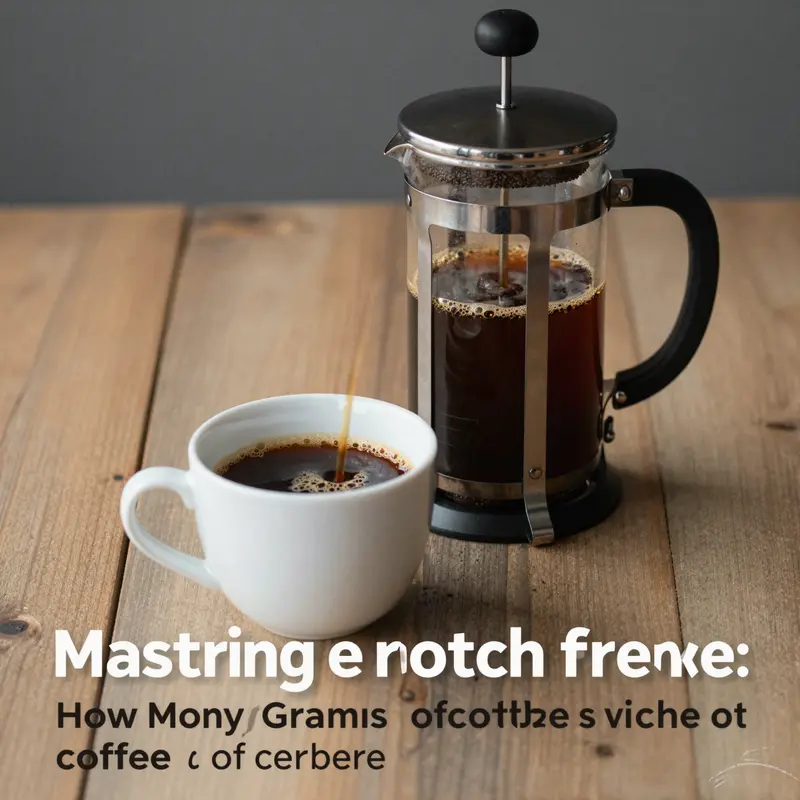
In the world of coffee, the French press offers a unique brewing method that many enthusiasts swear by. For business owners looking to serve the best possible cup to their customers, understanding the precise measurement of coffee grounds is essential. The key to achieving rich flavor lies in knowing how many grams of coffee to use for the amount of water. This article will break down the recommended coffee-to-water ratios, how to adjust measurements based on personal preferences, and the best practices for grind sizes to optimize extraction. With these insights, you can elevate your coffee offerings and satisfy your clients with each brew.
Weighing the Ratio: Mastering Coffee-to-Water in the French Press

The process of dialing in a French press coffee begins with a quiet, precise act: weighing the grounds. In the world of manual brews, the scale often outsizes any intuition about how a cup should taste. The general community wisdom for a French press centers on a water-to-coffee ratio that favors depth and clarity without tipping into muddiness. For many readers, the most practical starting point is a range that translates the feel of a robust, full-bodied cup into numbers you can reproduce. A widely recommended starting point is that the water-to-coffee ratio should sit between sixteen to one and eighteen to one, water to coffee. Put simply, if you are preparing roughly five hundred milliliters of water, you would aim for about twenty eight to thirty two grams of coffee grounds. That range is designed to give you balance: enough presence to showcase the roast, but not so much that the cup becomes heavy or bitter with over-extraction. This guidance aligns with reputable sources that emphasize two often overlooked elements: the grind size and the grind consistency. The recipe’s success hinges not only on the amount of coffee but on how evenly the grounds are prepared for extraction. As you picture this ratio, remember that the water you pour will extract flavors from the coffee at differing speeds as it dwindles through the ground bed. The aim is to match the water’s pace to the grind’s surface area so that extraction proceeds evenly, avoiding the harsh bite that comes from over-extracted compounds or the insipid taste that arises when the extraction is incomplete. In practical terms, the numbers give you a roadmap, but your palate is the compass. You may try a touch more coffee if your roast profile leans toward boldness, or scale back slightly if you detect silt or an astringent finish in the middle of the cup. This balancing act is not a fixed rule but a starting point that invites minute adjustments. It’s helpful to think of the ratio as a scaffolding that lets you map your technique, not a cage that confines your preferences. A common reference point arises from the idea of a 1:20 ratio by weight, a standard most baristas rely on as a solid foundation for a well-rounded cup. In practice, this means that if you weigh out twenty grams of coffee, you would target approximately four hundred milliliters of water. That 1:20 proportion keeps the extraction within a comfortable corridor where the flavors of the coffee are allowed to bloom rather than being under- or over-extracted. Yet, even this widely accepted standard is not immutable. If your goal is a bolder, more assertive cup, you may tilt toward a 1:18 ratio, which simply means more coffee relative to the same amount of water. Conversely, for a milder cup, moving toward a 1:22 ratio reduces the concentration, allowing the more delicate notes to come through with less intensity. The key, as with so much in coffee, is to start with a repeatable baseline and then adjust with intent after careful tasting. The numbers themselves are only a beginning; the sensory result is what tells you whether to keep what you have, nudge in one direction, or pivot again. In the practical kitchen or the campfire setup, one fast approach to making this repeatable is to begin with a scale and a timer. Weigh twenty grams of coffee for a target of four hundred grams of water for a typical two-cup French press, then brew and observe. If the resulting cup feels too strong or too weak, recalculate for the next batch: twenty-gram coffee with three hundred fifty to four hundred grams of water would maintain the 1:17.5 to 1:20 range, but the flavor will reveal whether your preferences align more with the higher or lower end of the spectrum. For some readers, the difference between a 1:18 and a 1:22 ratio can translate into a noticeable shift in the perceived sweetness, acidity, and the body of the coffee. Those who enjoy a bold brew might find a 1:18 ratio suits their palate, especially with a medium-dark roast that carries oil and aroma into the cup. In that scenario, the higher coffee concentration can emphasize the roast’s texture and mouthfeel. Others who lean toward a milder cup—perhaps when using a lighter roast or beans with delicate aromatics—may appreciate a 1:22 ratio, which allows the cup to breathe and reveal more nuanced flavors without overwhelming them with intensity. This does not mean one should abandon the ratio and rely on intuition alone. The balance still relies on proper grind size and contact time, both of which influence extraction as surely as the ratio does. A coarse grind becomes the ally of the French press; it helps keep the mesh filter from becoming clogged with fine particles and minimizes the risk of a gritty, silty finish that can coat the palate with bitterness. The texture should be reminiscent of sea salt or rough breadcrumbs—distinct enough to stay in the filter, yet uniform enough to avoid uneven extraction. The choice of grind size is also intimately tied to the type of grinder you use. A burr grinder, set to the coarsest yet consistent setting, is typically the best tool for this job. Blade grinders are less forgiving; they tend to produce a range of particle sizes, including finer fragments that can slip through the mesh and contribute to the very silty, often bitter aftertaste we aim to avoid. The grind’s integrity influences not only texture but also the rate of extraction, which interacts with the coffee-to-water ratio to produce the cup you taste. In practice, you’ll notice that the grind’s consistency helps ensure that the water can pull the desired compounds from the grounds within the brew window you have chosen. The brew window itself is a feature of the French press method. A typical steep time in a French press ranges around four minutes, though some prefer a shorter or longer interval depending on the roast and the coffee’s density. The length of contact between water and grounds is an element of taste as much as dose and grind. A four-minute steep provides a balance between extraction and ease; it gives enough time for fragrant oils, soluble solids, and sugars to dissolve into the water, forming a cup with body and depth, but without yielding the flat, over-extracted bitterness that can accompany longer contact times. To preserve the clarity of flavors within that window, it’s wise to begin by preheating the press with hot water. This simple step reduces the temperature drop that often occurs after you pour the initial water, and it helps maintain a consistent extraction temperature through the brew. A warm vessel ensures you don’t inadvertently under-extract because the gravity of cooler glass or metal slows the process. When you add the grounds, a brief bloom can help awaken aroma and even out saturation. Pour a small amount of hot water, just enough to wet the grounds, and wait for about thirty seconds as the coffee swells and releases its initial aromas. Then add the rest of the water to reach your total. A gentle stir at this stage can improve saturation, especially if your grounds have settled into clumps from storage or transport. After the four-minute mark, press slowly and steadily. The pressure should be even and controlled, with a smooth, continuous motion to avoid sudden bursts that stir up extra fines and sediment. The resulting brew should be a near-black liquid with a rich aroma, and the cup should present a balanced interplay of sweetness, acidity, and bitterness that speaks to the roast’s character and the farmer’s craft. If you notice an overly bitter finish, you may be pulling too much from the grounds or allowing too long a contact time, or the grind may be too fine for the press. If the cup tastes flat or weak, you may need more coffee, a coarser grind, a slightly shorter brew time, or a higher water temperature. The coffee’s roast level naturally informs how you fine-tune your approach. Darker roasts can tolerate a stronger ratio or longer steep to bring out oils and burnt-sugar notes, as their oils coat the palate with a more pronounced mouthfeel. Lighter roasts, with their brighter acidity and more delicate aromatics, may require a touch more water, a slightly finer grind, or a shorter steep to avoid overpowering the subtler flavors with bitter tannins. Above all, the act of making coffee with a French press rewards repetition and sensory evaluation. Once you establish a baseline with, say, twenty grams of coffee and four hundred grams of water for four minutes, you then brew again, compare the outcomes, and decide how to adjust for your next session. This is where the mathematics of the ratio becomes a map rather than a rulebook. The goal is not to chase a single perfect number but to cultivate a method that yields consistent results that mirror the roast’s intent and your personal taste. For readers who want a deeper dive into the mechanics and the fine details of ratio and technique, there is a comprehensive guide that lays out the nuances of French press coffee ratios in clear, actionable terms. This resource offers a careful exploration of dose, grind, water temperature, and timing, helping you fine-tune your approach for different bean profiles and roast levels. French press coffee ratios—the ultimate guide provides a structured outlook on the subject while leaving room for your own experimentation and preference. The conversation around grams, ratios, and grind size is not an either/or proposition; it is a continuum of adjustments that empower you to make the cup you want, every time. However, the journey toward an ideal cup hinges on one principle that is easy to forget in the rush of morning: accuracy. The scale you use matters as much as the roast or the water’s temperature. A reliable kitchen scale that can measure to at least one-tenth of a gram gives you the precision necessary to reproduce a target ratio faithfully. Once you commit to weighing your coffee and your water, you begin to remove the guesswork from the process. And when you combine accurate dosing with a deliberately chosen grind and a mindful brewing time, the French press stops being a ritual of chance and becomes a reliable practice. In the end, this is what makes the grams matter: the ability to reproduce the character you are chasing in a consistent cup. The grams are not just numbers; they are a language that communicates your intentions to the coffee maker, the water, and the roast. They bridge the gap between a bag of beans and the cup you enjoy, turning arithmetic into aroma, texture, and memory. When you walk back to the kettle after the first cup and feel the pull of tomorrow’s brew, you’ll know you have created something repeatable, something traceable, something personal. If you choose to adjust your route—be it a more extended steep for darker roasts, or a lighter touch for brighter origins—do so with a record in mind. Log the grams used, the total water, the temperature of the water, the time of the steep, and your tasting notes. Over time, those notes become a personal map of your palate’s preferences, a guide that helps you move through roasts and origins with confidence rather than through trial and error alone. The practice of weighing, grinding, and timing becomes not a rigid method but a conversation with your coffee, an ongoing dialogue that grows with your experience. For those who occasionally brew for guests or for a household with different tastes, the ratios still serve as a baseline you can reproduce with a fraction of a gram’s variation. In such scenarios, you might prepare a larger batch, scaling the grams and water to maintain the same ratio. The challenge then is not to overshoot the total time available or to water down the brew by pouring too much water at once. A well-made batch remains centered on proportion and control, rather than on shortcuts or guesswork. The implications of asking “how many grams of coffee for a French press?” reach beyond the kitchen into the rituals of daily life. The answer is not merely a number; it is a discipline. It is the discipline of measuring, of adjusting, of discerning how the cup feels on the tongue and what it reveals of the roast’s depth. It is a reminder that coffee brewing is a practice as much as a product, and that the best cups come from patience, precision, and a willingness to refine. As you close this chapter and think about your next brew, keep your sense of inquiry ready. Try a consistent baseline, then vary the ratio by a few points to compare the outcomes with your preferred roast and origin. No matter your environment—home kitchen, camping setup, or a casual cafe bench—the principle endures: weight matters. The grams you measure ground with intention today create tomorrow’s expected aroma and flavor. The path to a balanced, flavorful cup is built from the steady hands of the grams you pour, the grind you choose, and the time you give the coffee to meet the water in the press. External reference: https://www.illy.com/en/recipes/how-to-use-a-french-press/
Weighing Your Way to the Perfect Cup: Dialing French Press Grams to Fit Your Taste

Choosing the right grams for a French press is less a fixed rule and more a personal calibration. It begins with a simple truth: when you swap grams, you swap flavor. Start with a dependable baseline and then fine-tune with careful, incremental adjustments. The widely cited starting point is a water-to-coffee ratio of roughly 1:15 to 1:16. For example, 30 grams of coffee with 450 milliliters of water yields a 1:15 ratio. If you want a brighter cup, consider 1:14; for more body, 1:16 or 1:17. The key is to weigh both coffee and water so the changes you make are precise and repeatable. Grind size matters too: a coarser grind supports a smooth immersion, while too fine a grind can lead to over-extraction. Keep additional considerations in mind: temperature around 195–205 F (90–96 C) and a steady four-minute brew time help you compare results reliably. Finally, keep a compact log of your experiments—dose, water weight, grind, time, and sensory notes—to reveal how small gram tweaks influence brightness, body, and finish.
From Grinds to Greatness: Fine-Tuning Grains, Weights, and Water for French Press Perfection

The journey from a mere handful of coffee beans to a cup that feels balanced, clean, and comforting begins with something as simple as grams. In the world of French press brewing, the ratio of water to coffee is not just a suggestion but a compass. Most practitioners settle into a range near 16:1 to 18:1 (water to coffee). Translate that to a practical scene: for every 500 ml of water, you would use roughly 28 to 32 grams of coffee grounds. This window is not a cage, but a flexible framework that accommodates flavor ambition, bean roast, and personal preference. When you start with the right proportional foundation, you build a smoother path toward a cup that tastes well‑balanced rather than edgy or flat. The numbers matter because they govern extraction—the process by which water pulls flavor from the grounds. Too little coffee and you invite under-extraction, yielding a milder cup with incomplete sweetness and measurable sour notes. Too much coffee and you risk over-extraction, which can produce a heavy body, a bitter finish, and a slurry of particles that muddy the cup. The 16:1 to 18:1 range is a sweet spot that has emerged from hands-on testing and thoughtful reasoning about grind size, water quality, temperature, and contact time. It aligns with guidance from reputable sources and the practical experience of many home brewers who want a reliable result without fuss.
To make this more concrete, consider a liter of water. At 16:1, you would use about 62.5 grams of coffee; at 18:1, about 55.6 grams. A liter is a typical batch size for a quiet morning, a small group, or a personal ritual stretched to last a bit longer. If you brew a smaller amount, say 250 ml, the same ratio translates into roughly 15.6 grams at 16:1 or 13.9 grams at 18:1. Those numbers may seem precise, and they are, but they are also gentle reminders that grams, not approximate tablespoons, create consistent results. A scale becomes your most trustworthy ally. By weighing your coffee, you anchor the brew in a reproducible way, so that changes in roast level or grind size do not become a guessing game. A scale helps you move beyond the variability of “roughly this many scoops” and into a disciplined discipline of craft.
Yet grams alone do not tell the full story. The relationship among grind size, weight, water temperature, and brew time shapes the final cup just as decisively as the grams themselves. The grind is the primary gatekeeper for extraction. A French press relies on a metal mesh plunger to separate the grounds from the liquid, but the mesh can only do its job well if the particles feeding it are consistent and of the appropriate size. This is where the grind becomes a central character in the chapter of achieving clarity rather than sludge. The ideal grind for a French press is coarse—resembling sea salt or breadcrumbs. Coarse particles resist rapid compaction and ensure that the metal filter traps the larger bits while allowing the brew to rise through without dragging a cloud of fines into the cup. The more consistent the grind, the more predictable the extraction and the cleaner the final beverage. A uniform grind reduces the amount of fines that slip through the filter, which in turn minimizes the cloudy, gritty texture that can dominate a poorly filtered batch.
There is a distinct difference between using a burr grinder and a blade grinder when it comes to achieving that consistent coarse texture. Blade grinders, with their spinning blades, tend to create a heterogeneous mix: some grounds are enormous, some are powdery, and many fall somewhere in between. The result is an uneven extraction, more fines, and a higher likelihood of sediment and sludge. In contrast, a burr grinder—especially a conical burr model—crushes beans between two precisely spaced surfaces, producing a more uniform particle size distribution. This uniformity translates into more even extraction and, ultimately, a cleaner cup. Within the burr‑grinder family, adjusting the setting to medium‑coarse or coarse is typically the sweet spot for French press brewing. The goal is a texture that feels substantial on the palate but still allows water to flow and extract without grinding to powder.
As you settle into a grind that favors consistency, you begin to appreciate how much the grind, weight, and water interact. The interplay is delicate: grind affects surface area, which in turn affects how much of the coffee’s compounds dissolve into the water, while weight controls the pool of solubles available for extraction. Brew time adds another layer of control. With a French press, the standard was often a four‑minute contact period, though some roasters and home brewers extend to five minutes for a deeper, more robust profile or trim back to three and a half minutes for a lighter, brighter cup. Temperature matters as well. Water in the 92 to 96 Celsius range is commonly recommended for even extraction with a French press. If the water is cooler, extraction slows and the cup can taste underdeveloped; if it’s hotter, you risk over-extracting and pulling bitter, astringent notes from the grounds. The interplay of these variables means that making coffee with a French press is less about a single magic number and more about a harmonious set of conditions that you can control and repeat.
To connect the dots between the numbers and the results, imagine stepping through a single, well‑planned workflow. Start by preheating your vessel, then weigh your coffee—say 30 grams for a 500 ml batch, which sits comfortably between 16:1 and 18:1. Grind to a coarse texture, careful not to over‑grind into a crumbly, dusty powder; the aim is a consistent, slightly chunky texture that resembles sea salt. Pre-warm your carafe so the brewing water doesn’t dramatically drop in temperature upon contact with cold glass. Boil your water and let it rest briefly to reach the mid‑high eighty degrees before pouring. As you start the pour, saturate the grounds evenly, then give the mix a gentle stir to ensure all the particles see water. After a one‑minute bloom, continue pouring until you reach the target water level. Place the plunger on top and press down slowly after about four minutes of total contact time. The goal is a smooth, even extraction that yields a balanced cup with clarity rather than a murky, sediment‑heavy finish.
The sediment question anchors a large part of this discussion. Sediment, often described as sludge, is not merely a nuisance. It is a symptom of extraction dynamics and grind quality. There are multiple levers you can pull to minimize it. First and foremost, ensure the grind is coarse and uniform. The better the grind matches the body and filtration system of the device, the easier it is for the plunger to separate the fines from the liquid. Second, maintain a ratio that favors a clean extraction without starving the brew of body. An imbalanced ratio—either too much water for too little coffee or too little water for too much coffee—can destabilize the extraction and release more insoluble particulates. Third, be mindful of brew time. Over‑steeping consequences include more solids suspended in the liquid as a natural consequence of extended contact and gradual breakdown of particles. When the plunger finally emerges and you decant, pour slowly and steadily to avoid dragging settled grounds back into suspension. This technique preserves a clean, drinkable coffee without reintroducing dust and tiny particles into the pour.
Roast level also threads into this narrative. Lighter roasts often benefit from a slightly finer grind or a touch more contact time to unlock delicate aromatics, while darker roasts may lean toward a coarser grind with careful attention to temperature and extraction speed to prevent an overbearing bitter finish. The point is not to chase a universal recipe but to honor the relationship between bean characteristics and the brew’s physical realities. The grams you choose are a fundamental control, but you will likely adjust by a gram or two to accommodate bean density, roast level, and even the water you brew with. Mineral content, temperature stability, and the freshness of the grounds each leave their imprint on the final cup. You can measure, adjust, and taste until you discover your preferred balance, and you will repeat that balance with growing confidence.
There is a quiet elegance in seeing how small, disciplined adjustments create meaningful differences. If you are new to the practice, you can anchor your experimentation in a simple, repeatable framework. For a practical frame of reference, see the French press coffee ratios guide. This resource helps you translate general guidelines into precise, reproducible numbers for different batch sizes, while also acknowledging the role of grind size and brew time. The guide reinforces that a consistent ratio, combined with a coarse grind and mindful timing, often yields the most satisfying results in a French press brew. It is not a rigid formula but a dependable roadmap for exploring flavor with intention. As you read that guide and apply its logic to your own grind, you may find yourself moving toward a personal standard—one that feels both scientifically grounded and sensorially rewarding. Keeping your process anchored in grams and grounded in a coarse, uniform grind helps you push the flavor envelope without slipping into the uncertain territory of over‑ or under‑extraction.
Part of this journey is understanding how the variables dance together in real life. A scale, a burr grinder, a kettle with temperature control or at least a reliable thermometer, and a few trusted batch sizes can transform a ritual that once felt uncertain into a series of intentional steps. The scale tells you precisely how much coffee you used, and how much water you poured. The grind quality tells you how uniformly those particles will interact with water. The temperature tells you the speed and extent of extraction. The brew time marks how long water and coffee remain in intimate contact. The pour technique—how you saturate, when you stir, and how you finish pouring—controls how evenly everything is exposed to heat and solubles. When you practice this routine, you develop a feel for the cup that goes beyond the numbers. You learn to hear the telltale sounds of a well‑timed brew—silky water looping through grounds, a steady rise of aroma, and a pressing plunger that glides with a steady, almost calm pressure. The outcome is a cup whose body and sweetness feel balanced, whose acidity is present but not sharp, and whose finish lingers with a clean clarity that invites the next sip rather than leaving you chasing after it.
If you take a broader view, the exercise of dialing in grams and grind texture with a French press is not merely about achieving a single perfect cup. It is about cultivating a process that respects the physics of extraction, the chemistry of aromas, and the artistry of flavor. The grams you measure become a language, a precise vocabulary to describe your coffee’s strength, mouthfeel, and aromatic profile. The grind size is the vehicle for that language, shaping which compounds are released and which remain bound. The water, heat, and time are the grammar that governs how those compounds travel from bean to cup. In this light, the practice moves from a set of rules to an ongoing dialogue with your beans. You learn to listen for the subtle shifts that happen when you alter one variable by a small amount and to interpret the way those shifts translate into taste. It is a conversation that evolves as you gain experience, taste more thoughtfully, and approach each brew with a calm, curious mindset.
For readers who want to anchor these insights in a concise, practical strategy, the following stream of steps can serve as a reliable baseline. Begin with a clean, preheated carafe and a calibrated scale. Weigh out your coffee according to your target batch size, starting with the 16:1 to 18:1 window. Grind the beans to a coarse consistency appropriate to the device, aiming for a texture similar to sea salt or breadcrumbs. Heat water to just below boiling, then allow it to settle briefly before pouring. Saturate the grounds evenly by pouring in a controlled spiral, ensuring all particles are wetted. Give the grounds a gentle stir to ensure even contact, then wait one minute for a brief bloom. Continue pouring until you reach your desired water level, place the plunger on top, and press after a total brew time of about four minutes. Finally, decant slowly, avoiding agitation that could disturb settled grounds, and pour into warmed cups to maximize aroma and perceived sweetness.
Within this systematic approach lies the essence of control. If your brew reveals lighter notes or a tenuous body, slightly adjust toward a touch more coffee or a shorter brew time. If you taste a heavier mouthfeel or a lingering bitterness, consider dialing back the grams by a small amount or shortening the contact time by a minute, all while keeping the grind uniformly coarse. The texture of the cup—the feel of the liquid on the tongue—tells a story about extraction that words may not fully capture. You learn to interpret that story through repeated practice: you taste, you adjust, you taste again, and you refine. The end result is not a single perfect recipe but a reproducible method that yields a consistently good cup across days, roasts, and even slight changes in home equipment. You begin to see that grams, grind texture, and timing are not isolated variables; they are a trio whose harmony determines the success of a French press brew.
As you refine your routine, you may also wish to consult additional resources that discuss the nuanced relationship between grind size, bag density, and water interaction. The external resource below offers a focused examination of grind sizes for French press and helps align your practical steps with broader guidance and research about extraction and filtration. This external resource complements the hands-on approach described here and can deepen your understanding of why a coarse, uniform grind matters so deeply for a clean, robust cup. It is a useful reference as you experiment with grams and timing and as you search for the precise balance that matches your palate. In the end, the best practice for grams in a French press is not a fixed value but a disciplined method: weigh with care, grind for uniformity, control the water and time, and pour with patience. When you treat each variable with respect, the sediment disappears from your enjoyment and the cup reveals its character with clarity and purpose.
Internal resource: For practical alignment with everyday measurements and batch scaling, you can explore this guide on French press ratios and how to scale them to different batch sizes and roasts. It provides a framework that resonates with the numbers and concepts discussed here without forcing a rigid recipe. French press coffee ratios guide. This reference supports the idea that grams, grind, and water together form a coherent system you can trust, a system that invites you to taste thoughtfully and to adjust deliberately as you discover your preferred profile.
External resource: For an additional, theory‑driven look at grind size and filtration, refer to the French press grind size guide from a reputable coffee resource. This external reading offers a targeted examination of particle size distribution, extraction kinetics, and how a coarse grind interacts with a metal plunger to minimize fines and sludge. French press grind size guide
Final thoughts
Understanding how many grams of coffee to use in a French press can greatly enhance the quality of your coffee service. By mastering the recommended coffee-to-water ratios and adjusting based on personal preferences, you can create a memorable coffee experience for your customers. Furthermore, adhering to best practices regarding grind size ensures optimal flavor extraction. Pay attention to these details to consistently serve an exceptional cup of coffee that will keep patrons returning for more.