
Understanding the caffeine content of beverages is crucial for businesses, especially those in the food and beverage industry. Mountain Dew, a popular soft drink, has varying caffeine levels based on its specific variants, which can impact consumer preference and purchasing decisions. This article will delve into the caffeine content in standard Mountain Dew variants, compare it to other popular caffeinated beverages, and explore health considerations regarding caffeine intake. By the end, business owners will have a clearer understanding of how caffeine in Mountain Dew can influence their product offerings and customer health.
The Steady Pulse: Decoding Caffeine Levels Across Mountain Dew’s Standard Variants

Caffeine lives in many everyday beverages, but few products lean on that kick as reliably as a certain citrus-forward soft drink that has built a reputation for delivering a noticeable energy surge. In the realm of caffeinated sodas, this brand has carved a niche by pairing flavor with a measurable caffeine punch. Understanding exactly how much caffeine is in the standard variants is not just about curiosity; it informs choices for people who want a predictable boost, whether for a long workday, a late study session, or a momentary pick-me-up during a busy afternoon. The general pattern across the standard Mountain Dew family is a caffeine content that remains consistent enough to offer a reliable jolt, with only small fluctuations that depend on can size, regional formulation tweaks, or the specific variant in question. When you pick up a can, you can expect a caffeine profile that stands out from many other soft drinks, yet remains within a familiar range that regular consumers learn to anticipate.
For the most common serving size—the traditional 12-ounce can—the caffeine content typically hovers around fifty-five milligrams. In more precise terms, this is often cited as about 55 mg per 12-ounce serving, a figure that aligns with the product’s branding as a beverage designed to deliver a reasonable energy lift without veering into the territory of energy drinks that carry markedly higher caffeine loads. It is worth noting that this principal reference point may appear slightly different when you look at smaller or larger can formats. For example, a 330-milliliter can, which is a similar volume in many markets, tends to show a nearly identical caffeine level, around 54 mg. The slight difference between 54 and 55 mg is so minor that most drinkers experience no perceptible shift in effect from one can size to another, yet the distinction is meaningful for anyone tracking caffeine intake precisely.
Against this steady baseline, a few variants in the Mountain Dew line do diverge sharply in caffeine content, an intentional design that reflects different product goals within the same brand family. The most striking outlier in this context is Mountain Dew Kickstart, a variant that pairs the bright, citrus-forward flavor with a significantly higher caffeine payload. In a 12-ounce can, Kickstart clocks in at about 120 mg of caffeine, more than double the amount found in the standard lineup. This elevated level is consistent with the product’s positioning as a faster-acting energy option intended for moments when a stronger lift is desirable or necessary, such as early mornings or during physically demanding activities. The contrast between Kickstart and the standard variants is a clear reminder that caffeine content is not a single, monolithic figure across a brand family; it varies to meet different consumer needs while staying true to the overarching flavor identity that defines Mountain Dew.
Within the standard Mountain Dew family, the caffeine field remains remarkably uniform across several well-known flavors. Mountain Dew Original and Mountain Dew Code Red—two of the most widely recognized staples—each contain around 55 mg of caffeine per 12-ounce can. A third popular flavor, Mountain Dew Live Wire, also known as Wild Orange in some markets, falls within the same caffeine window, offering a comparable kick alongside its bright citrus profile. This consistency is not a mere coincidence; it reflects a deliberate formula design where the caffeine level is a core component of the drink’s energy-forward appeal. Even variants that emphasize a lower-calorie or sugar-free experience preserve this characteristic, with Mountain Dew Zero Sugar maintaining roughly the same caffeine content as its sugared counterparts. In all these cases, a 12-ounce serving reliably delivers about fifty-five milligrams of caffeine, making it straightforward for consumers to anticipate the stimulant effect regardless of flavor.
The regional and product-specific nuances that do exist can cause a subtle variation in caffeine numbers. In some markets or batches, a 355-ml can may present a caffeine range from about 42 mg to 55 mg. That spread reflects factors such as batch-to-batch consistency, labeling conventions, and minor formulation adjustments that can occur as producers fine-tune taste without altering the fundamental caffeine framework. For most people, the practical takeaway is that the standard Mountain Dew variants deliver roughly the same energy signal per typical serving, with any deviation falling within a narrow margin that won’t drastically alter how you feel after drinking—though individual sensitivity to caffeine inevitably colors the subjective experience.
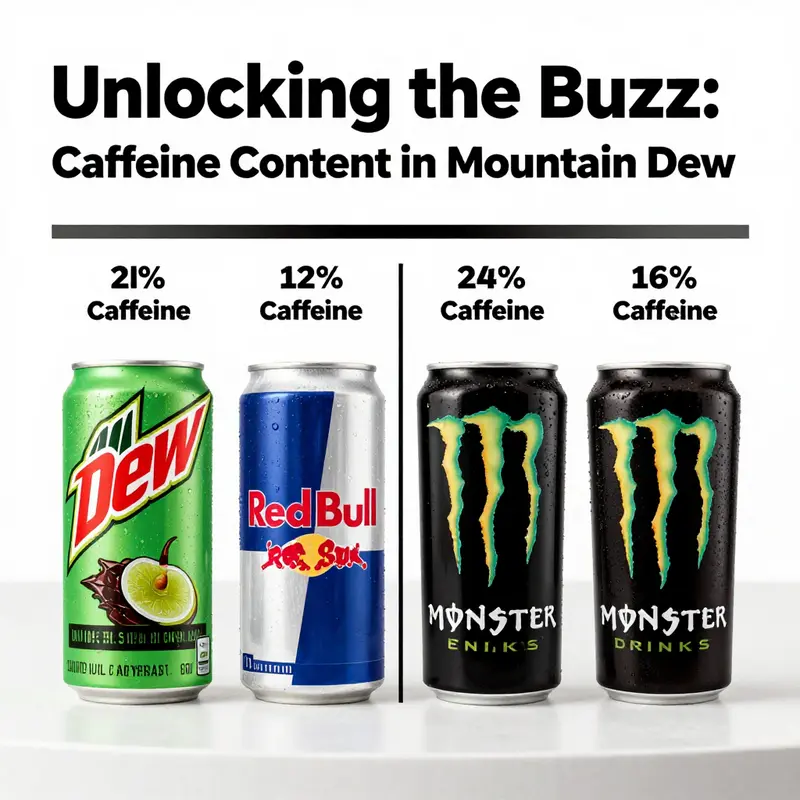
Understanding these figures is more than a matter of counting milligrams. It helps create a context for daily caffeine consumption, particularly when you compare Mountain Dew to other popular caffeinated beverages. For instance, a standard 8.4-ounce can of Red Bull is often cited as containing about 75 to 80 mg of caffeine, a higher concentration than the standard Mountain Dew in a similar volume. A 240-ml can of a leading energy drink, another common comparison, commonly carries around 86 mg of caffeine. In practical terms, the Mountain Dew baseline sits near the middle-to-lower end of adult energy-beverage caffeine levels, offering a measurable lift without the intensity associated with many energy drinks. This positioning can be attractive to individuals who want a noticeable but not overwhelming caffeine experience or who are balancing caffeine intake with other beverages as part of a daily routine.
The reasons behind this consistent caffeine level across the main line of flavors are rooted in both branding and consumer expectation. The product line is built around a recognizable energy pulse that complements the drink’s signature citrus flavor profile. The standard formula provides a reliable energy signal that consumers can count on, particularly when they are choosing a familiar flavor preference. This predictability is valuable for people tracking caffeine intake or for those who want to structure their day with an energy cycle that aligns with their schedules. While the brand experiments with additional variants—some offering zero sugar or reduced calories—the caffeine baseline remains a constant anchor, ensuring that even healthier or lighter versions do not dramatically alter the energy outcome per serving.
Of course, individual reactions to caffeine vary, and that variability can color the perceived intensity of the boost. Some people metabolize caffeine quickly, experiencing a sharper onset and shorter duration, while others feel a more gradual lift that lasts longer. Body weight, tolerance built from regular use, and concurrent dietary factors like sugar intake can influence how a given person experiences the caffeine kick. For many, a standard Mountain Dew serving provides a dependable lift without an overwhelming surge, which can be preferable in contexts where a gentler, more manageable energy boost is desirable. In other cases, especially when days demand sustained focus or physical stamina, the higher-end payload of a Kickstart-like variant may be the more appropriate choice, delivering a robust caffeine signal that helps maintain alertness over a longer period.
To put it plainly, the caffeine content in the standard Mountain Dew lineup offers a balance that aligns with a broad spectrum of consumer needs. The typical 55 mg per 12-ounce serving stands as a reliable reference point, supporting a straightforward intake calculation for people who monitor caffeine across their day. The slight nuance between 54 mg and 55 mg in a 330 ml can translates into an almost negligible difference in real-world effects, but it is still a useful detail for those who are precise about their consumption. Meanwhile, the existence of a much stronger option within the same family—Kickstart—demonstrates that the brand can scale its caffeine content to meet different situations without straying from the core flavor identity that fans expect.
If you are charting caffeine intake across beverages, it helps to keep in mind that the flavor variety you choose within the standard Mountain Dew family does not significantly alter the caffeine punch on a milligram-per-serving basis. Whether you favor Original, Code Red, or Live Wire, you can anticipate a similar stimulation level per can, with the caveat that regional packaging or limited editions may introduce minor discrepancies. The Zero Sugar variant confirms this pattern as well, preserving the same caffeine footprint while offering a sugar-conscious option for those who want a lighter metabolic footprint in terms of calories and sugar. This consistency is not merely a statistical artifact; it is a practical feature that enables consumers to plan their caffeine exposure with confidence, especially when combined with other caffeinated sources in a given day.
For readers who want a quick, concrete reference—especially those who compare beverages side by side in real time—the numbers can be summarized as follows: a standard 12-ounce can of the baseline Mountain Dew lineup carries about 55 mg of caffeine, while a similarly sized can of Mountain Dew Kickstart contains around 120 mg. In practical terms, that means the Kickstart option roughly doubles the caffeine load, delivering a more pronounced stimulant effect that some users may seek for specific tasks or activities. In contrast, the sugar-free variant retains the same caffeine intensity as the sugared versions, making it a convenient choice for caffeine-conscious consumers who want to avoid extra calories while still obtaining a familiar energy lift. These patterns enable a simple mental model: if you are after a reliable morning pick-me-up in a familiar flavor, the standard 55 mg-per-12-ounce formula suffices; if you need a more aggressive energy signal, a higher-caffeine option within the same family is readily available.
As with any caffeine-dependent routine, it is wise to consider personal limits. Health guidelines typically emphasize that most healthy adults can safely consume up to roughly 400 mg of caffeine per day, though individual tolerance varies. Pregnant individuals, people with certain medical conditions, or those taking medications that interact with caffeine should consult a healthcare professional about appropriate limits. Even within these boundaries, it is prudent to track caffeine from all sources, including coffee, tea, other soft drinks, and energy products, to avoid unintentional overconsumption. When you view Mountain Dew as part of a broader caffeine portfolio, its role becomes clarifying rather than complicating: a moderate, predictable dose in a familiar flavor can serve as a useful component of daily routines, while more potent options within the same family can be reserved for moments when a stronger lift is truly beneficial.
For readers who enjoy making connections across related topics, a natural point of reference emerges when you examine the broader landscape of caffeinated beverages and their comparative intensities. Within the same family of drinks and the extended category of citrus-forward, non-coffee caffeinated options, the standard Mountain Dew variants hold a mid-range position. They offer more caffeine than many classic soft drinks but sit below the high-end energy drinks that target heavy caffeine users. This relative standing matters for people who want a boost without stepping into the domain of rapidly escalating caffeine intake. It also informs conversations about daily caffeine budgeting, the environmental and social contexts in which these beverages are consumed, and the trade-offs between flavor-forward experiences and stimulant intensity. In short, the standard Mountain Dew lineup delivers a reliable, moderate uplift that harmonizes with its bright, energetic branding, while its Kickstart sibling demonstrates the brand’s capacity to scale caffeine content when stronger investment in alertness is desired.
If you are curious about how this information translates into practical decisions, consider this: the caffeine level in a typical Mountain Dew serving is high enough to be noticeable but not so extreme as to demand careful monitoring for most adults. In daily life, that means a can or two in a given day can contribute to wakefulness and focus, especially in late mornings or during mid-afternoon slumps. It can also interact with physical activity in ways that some people appreciate, providing a perceptible lift during workouts or long study sessions. Yet, for those sensitive to caffeine, even a single can can feel stronger than expected, and that awareness is a meaningful part of mindful consumption. The consistency across flavors makes it easier to predict how a chosen variant will behave in terms of energy, which can reduce guesswork when planning your intake around workouts, classes, or meetings.
For readers exploring this topic further, an accessible, topic-relevant resource that expands on caffeine content across Mountain Dew variants and similar beverages can be found at the linked reference caffeine-content-mt-dew. This internal source offers a concise, consumer-friendly breakdown that complements the figures discussed here, helping readers situate the Mountain Dew numbers in a broader caffeine landscape. In the same spirit of cross-charting, the broader conversation about where Mountain Dew sits in relation to other caffeinated beverages—without losing the flavor-focused context—can be enriched by considering both the fixed caffeine baseline and the occasional, higher-strength option within the family. The bottom line remains clear: for routine caffeine planning, the standard Mountain Dew variants present a dependable, well-defined caffeine profile that aligns with consumer expectations and daily needs.
External resources that situate these numbers within wider safety and consumption guidelines can provide additional context for readers who want to anchor their decisions in official recommendations. For those seeking a regulatory or medical frame, an external resource such as the U.S. Food and Drug Administration’s caffeine information can offer authoritative notes on acceptable intake levels, general cautions, and how caffeine interacts with nutrition labeling and labeling disclosures. This broader perspective helps readers translate milligrams into practical, daily choices that fit their personal health goals and lifestyle requirements.
External resource: https://www.fda.gov/food/food-labeling-nutrition/caffeine-information
The Neon-Green Buzz: Caffeine in Context
Caffeine is a familiar shorthand for energy, a quick map of wakefulness that fits on a can label. In the neon-green citrus soda, a typical 12-ounce serving carries about 54 milligrams of caffeine, with a commonly cited range from roughly 42 to 55 milligrams per serving. This places it above many standard soft drinks but below high caffeine energy drinks, making it a mid range option for a daily lift.
Beyond the number, the beverage’s caffeine timing and sugar content shape how people feel the effect. The effect is not uniform; tolerance, sleep needs, and overall diet influence how noticeable the lift is, and how long it lasts. Reading the label helps consumers balance caffeine with other sources and plan a day that aligns with their goals.
In short, this neon-green soda sits in a middle ground: more energized than a typical cola, but not reaching the higher caffeine levels found in energy-focused beverages. There is value in knowing the exact milligrams per serving and in considering the total caffeine load across all sources.
Between Buzz and Balance: Decoding How Much Caffeine in Mountain Dew Really Affects Your Day
Caffeine is the most talked-about molecule in many beverage discussions, and Mountain Dew sits squarely in the middle of the conversation. For some, it’s a reliable morning kick that helps them shake off sleep; for others, it’s a favorite afternoon pick-me-up that blends with a craving for sweetness. The truth, as researchers and daily users alike recognize, is that the caffeine in Mountain Dew is a real factor—one that interacts with your physiology, your daily routine, and the sugar-laden profile of the drink itself. When you peel back the layers, you find a straightforward, data-driven landscape: caffeine content varies by product and region, a typical serving sits in a moderate range for a caffeinated beverage, and safety guidelines depend on who you are and how much you’re consuming across the day. This chapter moves through those layers in a way that keeps the numbers meaningful without getting lost in measurements, ratios, and acronyms. It is not a treatise on every possible variant, but a careful, practical map of what the caffeine in Mountain Dew means for health, daily planning, and personal limits.
First, consider the baseline: the classic Mountain Dew profile most people encounter. In its standard 12-ounce form, Mountain Dew generally clocks in around 55 milligrams of caffeine per serving. If you happen to grab a larger 355-milliliter can, the caffeine content is in a similar range, often cited as roughly 42 to 55 milligrams depending on the exact product line and regional formulation. This is not an extreme caffeine load by energy-drink standards, but it is noticeably higher than many traditional sodas and clearly nonzero for someone who prefers to zero in on caffeine as a daily limit rather than a sporadic indulgence. The value of 55 mg per 12-ounce serving, in particular, has become a kind of reference point for readers who are comparing Mountain Dew to other common beverages—like a standard soft drink, a cup of coffee, or an energy shake—because it places Mountain Dew inside a familiar spectrum rather than as an outlier.
To appreciate these numbers in context, it helps to widen the lens beyond a single can. Fluently reading caffeine content means recognizing that variant flavors and formats can shift the tally. A number of Mountain Dew products carry different caffeine profiles: some line extensions and regional variants trend toward the upper end of the 42–55 mg per 12-ounce spectrum, while others may drift lower or higher depending on formulation decisions made for taste, marketing goals, or regulatory alignment. A notable example within the broader Mountain Dew family is Mountain Dew Kickstart, which is widely described as containing significantly more caffeine than standard Mountain Dew—roughly 120 milligrams per 12-ounce can. That level sits near the upper end of what many beverage-makers consider acceptable for a single serving and underscores a crucial point for readers: caffeine content in Mountain Dew is not a fixed figure across the board; it scales with the product line and intended use, sometimes approaching what you might expect in an energy drink rather than a simple soda.
The practical implication of these variations is not just a curiosity about numbers but a personal budgeting question: how much caffeine am I consuming from Mountain Dew, and how does that fit into my day? The standardized 12-ounce can with about 55 mg provides a clear baseline. If someone drinks two such cans in a day alongside coffee or tea, the cumulative caffeine intake rises quickly. Consider this calculation as a rough guide: two 12-ounce Mountain Dew servings equal about 110 mg of caffeine from that beverage alone. Add a cup of coffee at 95–120 mg and perhaps a cup of tea at 30–60 mg, and the daily total can edge toward significant thresholds before you realize it. Of course, these are approximate numbers, reflecting typical formulations rather than a universal constant. Regional differences, product variants, and even the time of day can tilt the total differently. The key takeaway is straightforward: Mountain Dew contributes a nontrivial caffeine load, and it’s one piece of a larger caffeine puzzle in daily life.
Health guidance around caffeine is anchored by authoritative recommendations that help people decide what amounts feel safe for them. The U.S. Food and Drug Administration has established a general daily limit of about 400 milligrams of caffeine for most healthy adults. This benchmark provides a practical framework: it indicates that within the typical range of Mountain Dew consumption, most adults can stay within what is considered a conservative upper limit for caffeine intake. For example, seven 12-ounce Mountain Dew servings would, in theory, stay within that 400 mg ceiling. Yet, this arithmetic can be dangerously simplistic when real life intersects with sugar, sleep patterns, and overall health status. The sugar content in Mountain Dew compounds the risk profile because high sugar intake carries its own set of health considerations, ranging from weight management challenges to blood sugar fluctuations and dental health concerns. A standard 12-ounce can of Mountain Dew carries about 46 grams of sugar. Combine that with caffeine, and you have a beverage that can deliver a double-edged effect: stimulant alertness on one hand, plus metabolic load and potential energy crashes on the other. This combination is precisely why many health professionals advocate for mindful consumption rather than relying on caffeine alone to keep alertness high.
The concerns become more nuanced for individuals who may be more sensitive to caffeine. Pregnant people, individuals with anxiety disorders, and people with certain heart conditions are often advised to limit caffeine intake more strictly. In those cases, daily targets may be closer to 200 milligrams or less, and even a single Mountain Dew can push someone beyond a comfortable limit depending on the rest of their diet and physiology. The health psychology here is simple but powerful: caffeine is not a single-dimensional stimulant for everyone. Its effects depend on timing, concurrent medical considerations, and the body’s unique tolerance and sensitivity. For example, caffeine can interfere with sleep if consumed later in the day, which in turn can cascade into daytime fatigue, reduced cognitive performance the next day, and a need for more caffeine—a cycle that many readers will recognize from personal experience.
Beyond the caffeine tally, the structure of Mountain Dew’s sweetness matters. Sugar, when consumed in tandem with caffeine, can alter the subjective experience of energy. The sweetness can mask jitters or anxiety a bit, or it can amplify a crash later on if blood sugar swings occur. For people watching calories or dental health, the sugar content is a separate factor to weigh. Health guidelines often suggest balancing caffeine choices with broader dietary patterns, especially for those managing weight, insulin sensitivity, or cardiovascular risk factors. The chapter’s core idea is simple: caffeine is part of Mountain Dew’s appeal, but the product’s sugar load and its place in a person’s overall daily intake are equally important in determining whether such a beverage is a good daily fit.
How does this translate into day-to-day decisions? If you’re trying to keep caffeine within safe bounds while enjoying Mountain Dew, a practical approach is to map out your beverages for a day. Start with your non-across-the-board caffeine sources—coffee, tea, chocolate, and certain teas—and tally their approximate milligrams. Then add Mountain Dew’s contribution from the can or can-and-repeat you might plan to drink. If the day involves multiple caffeinated drinks, consider staggering them so you’re not sipping the stimulant continuously for hours. Hydration matters too; caffeine’s diuretic profile in high quantities is modest for most people, but staying hydrated can help offset any mild dehydration that sometimes accompanies caffeinated consumption. For many readers, the moderation rule is the simplest and most reliable: enjoy Mountain Dew as part of a varied beverage plan rather than relying on it as a steady, all-day energy source.
A note on the numbers themselves: when you encounter claims like “55 mg per 12-ounce can,” remember that this is a representative figure. The precise mg can shift slightly by flavor and by the region where the product is sold. The flavor profile that appeals most to you can sometimes tilt caffeine content by a small amount due to formulation tweaks. This is why, in real-world shopping, people often notice slight differences between a can bought in one city and another. Those small differences add up if you monitor caffeine intake closely, but they rarely create dramatic deviations from the baseline range described here. The important thing is to start from an informed baseline and then apply your own daily rhythm and health considerations to decide how much is best for you.
If you’d like a deeper dive into the caffeine content of Mountain Dew and how it compares with other popular beverages, you can explore a dedicated resource that surveys the caffeine load across Mountain Dew variants and other drinks. It offers a clear, side-by-side view of caffeine mg per serving across a selection of products. For context, a rough comparison helps: a standard 8.4-ounce can of Red Bull contains about 75–80 mg, while a 240 ml can of Monster energy drink clocks in at around 86 mg. Those figures often feel surprisingly close to Mountain Dew’s per-serving caffeine, though the sugar content and flavor profiles differ, shaping the overall energy effect and the post-consumption experience. This landscape helps readers gauge not just how much caffeine Mountain Dew contains, but how its punch stacks up against other familiar beverages.
As you weigh whether Mountain Dew fits into your daily regime, consider not only the caffeine number but how your body responds to it. Some people notice improved focus or a mild lift in mood after a Mountain Dew, while others report jitters, heightened heart rate, or trouble sleeping if they drink it too late in the day. Sleep disruption is a particularly important factor for many, because a single late-afternoon Mountain Dew can linger into the night in ways that are not immediately obvious when you’re planning your caffeine for the morning. If your days end late or if you’re particularly sensitive to stimulants, it can be prudent to reserve Mountain Dew for earlier hours and rely on non-caffeinated beverages after dinner. This approach protects sleep quality while still allowing you to enjoy the product during the hours when a sugar-and-caffeine lift might be most welcome.
The idea of “safe” caffeine consumption is not a one-size-fits-all prescription. It is a personalized calculation that should account for life stage, existing health conditions, and daily routines. The FDA’s guideline of a 400 mg daily limit represents a general ceiling for healthy adults, but it is not a universal guarantee of safety for every individual. Pregnant people, people with certain heart conditions, or individuals who experience anxiety or sleep disturbances may be advised to reduce that ceiling significantly. In those cases, even a single Mountain Dew could contribute to exceeding safe levels, depending on other caffeine sources and the individual’s metabolic rate. The best practice is to talk with a healthcare provider who can tailor advice to your health profile and daily lifestyle. This personalized approach complements the general numbers and helps readers translate data into behavior that supports long-term well-being.
Another factor to weigh is the broader nutritional profile of Mountain Dew. The drink’s caffeine content sits alongside its sugar and caloric load, which means that the beverage serves as both a stimulant and a quick source of calories. For daytime consumption, especially in the context of busy schedules or heavy physical activity, the quick energy can be welcome. For weight-management goals or conditions like diabetes, the sugar content invites careful planning and, in some cases, substitution with lower-sugar or sugar-free alternatives. The landscape of choices within the Mountain Dew family reflects a broader consumer trend toward balancing taste, stimulation, and health outcomes. Readers who are sensitive to either caffeine or sugar—and who live with medical considerations—will likely gravitate toward options that help them manage both signals coherently, rather than chasing a caffeine high alone.
From a practical standpoint, the core message remains: Mountain Dew is a caffeinated beverage with a meaningful but not extreme caffeine profile. For a typical adult, the standard 12-ounce serving sits in the midrange of caffeine content among everyday beverages, and variants exist that push the number higher or keep it closer to the baseline. The sugar content is the other major factor that cannot be ignored when evaluating the health implications of regular Mountain Dew consumption. For those who want to enjoy the drink while maintaining a calm, measured daily caffeine intake, the best path is to know the baseline, recognize how much you are already consuming from other sources, and plan your day so that caffeine delivery aligns with your circadian rhythm and health goals. The numbers are not a verdict; they are a map to a wiser relationship with caffeine, sugar, and alertness in the rhythm of daily life.
For readers who want a concise reference framed by the exact beverage you’re considering, a quick note to look up the specific Mountain Dew product you plan to drink can be useful. The caffeine content can vary by flavor and packaging, and a quick check can prevent the surprise of a higher-than-expected number when you’re tallying daily intake. If you’re curious about the caffeine content of Mountain Dew in a specific product line, there is a resource that compiles and explains these details in a user-friendly way. It presents comparative data across products, helping you place Mountain Dew in the broader caffeine landscape and decide what best aligns with your health priorities. See Caffeine content MT Dew for a deeper breakdown and cross-variant comparisons that can sharpen your everyday choices.
As this chapter weaves together numbers, health guidelines, and practical advice, it’s worth returning to the broader takeaway: caffeine in Mountain Dew is real and measurable, but its safety and desirability depend on context. For most healthy adults, staying within the 400 mg daily limit and balancing caffeine with ample hydration and nutrient-dense foods is a sensible default. For those with heightened sensitivity or special health considerations, a more cautious stance—potentially limiting to a single can per day or opting for lower-caffeine or sugar-free alternatives—often makes more sense. The conversation isn’t about demonizing a popular beverage; it’s about understanding what you’re putting in your body, how it interacts with your daily routine, and how to navigate a beverage-filled life with clarity and care. In the end, the numbers illuminate a path toward informed choice, not a prescription for inconvenience. The decision rests with you: how Mountain Dew fits into your daily energy strategy, how you manage sugar load, and how you harmonize caffeine with the rest of your health goals.
External resource: For a broader regulatory and health context on caffeine consumption, you can refer to the U.S. FDA guidelines, which provide comprehensive information on safe limits and considerations across different populations. https://www.fda.gov/food/food-additives-petitions/caffeine-new-product-ingredients
Final thoughts
In summary, understanding the caffeine content in Mountain Dew is essential for business owners looking to navigate the beverage market effectively. With varying caffeine levels across its products and comparisons to other popular drinks like Red Bull and Monster, it’s crucial to grasp how these factors can influence consumer choices. Furthermore, by acknowledging health recommendations regarding caffeine consumption, businesses can promote responsible drinking habits while catering to consumer demands. Awareness of these elements can drive informed decisions in product offerings and marketing strategies, ultimately benefiting both your business and your customers.