
As caffeine consumption continues to influence consumer behavior in the beverage market, understanding the key differences between popular options like Mountain Dew and coffee becomes essential for business owners. This article explores the intricacies of caffeine content, health implications, preferences, variability across brands, cultural contexts, and regulatory standards that shape consumer choices. By delving into these topics, businesses can strategically position their offerings to meet the demands of caffeine enthusiasts and casual consumers alike.
Jolt in a Can, Charge in a Cup: A Deep Dive into Caffeine in Mountain Dew vs Coffee
Caffeine has become a quiet compass for how people pace their days, split products into categories, and calibrate the energy they need for study sessions, deadlines, or long drives. In the landscape of caffeinated choices, Mountain Dew and coffee sit on opposite ends of the spectrum: one is a carbonated, sugar-laced beverage designed for quick flavor-led jolts, while the other is a broader category of brewed beverages that can be tailored for strength, roast, and ritual. When you start to compare them, the first thing that matters isn’t just the mg of caffeine in a given container. It’s how much you’re drinking, how you’re drinking it, and what you’re hoping the caffeine will do for you in a given moment. A numerical breakdown helps illuminate these dynamics, but it also reveals a larger truth: caffeine’s impact is ultimately a function of serving size, absorption, and context, as much as it is about exact milligrams per serving. And in that sense, Mountain Dew—regular, Diet, and the various flavors that echo its citrus-tinged baseline—holds a distinctive place in the caffeine conversation. The beverage’s standout characteristic is its stamina within a soft drink framework: a 12-ounce can generally delivers about 54 milligrams of caffeine, a figure that remains steady across several standard variants. This makes Mountain Dew one of the higher-caffeine soft drinks, a claim that often surprises consumers who associate sodas with lighter stimulant profiles. It’s worth noting that Diet Mountain Dew maintains the same approximate caffeine level per 12-ounce serving, a deliberate choice that preserves caffeine as a consistent energy cue even as the product’s calorie load changes. Across the family—Code Red, Live Wire, Voltage—the caffeine footprint per 12-ounce serving stays around 54 milligrams, an attribute that positions Mountain Dew as a reliable energy source within the soft-drink aisle, especially for those who crave the drink’s iconic sweetness and fizz without stepping into fortified beverages or energy drinks. This consistency across variants matters. It means that if your gauge for caffeine is the can you’re picking up at a convenience store, you’re dealing with a relatively predictable power curve. It’s a different story when you move to coffee, where the caffeine payoff for a standard serving is not only larger but also more variable depending on roast, grind, and extraction method. A classic eight-ounce cup of brewed coffee—an everyday benchmark—feeds the body with roughly 95 to 100 milligrams of caffeine. That’s already a sizable margin above a single Mountain Dew can. The comparison becomes even more telling when you parse the numbers by the unit most people actually drink. An espresso shot, about one ounce, stacks up at around 63 milligrams of caffeine. That means a single, concentrated shot contains more caffeine than a 12-ounce Mountain Dew, yet it occupies only a fraction of the volume. It is here that the idea of “per-serving” flavor and energy certainty reveals its complexity. Espresso’s per-ounce density is high, but most people don’t drink a single ounce and call it a day. Coffee culture has trained a habit of multiple increments—larger mugs, refills, and the ritual of savoring a brew over time—partly shaping how caffeine affects alertness and fatigue on different trajectories than a can of soda does. In a straightforward numerical sense, coffee is more caffeinated per standard serving than Mountain Dew. The commonly cited range of 80 to 100 milligrams in an eight-ounce cup dwarfs the roughly 54 milligrams found in a Mountain Dew can. That means coffee is typically about 1.5 to 2 times stronger in caffeine content per conventional serving. Yet a fairer comparison must account for volume. Two 12-ounce Mountain Dew cans yield about 108 milligrams of caffeine, which is in the vicinity of a cup of coffee’s caffeine yield, especially at the lower end of the coffee spectrum. If you’re transitioning from Mountain Dew to coffee, those two cans can accumulate caffeine in a way that starts to resemble a full cup’s intake, while also delivering two distinct sensory experiences—fizzy sweetness versus the aroma and warmth of brewed coffee. The mathematics paints a compelling picture: the energy customers chase from Mountain Dew is the energy of a quick, flavorful lift delivered in a way that aligns with fast-paced, snack-friendly consumption. The energy we feel from Mountain Dew is often inseparable from the rapid intake of sugar and the carbonation that accelerates mouthfeel and sensory impact. Caffeine in this context is a reliable accelerant, but it’s not the sole driver of the perceived lift. Coffee, by contrast, carries caffeine in a more concentrated form and is commonly consumed in a way that supports sustained focus, ritual, and, for many, social or contemplative moments. The contrast is not merely about mg per serving; it’s about how the beverage is integrated into the broader rhythm of a person’s day. And that rhythm, in turn, shapes how strong the perceived effect is—whether the caffeine acts like a quick, bright spark from a Mountain Dew or a more enduring, steady beacon from a cup of coffee. To add nuance, it’s worth acknowledging that the numbers do shift with different products and preparation methods. In Mountain Dew’s lineup, the caffeine range per 12-ounce serving remains one of the highest among major soft drinks, with most standard variants hovering around the mid-50s milligram mark. This steady benchmark matters because it sets a predictable baseline for consumers who rely on a citrusy lift that lands with a familiar splash. On the coffee side, caffeine content is more fluid. The eight-ounce benchmark of 95 to 100 milligrams gives a sense of typical strength, but the reality is that roast level, grind size, grind time, water temperature, and extraction technique can nudge that value higher or lower. A lighter roast, for instance, often yields a different extraction profile than a dark roast, and a meticulously prepared pour-over can bring different caffeine intensities than a robust drip. The upshot is that coffee’s caffeine footprint is not just larger; it’s more adaptable to the consumer’s preference for intensity, flavor, and ritual. This adaptation, in practical terms, translates into a week’s worth of daily choices. For gamers, students, or anyone needing a jolt during long sessions, Mountain Dew presents a familiar flavor and a fast, accessible energy source. The sugar content adds another layer to the experience, contributing to a quick energy surge that coincides with taste and mouthfeel. In such situations, caffeine works in tandem with the drink’s other ingredients to shape the overall sensation. By contrast, someone seeking a longer, perhaps more focused uplift might reach for coffee, which offers versatility in preparation—from a brisk, caffeinated espresso to a smooth, high-caffeine brew with a lengthier finish. Even when comparing the same caffeine amount across beverages, the timing and quality of the effect can differ. Coffee’s caffeine often arrives with a more gradual onset, framed by the sensory complexity of aroma and warmth, while Mountain Dew’s caffeine comes wrapped in a bright, sweet, and carbonated experience that can feel more immediate and ephemeral. Any consumer who tries to align caffeine intake with daily goals should consider both the numerical facts and the consumption context. If the goal is a quick wakefulness during a quick break, a Mountain Dew might deliver the desired kinematic effect—fast, flavor-forward, and easy to grab. If the objective is a longer period of concentration, a cup of coffee, prepared to taste, can provide a steadier, more sustained lift across work or study blocks. The data are not merely abstract numbers. They align with real-world habits—how people reach for an energy source in a cafeteria line, a vending machine, or a kitchen at a desk. They also underscore a practical point about volume: the difference between a single can and a single cup matters, but the cumulative effect of multiple servings can converge to similar levels of caffeine, especially when the day’s schedule requires several doses of alertness. This convergence helps explain consumer behavior: in contexts where pace, flavor preference, and convenience dominate, Mountain Dew remains a strong choice, while coffee continues to be the standard-bearer for those who want a customizable, robust caffeine profile. For readers who want a straightforward reference to the numeric landscape, the comparison is clear: Mountain Dew around 54–55 mg per 12-ounce can versus coffee around 95–100 mg per 8-ounce cup, with espresso at roughly 63 mg per 1-ounce shot. The difference in minting logic—how people drink versus how much caffeine is present—shapes both personal decisions and broader dietary patterns. If you’re curious about these numbers in a concise, authoritative way, you can explore a focused discussion on Mountain Dew’s caffeine content here caffeine content of Mountain Dew. That resource provides a quick reference point for the baseline figures that anchor this chapter’s comparison, while the broader context of caffeine in beverages reinforces how these figures translate into everyday choices. In the end, the takeaway is not simply which drink contains more caffeine but how those amounts align with how a person wants to experience energy. The same milligrams can feel very different depending on whether they arrive in a sugary, fizzy chase or a grounded, aromatic cup crafted for steadiness. The choice becomes a reflection of personal rhythm and the moment’s demand, rather than a single universal rule about caffeine alone. For readers seeking further insight, an external reference that reviews Mountain Dew’s caffeine content offers an independent check on the figures discussed here: https://www.cafely.com/mountain-dew-caffeine-content/. This external resource helps situate the numbers within a broader public-facing reckoning about caffeine in popular drinks, complementing the numerical breakdown with additional context and validation. As you move forward in this article, you’ll see how these foundational numbers thread into broader themes: how caffeine interacts with sugar and carbonation, how different consumption contexts alter the perceived effect, and how consumers can calibrate their choices to support study, work, or recreation without overstepping personal limits. The texture of caffeine’s impact is shaped not just by the dose, but also by how and when it is consumed. Mountain Dew offers a reliable, flavor-forward option for those who want a rapid, noticeable lift in a familiar format. Coffee, with its breadth of preparation and its stronger per-serving content, invites a different relationship with energy—one that often rewards a slower entry and a longer burn. Both pathways have their place in a well-rounded approach to daily caffeine management, and understanding the numerical differences helps shoppers and readers make more informed decisions that align with their goals and their taste.
Buzz, Balance, and the Bottle: Understanding Caffeine in Mountain Dew versus Coffee—and What It Means for Health and Habit
Caffeine is a familiar currency in the modern diet, traded daily in the ledger of quick energy, focus, and the occasional jitters. When we compare a popular citrus-flavored soda with a cup of brewed coffee, the math is simple on a page: caffeine per serving, the size of that serving, and what arrives alongside it in the blend of sugars, acids, and rituals. But the story that unfolds as you sip, or chug, depends not only on milligrams but on how those milligrams are delivered, what else travels with them, and how a person’s body responds to the combination. In the case of Mountain Dew and coffee, the numbers are telling and the implications are worth weighing in the broader context of daily energy, sleep, dental health, and mood.
A 12-ounce can of Mountain Dew delivers about 54 milligrams of caffeine. That figure, consistent across several variants, places it among the higher end of caffeinated soft drinks, yet it sits well below the caffeine punch of an eight-ounce cup of brewed coffee, which typically contains about 95 to 100 milligrams. Even a single shot of espresso, roughly one ounce, comes in around 63 milligrams—more than a can of Mountain Dew, but consumed in a far smaller volume. These numbers matter, not merely as trivia, but as a guide to how energy is delivered to the body. A can’s energy is spread across a familiar, fizzy sweetness and a citrus punch, while coffee’s energy is concentrated in a darker brew that often carries a broader constellation of compounds beyond caffeine. When you multiply Mountain Dew’s 54 milligrams by the volume you drink—two cans, for instance—the caffeine exposure climbs to roughly 108 milligrams. That intake begins to align with, or even exceed, a single standard coffee serving, depending on the brew and the cup size, and it highlights how volume can shift caffeine exposure as much as the beverage type does.
Behind the numbers lies a nuance: caffeine does not operate in a vacuum. It interacts with the other ingredients and the way a drink is consumed. Mountain Dew’s caffeine arrives alongside a relatively high dose of sugar—about 46 grams per 12-ounce can—a quantity that rivals the sugar load of many sweetened beverages. The combination of caffeine with such sugar creates a rapid rise in blood glucose, followed by a potential crash that can feel more abrupt than the steadier energy lift some associate with black coffee. The body’s response to caffeine is shaped by this sugar context as well as the drink’s acidity. Mountain Dew carries notable acidity from citric and phosphoric acids, which, over time, may contribute to dental enamel erosion and a higher risk of cavities when consumed habitually. These risks intertwine with caffeine’s stimulating effects, so a person might feel a sharp jolt followed by a period of fatigue or restlessness that is intensified by the sugar crash and the acid on teeth.
In contrast, brewed coffee offers caffeine in a context that many people perceive as more durable and less crash-prone, especially when consumed without added sugar. The absence or reduction of sugar shifts the energy profile from a rapid glucose spike to a steadier, more prolonged alertness. Coffee also contains a suite of bioactive compounds, such as chlorogenic acids and other polyphenols, that can influence metabolic and inflammatory markers in ways that are not present in most standard sodas. While the caffeine dose in coffee is higher per standard serving, the other components and the typical accompanying habits—whether a plain cup, a splash of milk, or a carefully measured pour-over—shape the overall metabolomic and subjective experience of caffeine. This means that two beverages with similar caffeine counts can feel quite different in how they influence mood, appetite, sleep patterns, and even perceived energy.
The health implications extend beyond the caffeine meter. Caffeine itself, when consumed in moderation, may support alertness and cognitive performance for many adults. Yet the context matters. For Mountain Dew, the sugar load and acidity amplify considerations about dental health, metabolic risk, and weight management if intake becomes habitual. High sugar intake can contribute to tooth decay and, over time, influence insulin response and weight trajectory in ways that differ from the metabolic impact of caffeine alone. Coffee, particularly when consumed without added sugar or with modest dairy or plant-based alternatives, tends to present fewer of these sugar-related concerns, and its antioxidant components invite interest from researchers examining potential protective associations with certain chronic diseases. That said, caffeine can still disrupt sleep, elevate anxiety, or provoke jitters in sensitive individuals, especially when intake is late in the day or when combined with high-sugar, high-acid drinks that provoke rapid physiological shifts.
Regulatory and public-health dimensions further color the comparison. Mountain Dew, as a manufactured beverage from a major beverage company, has faced scrutiny around additives, including artificial colors and previously, some controversial components. Even when formulations evolve, the broader questions about a sugary, caffeinated beverage—its impact on dental health, metabolic health, and long-term appetite regulation—remain topics of ongoing policy and public discourse. Coffee, by contrast, is a natural product with minimal processing and a longer, storied history of cultural use and research. It does not typically carry the same level of additive controversy that has accompanied some soft drinks. This difference in framing matters to consumers who want transparency and consistency in what they are putting into their bodies, beyond the caffeine content alone.
From a consumer behavior standpoint, taste, ritual, and health priorities guide choices as much as the caffeine numbers do. Mountain Dew appeals to those seeking a bold, sweet, citrus-flavored lift—often in social or high-activity contexts. Its energy comes with a quick, familiar flavor profile that complements moments of gaming, sports, or rapid energy needs. Coffee, meanwhile, often serves as a daily ritual, valued for the perceived depth of flavor, the opportunity for mindful preparation, and the potential for sustained, caffeine-driven alertness with less of a sugar rollercoaster. The shift toward health-conscious consumption has nudged many away from high-sugar beverages, favoring black coffee or coffee with minimal sweeteners. Yet personal preference remains central: some people prefer the immediate, energetic jolt that a sugary, carbonated drink provides, particularly when caffeine is only part of a broader sensory experience that includes taste and texture. In this sense, caffeine acts not just as a pharmacological stimulant but as a cue in a broader pattern of eating, drinking, and daily rhythms.
For those navigating these choices, the practical takeaway rests on mindful serving sizes and a clear eye on what accompanies the caffeine. If the aim is rapid energy without a pronounced sugar spike, coffee—especially when consumed with little or no added sugar—offers a straightforward profile: a higher caffeine dose per standard serving, a leaner caloric footprint, and a body of evidence suggesting potential health benefits when consumed in moderation. If one values sweetness, a familiar flavor, and a quick, plentiful caffeine dose in a single, convenient can, Mountain Dew can satisfy that brief but powerful demand. Yet this choice comes with a higher sugar load and a more acidic profile that can affect teeth and metabolic balance over time. The clearer path for long-term energy stability and health may involve coffee with controlled sugar or alternative flavorings, or lower-sugar caffeinated beverages that maintain caffeine without tipping the scales toward sugar-driven energy swings.
In practical terms, readers who want to deepen their understanding might explore how caffeine content translates into daily intake across different beverages and serving sizes. The same absolute amount of caffeine can feel quite different depending on where it lands in the day, what else travels with it, and how the body processes both caffeine and sugar. For those who track caffeine for health reasons—whether to improve sleep, mood, or anxiety management—the numbers matter, but so too do the surrounding dietary choices, hydration, and overall meal timing. When in doubt, tuning in to personal responses—watching sleep quality, mood fluctuations, and appetite—offers a more reliable compass than any single score on a nutrition label.
If you’d like to explore one aspect of this topic in more depth, you can read further about how caffeine content varies across popular beverages in a dedicated analysis here: caffeine content MT Dew. This broader context helps anchor the caffeine discussion not only in milligrams but in how people use these drinks to fuel, socialize, or unwind. And for a broader safety perspective grounded in public health guidance, see the FDA’s caffeine questions and answers, which provide foundational considerations about safe intake levels and variability across individuals and life stages. External resources can help readers translate numbers into healthy habits, especially when caffeine interacts with sleep, stress, and metabolism. External resource: https://www.fda.gov/food/food-additives-petitions/cfsan-fda-caffeine-questions-and-answers
Dosing Dissonance: Unpacking Caffeine Variability Between Mountain Dew and Coffee Across Brands
The question of how much caffeine sits in a cup or a can rarely yields a single, universal answer. In fact, when you compare Mountain Dew—the bright, citrus-flavored energizer that many reach for on a long afternoon—with coffee, you face a layered picture: the dose you get depends on how you measure, what you drink, and when you drink it. In practical terms, the two beverages sit on opposite ends of a spectrum of predictability and variability. One is a product with a deliberately standardized formulation, the other a natural product whose stimulant content shifts with beans, roasts, and brewing methods. Understanding this distinction helps explain why caffeine feels so different from one sip to the next, even when you think you are chasing a similar energy lift.
On the most common, standardized serving, Mountain Dew delivers caffeine in a way that is easy to compare across retailers and packages. In the classic 12-ounce can, the caffeine content is widely cited near 54 milligrams. This figure appears consistently across several Mountain Dew variants, including the original formula and the popular Diet version, as well as widely available flavors that share the brand’s signature profile. The caffeine dose remains remarkably stable because the company controls the formulation and packaging with tight quality assurance. That stability—54 mg per 12-ounce can—gives a consumer a dependable baseline and a predictable energy response. It is the anchor of Mountain Dew’s identity as a caffeinated soft drink, one designed to deliver a quick lift without the variability that often accompanies natural products.
Coffee, by contrast, is a moving target. The caffeine you get from an 8-ounce cup of brewed coffee depends on a constellation of variables that begin with the green bean and end with your cup. The bean species and variety—Arabica versus Robusta—carry different caffeine loads. Roast level subtly shifts caffeine availability in the grind, while the grind size itself affects extraction efficiency during brewing. The brewing method—drip, pour-over, French press, or espresso—matters just as much, because each method maximizes or suppresses caffeine extraction in different ways. And serving size, of course, changes the math. A typical 8-ounce cup of brewed coffee contains roughly 95 to 100 milligrams of caffeine, a level that dwarfs the standard 12-ounce can of the citrus soda. A single shot of espresso, about 1 ounce, typically clocks in around 63 milligrams, reminding us that caffeine delivery can come in small, intense bursts rather than a longer, more uniform lift.
Beyond these baseline numbers lies a deeper, less predictable reality for coffee. Research into coffee caffeine content emphasizes substantial variability. Studies on soluble coffee show a broad range, with caffeine concentrations fluctuating widely by weight—from roughly 0.36% to 0.56% for instant coffees, and around 0.46% for roasted beans. In practical terms, that means the same “8-ounce cup” brewed using the same method and the same beans can still deliver noticeably different caffeine amounts depending on grind size, brewing duration, water temperature, and even the batch of beans. A separate PubMed-backed line of inquiry extends this unpredictability to commercial settings, noting day-to-day variability in caffeine concentrations among samples from major brands. Seventeen samples drawn from five brands revealed inconsistencies that challenged the notion of a fixed caffeine dose for a given cup. The lesson is clear: coffee’s stimulant content is a moving target, even when you try to standardize the process.
This variability matters not just for the math of caffeine intake, but for how people experience energy. When a consumer reaches for a cup, the expectation is often a reliable lift that matches past experience. With Mountain Dew, you can reasonably anticipate the effect given the fixed dose per serving, coupled with the beverage’s sugar and carbonation that can affect how quickly energy is perceived. With coffee, the lift can arrive more unevenly, sometimes stronger, sometimes milder, sometimes delayed by the rate of caffeine absorption in a given brew. The sensory and physiological responses—nervous energy, wakefulness, focus—often ride on how quickly caffeine enters the bloodstream, and that is shaped by brew method and serving size as much as by the caffeine content itself.
The contrast between beverages also becomes evident when you scale up. If someone drinks two 12-ounce cans of the citrus soda, they would ingest roughly 108 milligrams of caffeine—close to a standard one-cup measure of brewed coffee but arriving in a different temporal profile due to the soda’s carbonation and sugar. In coffee, drinking two cups, or a larger pour, often translates into a markedly different caffeine load and a different pattern of absorption. In short, the same caffeine tag line—“per serving”—can translate into very different experiences because the overall composition of the drink changes with each product and each preparation.
To navigate this terrain, it helps to separate the questions of dose and delivery. The dose question is about the milligrams of caffeine present in a given container or cup. The delivery question concerns how the caffeine is released into your system, which depends on how the product was produced and consumed. Mountain Dew’s frame is straightforward: its caffeine content is an intended, fixed parameter for each 12-ounce serving, reflecting a design choice to provide a steady energy boost with a predictable sugar-forward flavor profile. Coffee’s frame, on the other hand, is a tapestry of potential outcomes. Each variable—bean origin, roast, grind, brew time, water temperature, and even ambient conditions—can shift the final caffeine tally and the pace at which you notice the lift. The variability is not merely a curiosity; it has practical implications for people who track caffeine intake for health, performance, or personal comfort.
Recognizing this variability also enriches how we read nutrition labels and research summaries. The mountain of data in the literature shows a general trend: soft drinks marketed as caffeinated beverages are more tightly controlled in their caffeine content, whereas coffee—despite widespread cultural use—exhibits more biological and processing variability. This nuance matters when you are balancing caffeine alongside other dietary concerns, such as sugar intake, caloric load, or the timing of caffeine with respect to sleep. It also matters when you consider the broader landscape of caffeine-containing beverages, where the question often shifts from “how much caffeine is in here?” to “what is the most predictable way to dose myself for a given need?”
For readers seeking a concise reference on the topic, the current body of evidence supports the following synthesis: Mountain Dew, in its standard form, delivers about 54 milligrams of caffeine per 12-ounce serving, producing a consistent stimulant profile across the brand’s lineup. Coffee, in contrast, offers a higher average caffeine content per standard serving—roughly 95 to 100 milligrams per 8-ounce cup of brewed coffee—with substantial variability driven by botany, processing, and brewing technique. An espresso shot may deliver around 63 milligrams, a number that sits between the two beverages in absolute caffeine content but is consumed in a much smaller volume, emphasizing how serving size can drastically alter the perceived strength of the lift.
This landscape of variability also highlights an important caution for readers who rely on caffeine data for health or productivity strategies. Relying on a single value as a universal standard can mislead, especially when comparing beverages with different preparation realities. If you aim for a precise energy target, it is wise to consider not only the milligram content but also how your chosen preparation method affects absorption and onset. For those who prefer a predictable caffeine dose with less day-to-day fluctuation, a beverage with a defined formula offers appeal. For others who value the ritual and perceived intensity of coffee, embracing the variability may be part of the experience that keeps the routine compelling.
In this ongoing exploration, the role of consumer information remains central. The more transparent brands are about their caffeine content and the more researchers document the sources and ranges of caffeine in coffee, the better individuals can tailor their intake to fit personal goals and health considerations. If you want to explore one concrete example of how these measurements are framed in depth, you can check a focused discussion on caffeine content mt-dew for a compact, brand-referenced snapshot of the fixed-dose approach. caffeine content mt-dew.
Beyond the numbers, the practical takeaway is straightforward. Mountain Dew offers a steady, predictable caffeine dose per serving that is easy to plan around a day’s schedule. Coffee offers a greater potential range and a higher ceiling of caffeine per standard cup, but with more variability that can shift from day to day. If your goal is to manage caffeine intake with precision, leaning on beverages with fixed caffeine content can simplify tracking. If your aim is to maximize a caffeine hit in a single sitting, coffee—brewed or espresso—can deliver more punch, though with more uncertainty about the exact dose you ingest each time. Either way, understanding that variability helps you read labels more critically, choose preparation methods with intention, and align your caffeine strategy with your personal health and daily rhythm.
External resource for further reading: https://pubmed.ncbi.nlm.nih.gov/38159347/
Buzz, Ritual, and the Culture War: How Mountain Dew and Coffee Shape Our Caffeine Habits
Caffeine is more than a chemical; it is a mirror held up to our routines, communities, and the stories we tell about productivity, pleasure, and identity. The contrast between Mountain Dew and coffee is not simply a matter of milligrams per ounce but of social signals, contexts, and the ways a drink invites or discourages certain kinds of behavior. When we map caffeine onto culture, the numbers become a language of meaning: a can’s 54 milligrams, a cup’s 95 to 100 milligrams, or a single espresso shot’s 63 milligrams all carry implications about who is drinking, where, and why. The resulting picture is not one of a single winner in a caffeine race but of two distinctly useful tools in the modern consumer’s toolkit, each aligned with different moments, motivations, and aspirations.
Caffeine has long stood for wakefulness, efficiency, and focus in many Western contexts. Coffee, in particular, has accumulated a ceremonial aura. It is the beverage of early mornings and late-night study sessions, the social lubricant of meetings, and the ritual that marks transitions from sleep to wakefulness to action. In these scenes, caffeine becomes a catalyst for a certain disciplined mood: a quiet, almost scholarly alertness, a sense that time is available to be spent productively, a dignity in the daily routine of brewing, sipping, and moving through the day with intention. The culture surrounding coffee often treats the drink as a signal of seriousness—an everyday ritual that grounds professionals, students, and collaborators in a shared norm of preparation and progress. That cultural weight helps explain why coffee has persisted as a dominant global caffeine source even as alternative beverages proliferate.
Mountain Dew, by contrast, occupies a very different cultural niche. Its branding and flavor profile—bright citrus, high sweetness, fizzy texture—align with settings that prize immediacy, intensity, and momentary exuberance. The drink is closely associated with youth culture, gaming marathons, extreme sports, and late-night social scenes where the point is not measured by ritual but by rapid, sensory feedback. In these environments, caffeine is part of a broader package: a high-energy experience that blends taste, sweetness, and a perceived rush of stimulation with a social sense of belonging to a subculture that sees appetite and appetite’s thrills as legitimate forms of expression. The result is a form of caffeine consumption that is less about the quiet cultivation of focus and more about the intensified, shared experience of staying awake and engaged through a sequence of moments—whether a long gaming session, a concert after-hours, or a ride to the next adventure.
The numbers reinforce this cultural demarcation, even as they tempt with a simple, objective comparison. Mountain Dew, in its original and most common variants, contains about 54 milligrams of caffeine per 12-ounce can. That figure, sitting alongside other major soft drinks in the same family, is notable for being substantial in a beverage that is sweet and carbonated. It delivers a potent energy boost for a beverage of its kind, albeit one that travels with a significant dose of sugar and acidity. Coffee, on the other hand, typically delivers far more caffeine per serving, with brewed coffee averaging roughly 95 to 100 milligrams in an 8-ounce cup. An espresso shot—roughly 1 ounce—lands around 63 milligrams, which is comparable to a single can of Mountain Dew in caffeine content but is consumed in a minuscule volume. These figures are not merely numbers; they frame practical decisions about what beverage serves which moment, how much caffeine a person might want or tolerate, and what else a drink brings to the table in terms of flavor, calories, and context.
Viewed through the lens of consumption trends, the divergence deepens. Coffee has been part of a steady, global ascent toward higher quality, more deliberate coffee experiences. The market’s growth has often tracked broader wellness and precision—hand-poured brews, cold brews, lighter or more complex roasts, and a growing curiosity about origins and processing. Consumers increasingly seek control over sweetness, sugar content, and flavor notes, treating coffee as a craft rather than a mere source of caffeine. In parallel, the broader functional beverages category has expanded, even as traditional carbonated drinks mature and plateau. Within that landscape, Mountain Dew and its peers occupy a distinct space: a high-energy option with a defined brand personality that appeals to younger audiences, occasional indulgers, and those seeking a fast, communal rush rather than a refined ritual.
The interplay of taste, sugar, and caffeine creates a particular physiological and psychological effect. Caffeine alone acts on the central nervous system to enhance alertness, but the accompanying sugar and acidity shape the overall experience. Mountain Dew’s sweetness can produce a quick, enjoyable zing that fans describe as a mood lift, especially in social or high-energy settings. Yet this sweetness also invites a faster sugar crash, which may color the perceived intensity of the caffeine boost and influence how someone plans their day afterward. Coffee’s profile—bitterness, range of roast flavors, and absence or moderation of sugar—leans toward a steadier, perhaps deeper, sense of sustained wakefulness. The caffeine content is higher per serving and often paired with a slower intake pattern, as people savor a cup or a pour-over or a cold brew, turning caffeine into a ritual that unfolds over time rather than delivered in a single, impulsive moment.
This contrast helps explain consumption patterns. For a student pulling an all-nighter or a gamer streaming into the small hours, Mountain Dew offers a practical combination: rapid caffeination, a sweet-intense flavor, and a social atmosphere in which peers share the moment. For a professional facing a long meeting stretch or a morning routine that demands steady focus, coffee offers a more controlled, versatile, and potentially healthier caffeine source, especially when customized with brewing methods and roasts that emphasize clarity, balance, and aroma. The two beverages thus occupy complementary positions in the daily caffeine economy rather than a single linear hierarchy. They reflect how people calibrate energy, taste, and social signals in different life segments and moments.
Beyond individual choices, marketing and culture push Mountain Dew and coffee toward different signs and rituals. Mountain Dew’s branding has rode the wave of digital culture, interlocking with e-sports, youth culture, and fast-paced social interactions where immediacy and a sense of rebellious fun matter. Coffee culture, by contrast, has migrated through workplaces, universities, and coffeehouses into a domain of routine, conversation, and intellectual exchange. This divergence helps explain why, across countries and regions, people gravitate toward one or the other in particular contexts: a quick, social, high-energy burst in some scenes; a quiet, contemplative, craft-oriented ritual in others. The contrast also highlights how caffeine is not a neutral commodity but a cultural instrument that carries values about health, discipline, pleasure, and sociability.
The numbers, however, do not exist in isolation. They are embedded in choices about volume, timing, and intention. If someone drinks two 12-ounce Mountain Dew cans, the total caffeine intake can exceed 100 milligrams, a quantity that approaches the upper end of an average cup of coffee. This simple arithmetic matters because it frames real-world decisions: how much caffeine is too much for a particular day, how to balance energy with sleep, and how to manage sugar intake alongside caffeine. The same person may choose Mountain Dew to fuel a late-night gaming session and then switch to a more measured coffee routine for the workday, leveraging the distinct properties each beverage offers. In this sense, caffeine becomes part of a broader schedule rather than a single solution to fatigue.
The broader data landscape supports this interpretation. A careful reading of nutrition labels and external nutrient databases confirms the relative positions of these beverages, while regional formulations remind us that variations exist. The context matters as much as the content: the same caffeine milligram amount can produce different experiences depending on how quickly it is consumed, what else accompanies it, and what the drink signals about the moment in which it is enjoyed. In classrooms, offices, dorm rooms, and living rooms around the world, people are negotiating their own caffeine narratives, choosing scenarios in which energy is desired, taste is enjoyed, and social belonging is reinforced. In this sense, Mountain Dew and coffee function not as rivals in a single race but as partners in a broader ecosystem of daily energy, personal preference, and cultural expression.
For readers who want a concrete sense of the data behind these interpretations, the figures are widely documented and cross-validated across sources. A direct look at Mountain Dew’s caffeine figures reinforces the baseline: a 12-ounce serving containing roughly 54 milligrams of caffeine, a point that places it among the higher-caffeine soft drinks while still leaving room for coffee to deliver more per typical serving. The comparison to brewed coffee highlights the scale of difference by serving size; coffee’s 95 to 100 milligrams per 8-ounce cup dwarfs the soft drink figure, while espresso’s concentrated shot structure sits in a middle ground of flavor intensity and caffeine density. The implication is not simply about which drink wakes you up more, but about what kind of wakefulness each represents and in which social or personal moment it best serves a goal.
As the narrative of caffeine continues to unfold, two themes remain clear. First, context governs effect. The same milligrams can feel different when paired with sugar, acidity, pace, and social setting. Second, culture shapes choice. Coffee embodies ritual, contemplation, and professional identity; Mountain Dew embodies immediacy, communal energy, and a countercultural vibe that resonates with youth and online communities. Together, they compose a spectrum of caffeine consumption in contemporary life—each appealing to different needs, moods, and moments. The practical takeaway for readers is not to crown a universal champ but to recognize which beverage aligns with a given moment’s demands: whether you seek a ceremonial, measured, craft-driven experience or a rapid, social, high-energy burst. And within that alignment lies a thoughtful approach to caffeine management—one that respects taste, health, and the rhythms of daily life.
External resources and ongoing data updates remind us that this is not a fixed map but an evolving landscape. For those who want to verify caffeine content and explore regional variations, consulting up-to-date nutrient databases and official brand data remains essential. For a broader, data-driven context on caffeine content across beverages, see the USDA’s FoodData Central entry on caffeine in coffee and soft drinks. External resource: https://fdc.nal.usda.gov/
Internal link note: For a direct, user-friendly look at Mountain Dew’s caffeine figures, you can explore the Mountain Dew caffeine content page. Mountain Dew caffeine content
External resource note: USDA, FoodData Central provides real-time nutrient data that can help triangulate these figures across contexts and regions.
Caffeine in Mountain Dew vs Coffee: How Labeling Rules and Consumer Awareness Shape Our Picks
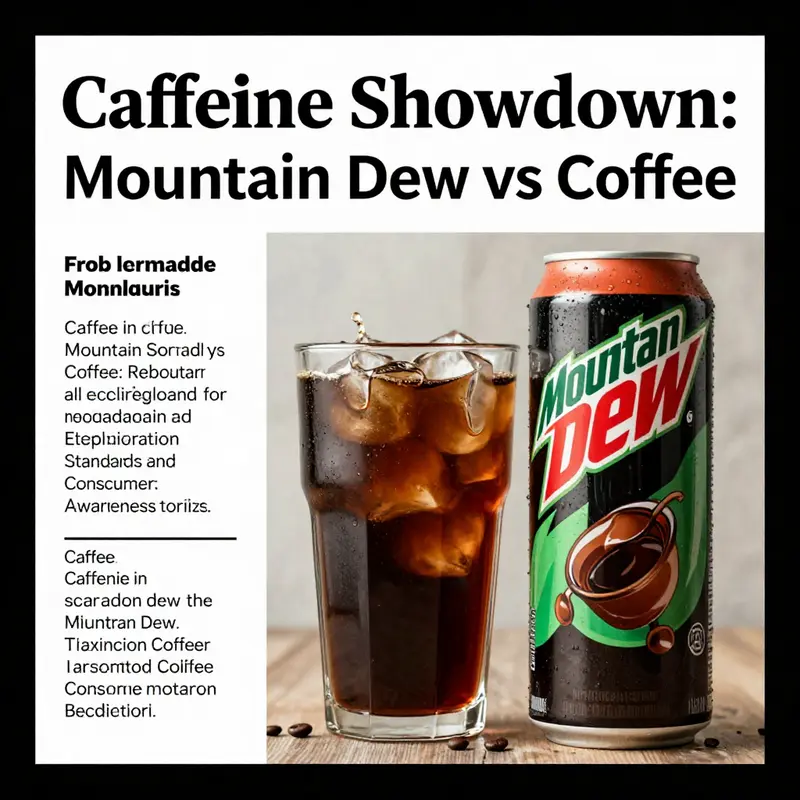
Caffeine has quietly become a cultural touchstone in the story of modern beverages, tugging at routines and social rituals in ways that are easy to overlook. When we compare Mountain Dew to coffee, the contrast is not simply a matter of taste or branding. It is a conversation about numbers, packaging, and the information consumers rely on to make choices that fit their energy needs, health considerations, and daily rhythms. The math matters because the way caffeine is quantified, labeled, and presented can change how people drink. It changes when and how much they reach for a can or a cup, and it shapes the expectations that accompany those sips. In this chapter, we explore not only the caffeine content itself but the regulatory frameworks that require disclosure and the consumer awareness that follows from clear labeling. We begin with the basics, then thread through the regulatory fabric and the lived experience of choosing between a fizzy, sweet drink and a hot cup that embodies a long-standing coffee culture.
On the numbers side, a 12-ounce can of Mountain Dew—whether Original or most other standard variants—delivers about 54 milligrams of caffeine. That figure sets Mountain Dew apart from many other soft drinks and places it in the upper tier of caffeinated beverages within its category. For those who prefer a diet version, the caffeine content per 12-ounce serving remains similar, around 54 milligrams, maintaining a consistent punch across major lime- and citrus-flavored lines. By comparison, a typical 8-ounce cup of brewed coffee contains roughly 95 to 100 milligrams, meaning coffee generally carries more caffeine per serving than a single Mountain Dew. An espresso shot, easily mistaken for a modest indulgence, clocks in at about 63 milligrams per one-ounce serving, which can feel like a heated contrast to a full can when you consider volume and context. The takeaway is not just the head-to-head numbers but how they accumulate in a day: two 12-ounce cans of Mountain Dew would bring roughly the same caffeine total as a single, standard cup of coffee, and depending on how one segments the day, the totals can swing in either direction.
This is where serving size and consumption patterns become central to understanding caffeine’s practical impact. The familiar can is a compact, ready-to-drink dose, especially appealing for on-the-go consumption or situational energy bursts. Coffee, by contrast, is a ritual, often tuned to the clock at the start of the day or a midafternoon pause, with a spectrum of brew strengths and serving sizes that invite a more deliberate intake. In the moment, caffeine’s mood-altering effects—alertness, focus, and a predictable lift—are similar in what they promise, but the way the body metabolizes that lift can differ depending on the matrix it comes in. Carbohydrates, fats, and sugars in Mountain Dew, for example, interact with caffeine’s absorption and subjective energy feel in ways that pure coffee does not, a nuance that matters to people who track their energy responses for work, study, or athletic activities. And because the caffeine content per serving can be higher than many other sodas yet lower than a full cup of coffee, the drinker’s interpretation of risk or benefit often hinges on how conscientious they are about serving sizes and total daily intake.
From a regulatory standpoint, the landscape looks straightforward on the surface: the federal framework requires that caffeine content be disclosed on the Nutrition Facts panel of caffeinated beverages, including soft drinks like Mountain Dew. There is no federal cap on caffeine for soft drinks, but manufacturers must ensure their products’ caffeine levels are safe under current guidelines and that the information presented to consumers is accurate and accessible. This means that most products in this category will list caffeine in milligrams per serving, and often per container, with the stated serving size as the anchor for the calculation. The lack of a universal maximum can be seen as both flexibility and risk: it allows products to vary within safe bounds, yet it places a spotlight on consumer literacy and label interpretation. The labeling standard, by design, invites people to check numbers, compare options, and adjust choices to fit personal tolerance, medical considerations, and daily caffeine goals.
Yet awareness does not always track with availability of the data. Consumer understanding of caffeine content can be uneven, and the bright marketing around a high-sugar, high-energy beverage can mask the fortitude of its stimulant. Public health conversations have centered on adolescents, pregnant or nursing individuals, and those who are particularly sensitive to stimulants. The fact that Mountain Dew’s caffeine content sits near the upper end of its soda peers can surprise some consumers who associate soft drinks with minimal stimulation. This disconnect—between a consumer’s perception of a drink’s strength and the actual caffeine dose—highlights a crucial gap: labeling alone does not guarantee informed decision-making if there is a lack of context about serving size, daily cumulative caffeine, or individual sensitivity. As a result, some advocates argue for clearer, more standardized guidance on packaging, perhaps in the form of concise “High Caffeine” indicators or explicit warnings aimed at youth and other vulnerable groups. The idea is not to demonize a beloved beverage but to empower readers to weigh caffeine alongside sugar content, total calories, and personal health considerations.
The regulatory and consumer awareness themes intersect with the broader cultural stance toward coffee, which enjoys ceremonial rituals and a spectrum of brewing strengths that have, over decades, shaped expectations about caffeine intake. Coffee’s familiar reference points—an 8-ounce default, a culture of pace and conversation—often set the frame for how people gauge a caffeine day. Mountain Dew, with its pulse of sweetness and carbonation, operates within a different social script: quick refreshment, a snack-like energy boost, and a portable option that fits into crowded schedules. The juxtaposition is not simply about which drink delivers more caffeine per ounce; it is about which format aligns with a person’s lifestyle, the moment’s demands, and the health boundaries they intend to observe.
Beyond the numbers and the norms, there is a practical dimension worth noting: measurement accuracy and consumer access to clear information. The Nutrition Facts panel is designed so that the label is legible and actionable, with caffeine presented alongside other nutrients and ingredients. In practice, however, label complexity and the science of caffeine metabolism can render a straightforward “more caffeine equals more alertness” interpretation insufficient. People vary in how they respond to caffeine, influenced by genetics, tolerance built over time, sleep quality, and concurrent stimulant or medication use. This variability reinforces a simple but powerful point: even when the caffeine content is clearly disclosed, the real-world effect depends on the individual. To navigate this, some readers turn to trend lines and total daily intake rather than peaks in a single serving. Others rely on community knowledge—coffee culture that celebrates precision with brew strength and serving size, or consumer conversations that normalize tracking caffeine across beverages rather than treating each product in isolation.
For readers who want a deeper read on the specifics, the data are available across primary sources that align caffeine content with official labeling practices. A detailed breakdown of Mountain Dew’s caffeine content, including variants, can be found in dedicated analyses that collate mg-per-serving information and compare it across categories. This kind of resource, while not a substitute for the label, provides a broader snapshot that helps contextualize the typical experiences associated with each drink. As you skim these numbers, it’s worth remembering that the label’s clarity matters as much as the numbers themselves. When a consumer sees 54 milligrams per 12-ounce can, that figure becomes part of a story about morning routines, study sessions, workouts, and late-day productivity. And when the label emphasizes a brewed coffee range of 95–100 milligrams per 8-ounce cup, it invites a different pacing—a reminder that a hot beverage can deliver a robust dose with a different social and sensory texture.
To anchor this discussion in practical implications, consider how a consumer might approach a Saturday afternoon calm-down or a mid-mrenovation work sprint. If energy needs are modest and one wants a quick, sweet lift, a Mountain Dew-like option may be perfectly suitable. If the goal is a longer-lasting, higher-dose lift, a cup of coffee will more often deliver that effect, especially when the ritual factor—brewing method, grind size, and water temperature—adds an element of intentionality. However, if someone is balancing caffeine intake across several beverages in a day, the distinction between per-serving caffeine and total daily intake becomes critical. The same person might start with Mountain Dew in the morning and add coffee later, unknowingly accumulating caffeine beyond their tolerance. This is where consumer awareness, reinforced by clear labeling, becomes a practical safeguard rather than a theoretical ideal. It is also where potential policy improvements—such as standardized labeling icons or warnings for high-caffeine products—could play a meaningful role in guiding choices without dampening personal preferences.
For readers seeking more on this topic, a concise, practical reference point is available through a dedicated discussion on caffeine content across common beverages. This resource provides a straightforward comparison that complements what you’ll find on product labels and helps translate mg-per-serving data into real-world choices. caffeine-content-mt-dew provides a focused look at Mountain Dew’s caffeine profile and situates it within the broader conversation about how caffeine sits in soft drinks compared to coffee. The broader regulatory landscape is summarized by official guidance from the federal authority that oversees food labeling and nutrition information; the agency’s caffeine page offers the formal framework behind what appears on Nutrition Facts panels and how those disclosures are intended to support consumer decision-making. External resources are essential for grounding these discussions in policy and science, so readers can see how the numbers map onto real-world use and safety standards.
In the end, the chapter on caffeine in Mountain Dew versus coffee is less a verdict and more an invitation to informed choice. The regulatory rules are designed to make the stimulant legible, while consumer awareness—shaped by marketing, education, and personal health goals—determines how that information translates into daily behavior. The story is ongoing: as formulations change, as labeling evolves, and as researchers deepen our understanding of caffeine’s effects across different beverages and contexts, the conversation will continue to hinge on how clearly we can read the numbers and how thoughtfully we can apply them to our own lives. The next chapters will extend this thread, examining how other popular caffeinated beverages compare and what that means for tips, thresholds, and healthier patterns of consumption.
External resource: https://www.fda.gov/food/food-labeling-nutrition/caffeine-in-foods-and-beverages
Final thoughts
In conclusion, comparing caffeine in Mountain Dew and coffee reveals critical insights for business owners aiming to cater to the caffeine-loving market. With distinct differences in caffeine content and varying health implications, understanding consumer preferences is essential. Additionally, the variability across brands and the cultural context of consumption trends should inform strategic decisions. It’s crucial for businesses to remain aware of regulatory standards and to prioritize transparency in product labeling to foster consumer trust and confidence. Armed with this knowledge, businesses can better navigate the competitive beverage industry.