

Brewing coffee in a French press is an artisanal practice that invites coffee lovers to engage in the nuances of flavor extraction. One of the most critical yet often overlooked aspects of creating the perfect cup is the coffee grind size. Achieving the ideal coarseness is vital for business owners looking to elevate their coffee offerings and satisfy their clientele. In the chapters ahead, we will delve into the science behind grind sizes, the significance of consistency, and practical tips for achieving the perfect coffee coarseness that will enhance the overall French press experience.
Groundwork to Clarity: The Quiet Power of Grind Size in French Press

Grind size matters more than it first appears in French press brewing. The surface area of the coffee particles determines how water extracts flavors during the several-minute immersion. A grind that is too fine can unlock bitter compounds and tannins, producing a heavy, muddy cup; too coarse, and the brew loses aroma and body. The sweet spot—often described as medium-coarse—aims for enough contact without over-extracting, balancing clarity and richness. A burr grinder helps achieve uniform particle size, reducing uneven extraction. Start with a consistent setting, observe the cup’s balance, and adjust in small steps. Typical guidance suggests a four-minute brew at mid-90s Celsius, with tweaks based on origin, roast, and personal taste. Keeping notes on grind and sensory outcomes builds a repeatable routine that improves consistency over time. For broader context, consider how grind texture, water contact time, and filtration shape flavor across brewing methods.
Grind Consistency as Compass: Navigating Coarseness for a Cleaner French Press Brew

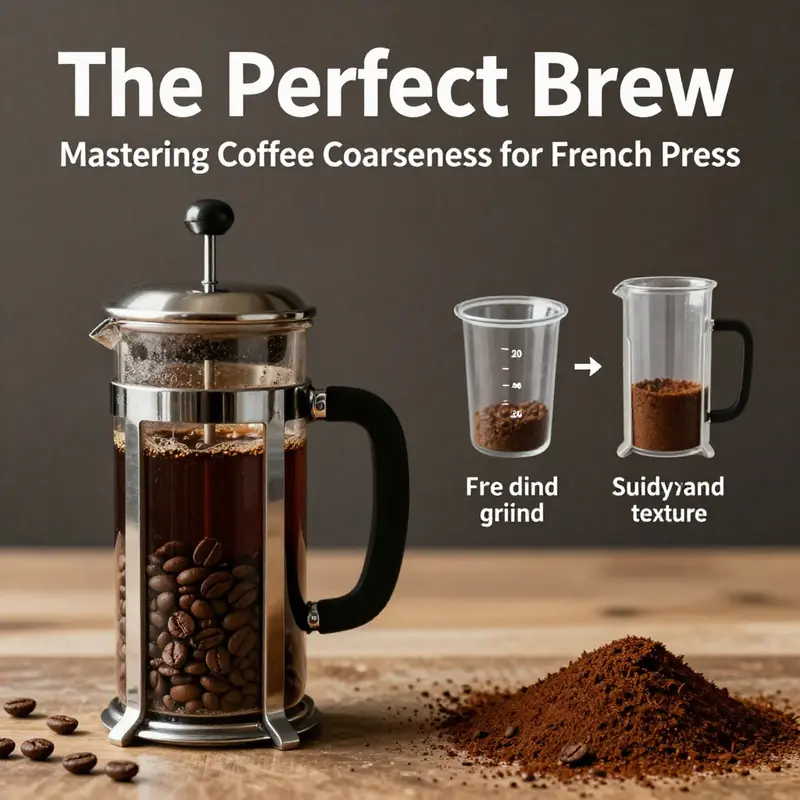
In the world of home brewing, French press sits apart, not because it resists finesse but because its virtue lies in a different clarity. The grinder you choose, and how it delivers grind size and uniformity, acts as the compass for a brew that reveals the bean’s true character without the distraction of fines and sludge. When we talk about coarseness for French press, we are talking about a balance: a texture that resists over-extraction yet accepts enough surface area to draw out sweetness. The texture should resemble breadcrumbs or coarse sea salt—distinct grains that water can flow around rather than grind into a muddy paste. This coarse, uniform grind becomes the foundation for a clean cup that carries the roast’s character, the bean’s aroma, and the subtle fruit or chocolate notes that can vanish if the grind is uneven.
Grind consistency is not cosmetic; it is the engine of repeatable flavor. The immersion method relies on contact time between water and grounds, and the rate at which that contact yields flavor compounds. When the grind is uniform, every particle has roughly the same opportunity to release oils and soluble components. The result is predictability: you can dial in brew time, temperature, and coffee weight with more confidence because the extraction curve behaves like a well-behaved line rather than a jagged staircase. In short, a consistent coarse grind keeps you from fighting your grinder each morning.
That clarity begins with how the grounds are produced. A burr grinder, whether manual or electric, tends to deliver more reliable results than a blade grinder. Burrs crush beans with a relatively even shear, creating a distribution of particle sizes that hugs a target range rather than a spectrum of fine and coarse fragments. In contrast, blade grinders slice and chop, which tends to produce a broad, uneven distribution. Some particles become ultra-fine, slipping into the brew and over-extracting, while others stay large and under-extracting, leaving the cup pale or tart.
To frame the conversation with authority, consider voices from the coffee world who emphasize grind consistency as a foundation of flavor. A grinder that produces a tight particle distribution enables predictable, repeatable extraction and flavor clarity. The idea is not to chase perfection with a single variable but to harmonize the variables you can control through disciplined grinding.
For French press brewing, aim for a coarse, uniform texture. A medium-coarse range tends to work well when the grind distribution stays even. The logic is simple: uniform particles allow water to penetrate evenly, giving a steadier extraction across the batch. The result is a cleaner cup with less muddiness, because fines are minimized. Yet the grounds still provide enough surface area to extract the earthy, often chocolaty notes that characterize the method.
There is a practical edge to these principles as well. The French press relies on immersion, and immersion invites time and temperature considerations. If the grind is too fine, the water over extracts and yields tannins and bitterness. If it is too coarse or uneven, extraction becomes uneven and you get a tea-like cup. A consistent coarse grind keeps the extraction rate within a predictable window, allowing you to adjust the steep time with more confidence. With this approach you can tune coffee weight, steep time, and agitation to match the roast level and the bean’s sweetness, without the grind undermining the process.
To translate these ideas into practice, choose equipment that delivers consistency. A burr grinder is the most reliable tool for achieving the target texture. Set it to a coarse, French-press-specific range to keep the grounds in that breadcrumb-like zone. A well-tuned burr grinder pairs with your scale and timer, turning the concept of a repeatable grind into a routine you can trust morning after morning. The goal is not a perfect grind for a single shot but a stable baseline you can rely on, so other variables can do the heavy lifting of flavor optimization.
The routine extends beyond the grinder itself. Calibration helps you verify the grind against a reference, adjusting until the distribution looks like a field of uniform particles. If you start with a blade grinder or a history of inconsistency, the switch to a burr requires a mental shift: the aim is a precise range of particle sizes rather than a precise gram of ground coffee.
The idea of coarse texture is not a single fixed target. It must adapt to roast level and bean density. Darker roasts can tolerate a slightly coarser setting, while lighter roasts may reveal more aromatics with a touch more surface area. Even within the same roast category, different beans demand subtle tailoring of grind size. The concept of uniform coarseness becomes a practical tool for aligning steep time, water temperature, and agitation.
The practical outcome is a smoother, more transparent cup. Inconsistent grinds create a muddy cup because fines slip through and dissolve as contact time lengthens. A uniform coarse grind fosters a cleaner extraction, letting sweetness come through with less bitter edge. The clarity in flavor comes from giving water a consistent route through similarly sized particles.
In practice, the brewing choreography after grinding matters too. The French press demands a deliberate sequence: pre-wet to warm the grounds, even saturation, and a timed immersion that respects the ground’s cook-time. A consistent coarse grind makes this choreography more forgiving. You can adjust the steep with less fear of flavor shifts because the grounds respond evenly to hot water. You also gain control over tannin extraction by minimizing ultra-fine particles that can contribute grit and astringency. Grind consistency underpins reliable flavor, while coarseness provides the texture that keeps flavor from becoming harsh or muddy.
If you want a practical frame, explore resources on grind discipline and brew ratios for French press. The goal is to see the grind as a continuous participant in the brew, not a one-time starting point. The idea is to keep notes, evaluate the cup critically, and refine your grind setting only when you notice a real shift in flavor, not a mere preference. Over time, grind consistency turns French press into a repeatable craft rather than a luck-of-the-draw ritual.
The journey toward grind consistency is complemented by the bean, the water, and the process. The water’s mineral content, the kettle’s agitation, and even the stir or gentle plunge influence extraction when grounds are uniform. Yet the backbone remains steadfast: a consistent coarse grind that offers a uniform canvas for extraction. When you achieve stability, the cup reveals the intrinsic sweetness and nuanced flavors of the bean rather than the quirks of the grinder. You learn to listen to aroma, texture, and aftertaste, and you gain a sense of how to coax the brew toward the balance you want.
In sum, the quest for coarseness and grind consistency in French press brewing is a practice of discipline and listening. It requires a burr-based approach, a coarse uniform texture, and a brewing routine that honors time, temperature, and water quality. The reward is a cleaner, sweeter cup that offers clarity rather than chaos. You will find the grind becomes a reliable instrument for shaping flavor, a compass that points toward better extraction rather than a wildcard that can derail it. The path is practical, and it is deeply satisfying: when you can grind with confidence, brew with patience, and taste the result without distraction, you have tapped into the craft of coffee in a way that feels both simple and profound.
null
null
Final thoughts
In conclusion, mastering the art of coffee coarseness for the French press is crucial for any business owner aiming to provide a superior coffee experience. By understanding the science behind grind size, emphasizing consistency, and applying practical solutions, you can enhance flavor extraction in your brews. This not only boosts the quality of your coffee but also fosters loyalty among your customers. A focus on the finer details of coffee preparation, such as grind coarseness, signals to your clients that you are dedicated to excellence in every cup.