
In the art of brewing French press coffee, every detail matters, with grind size standing as a critical element. Understanding the coarseness required for a perfect brew not only enhances flavor but also affects the overall experience a customer has. For business owners in the coffee industry, this knowledge is essential, as it directly ties to customer satisfaction and product consistency. This article will explore the science behind grind size, why coarseness is crucial in brewing, optimal grinding techniques, and recommended brewing ratios. By delving into these aspects, business operators can ensure that they are delivering the best coffee experience possible to their patrons.
Why Coarse Matters: How Grind Size Shapes French Press Flavor and Texture

The coarseness of your grind is not just a setting on a grinder. It is a central variable that controls extraction rate, mouthfeel, and clarity in French press coffee. When you dial in a coarse texture—think sea salt or large breadcrumbs—you are managing how quickly water pulls soluble compounds from the grounds. That management determines whether the cup will be balanced and clean, or muddied and bitter.
At the heart of this is a simple physical principle: particle size controls surface area. Smaller particles present more surface to hot water. More surface means faster extraction. Extract too quickly and you risk drawing out bitter compounds before the sugars and acids that give coffee its pleasant notes. Coarser particles slow the process and let desirable flavors develop more evenly. This is why French press is built around a coarse grind and a relatively long steep.
But texture alone does not tell the whole story. Grind distribution—the range of particle sizes present—matters equally. A theoretically perfect coarse grind with wide variation produces both fines and large chunks. The fines, tiny fragments produced during grinding, behave like a cloak of dust. They dissolve quickly and increase the suspension of particles in the brew. The result is a cloudy, gritty cup with harsh over-extracted flavors. The large pieces, meanwhile, extract slowly and can leave underdeveloped, sour notes. Burr grinders are recommended because they produce a narrow distribution with fewer fines, promoting more uniform extraction across particles.
The French press uses a metal mesh rather than a paper filter. That mesh allows oils and micro-particles to pass through more easily than paper. Those oils contribute to a fuller body and richer mouthfeel, a hallmark of French press coffee. But the mesh cannot trap very fine particles. If your grind is too fine, those fines slip through and settle in the cup. They carry concentrated, often bitter material, and they produce a gritty texture at the bottom. Coarse grounds, because they are larger, are far less likely to escape the mesh. Thus coarse grinding protects the brew from excessive sediment while preserving the desirable oils that define the method.
Extraction is chemical as well as physical. Different compounds dissolve at different rates. Acids and bright aromatic compounds dissolve early. Sugars dissolve a bit slower. Bitters and certain tannins extract later. With a coarser grind, water has less total surface to attack at once, which tempers the release of bitter compounds. This pacing gives you a chance to extract the full range of flavors without letting harsh notes dominate. Conversely, an overly fine grind exposes too much surface quickly, accelerating the extraction of bitter molecules like quinic acid and certain tannins. The cup becomes unbalanced: that quick bitterness masks the nuanced sweetness and acidity.
Texture and flavor interact in ways our palate reads holistically. A cup with some oils and negligible fines will feel round and smooth. A cup with the same dissolved solids but clouded by fines will taste heavier and more astringent. That sensation comes from the physical presence of micro-particles against your tongue and the concentration of bitter extracts they carry. Choosing coarse helps avoid the grittiness while still allowing body-enhancing oils through the mesh.
Practical cues help you find the right coarse setting. Visual and tactile checks are the fastest. Coarse grounds should look like coarse sea salt or small breadcrumbs, not like table salt or powdered sugar. They should be uniform enough that you cannot see an abundance of dust settled between larger pieces. When you rub a few between your fingers, they should feel grainy, not pulverized. If your grinder leaves a lot of dust, increase coarseness or switch to a different grinder. If the grounds are a mix of huge chunks and dust, you likely have an uneven distribution and should make finer adjustments.
Grind setting interacts with other variables. Water temperature, steep time, coffee dose, and agitation all change extraction. For a starting point, a 1:20 coffee-to-water ratio is a reliable baseline. That equates to roughly 10 grams of coffee per 200 milliliters of water. This ratio, when combined with coarse grounds, often yields a balanced cup. You can explore slight adjustments from there: a touch more coffee for body, or a touch less for brightness. If you push the ratio stronger, consider a slightly coarser grind or a shorter steep to avoid over-extraction. For detailed guidance on common proportions and their effects, see this concise guide to French press proportions: French press coffee ratios.
Steep time plays a key role. With coarse grounds, you typically steep between three and five minutes. Shorter times favor brightness and clarity. Longer steeps pull more body and deeper flavors, but also increase the risk of bitterness if the grind is not coarse enough. If your cup tastes thin and sour, you may be under-extracting; try slightly finer grounds or longer steep. If it tastes harsh and astringent, you’re likely over-extracting; coarsen the grind or reduce steep time.
Agitation and bloom matter, too. Blooming—pouring a small amount of water and allowing trapped gases to escape—encourages even wetting. Gentle agitation after bloom helps settle grounds and ensures more uniform contact with water. However, vigorous stirring breaks particles and creates more fines. Keep agitation light and deliberate. A few gentle stirs or a slow circular motion of the plunger before waiting will do more good than aggressive mixing.
The grinder you use changes everything. A burr grinder crushes beans between two abrasive surfaces, producing consistent particle sizes. A blade grinder chops indiscriminately, leaving a chaotic mix of fines and large chunks. That unevenness creates simultaneous over- and under-extraction: some particles go bitter while others remain sour. If you care about repeatable quality, a burr grinder is worth the investment. It gives you control over both the size and distribution of particles, enabling you to reproduce a preferred profile day after day.
Even with a good grinder, small adjustments can refine your cup. If you consistently find grit in the bottom of your cup, coarsen the grind a notch. If flavors are flat and underwhelming, try a slightly finer setting. When making changes, adjust one variable at a time. Change grind size, brew a few cups, and taste. Then change steep time or dose separately. That discipline makes cause and effect obvious.
Temperature also interacts with grind. Hotter water extracts faster. Most French press recipes recommend water just off boil, around 92–96°C (197–205°F). If your roast is very light or if you aim to pull out more acidity, the upper end of that range works well. For darker roasts, slightly cooler water can help tame bitter compounds. When you change temperature, compensate with grind or time. Hotter water paired with a fine grind can lead to quick over-extraction. Coarse grounds help buffer temperature effects, but they are not a catch-all.
Understanding fines helps with troubleshooting. If your cup is both bitter and gritty, fines are likely guilty. Even with a coarse setting, a worn or low-quality grinder can produce too many fines. Regular maintenance, including burr replacement and proper cleaning, reduces fines. If you do not have a quality grinder, consider a manual hand grinder with a good burr set. They often produce cleaner distributions than inexpensive electric blade models.
There is also a sensory balance to respect. French press is prized for its rich mouthfeel and body. If you grind too coarse to the point where extraction is minimal, the cup will taste weak with muted aromatics. The goal is not to eliminate sediment entirely, which is impossible with a metal mesh, but to minimize problematic fines while maximizing dissolved flavors and oils that contribute to body. The right coarse grind hits that sweet spot: enough surface area for a complete extraction, yet large enough particles to stay mostly out of the cup.
Finally, make tasting your laboratory. Taste under different conditions: slightly coarser or finer grinds, warmer or cooler water, longer or shorter steeps. Record what you change and what you taste. Over time you will build a map of how grind size affects the balance of sweetness, acidity, bitterness, and body for your beans. That map will let you adapt quickly when you switch beans, adjust roast levels, or change equipment.
For those who want to dive deeper into the science behind grind size and extraction, academic studies detail how particle size distribution and surface area drive extraction kinetics. One comprehensive paper on the topic explores these mechanisms further and provides data on extraction behavior at varying grind sizes. For more detailed scientific findings, see this study: https://www.sciencedirect.com/science/article/pii/S0969806X2400075X
Through all of this, remember a single truth: grind coarseness is the lever you pull most often to shape a French press cup. It controls texture, extraction speed, and how much sediment reaches the mug. Learn to read the visual, tactile, and tasting cues. Use a grinder that creates a consistent coarse distribution. Then adjust time, temperature, and dose to taste. Do that, and the French press will reward you with a full-bodied, clean, and balanced cup every time.
Texture as Taste: Mastering Coarseness in French Press Brewing
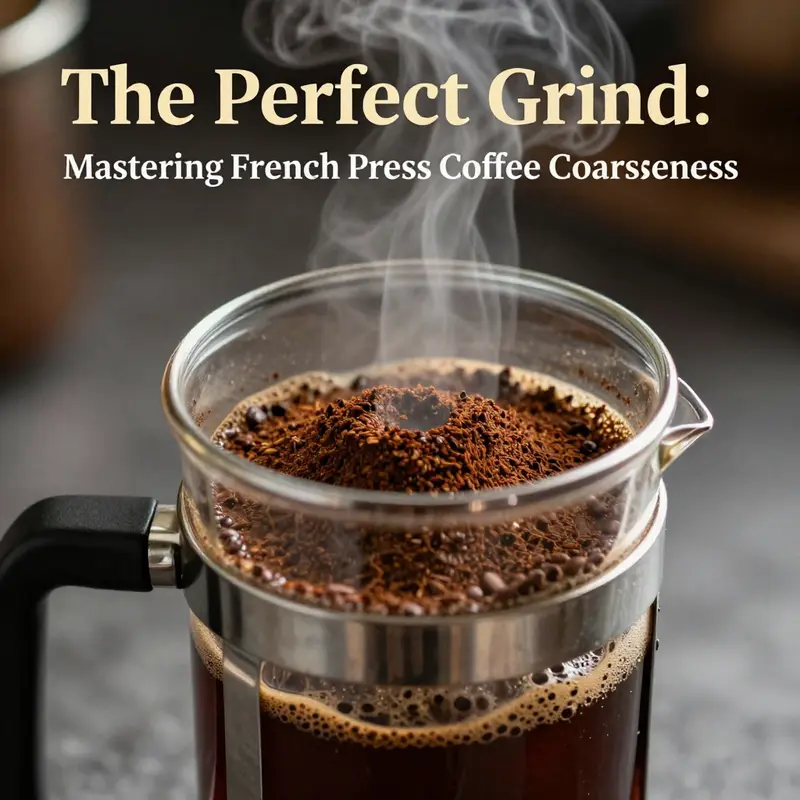
Coarseness is the quiet architect of a French press cup. It sits at the edge of perception, shaping aroma, body, and the sweetness of a sip without shouting its presence. When we talk about French press coffee, we tend to fixate on water temperature, brew time, or the filter’s mesh. Yet the grind size—how coarse or fine the coffee crystals are before they meet water—pulls the strings that determine whether the final cup is vibrant and clean or muddy and dull. The texture of the grind matters because it governs how much surface area of coffee is exposed to water, how quickly water can move through the bed, and how thoroughly oils and soluble compounds are drawn into the brew. A coarse grind, reminiscent of sea salt in texture, provides a balanced starting point where extraction can proceed steadily, and flavors can emerge without the harsh bite that accompanies over-extraction. In contrast, grounds that are too fine invite a cascade of problems: fines slipping through the mesh, a sludgy bottom, and a cup that tastes harsh, bitter, or flat as the well runs dry of nuance. The middle ground—coarse enough to be trapped by the filter, yet not so coarse that water rushes through without collecting flavor—maps a path to a smoother, more coherent cup. This is not merely a preference; it is a crucial technique in mastering the art of French press brewing.
Part of why coarseness matters comes down to how the French press extracts flavor. The metal mesh screen does a good job of holding back the bulk of the coffee grounds, but it cannot perfectly seal off every tiny particle. When the grind is too fine, a substantial portion of the coffee’s soluble compounds and oils are released into the brew in a relatively short time. These extracted compounds can overwhelm the cup if water contact is too intense, contributing bitterness and a harsh, almost astringent quality. The result is a cup that can feel heavy, with an unresolved aftertaste that lingers like a wake of sediment on the palate. The opposite scenario—grounds that are too coarse—presents a different challenge. Water will flow through the bed with less resistance, reducing the contact time between coffee and water. Although this can reduce bitterness, it can also strip the brew of many of its richer oils and aromatic compounds, leaving a cup that tastes thin, pale, or watery. The beauty of the right coarseness is in the balance: enough surface area to extract desirable flavors, but not so much that the brew becomes a swamp of over-extracted bitterness.
A practical way to grasp this balance is to imagine the texture of sea salt. It has enough heft to hold its shape, yet it dissolves evenly in water, releasing mineral notes and subtle sweetness rather than turning into a gritty mess at the bottom. The coarse grind behaves in a similar fashion during immersion. It resists passing through the mesh in droves and keeps most fines from muddying the cup. When the grind size aligns with a robust yet controlled extraction, the cup offers a coherent chorus of flavors—nutty, chocolatey, perhaps a hint of fruit or floral brightness—without competing harsh notes. In this way, coarseness becomes less about a personal preference and more about a practical lever for flavor clarity.
To put it in context, consider the classic statistics and recommendations that guide many brewers. The literature on French press brewing consistently emphasizes a coarse grind to avoid the dreaded sludge that can accumulate if fines slip through the filter. The logic is straightforward: larger particles extract more slowly and more evenly, so they are less likely to over-deliver bitter compounds in a single steep. Meanwhile, a precise, uniform grind helps ensure that most particles have a similar extraction profile, reducing the extremes of under- and over-extraction within the same brew. This is where equipment choice becomes important. A burr grinder, which produces a more uniform particle size, stands in contrast to a blade grinder, where particles vary wildly in size. The latter creates a mixed bed where some particles over-extract, becoming bitter, while others under-extract, failing to fully unlock sweetness and nuance. The presence of too many fines is another pitfall of low-quality grinding: they not only slip past the filter more easily but also dramatically increase the surface area exposed to water, accelerating extraction in an uneven, chaotic way.
If you walk into a coffee shop or home setup armed with the coarse-ground mindset but without the right grinder, you may still fight unnecessary frustration. The goal is to create a grind that feels substantial in your palm and looks visibly coarse when you spread it on a sheet of paper. You want particles that resemble breadcrumbs rather than flour, with a sand-like consistency rather than a powder. In practice, this means dialing in your grinder to a setting that yields larger, more uniform particles. It often requires a few experiments—brewing small test batches, adjusting the grind slightly finer or coarser, and observing how the bloom, aroma, and mouthfeel respond. The point is less about chasing a perfect number and more about training your palate and your tasting memory to recognize when the grind size is in the right neighborhood. The path to this sensitivity is incremental and patient, not dramatic or rushed.
An additional element of control lies in the coffee-to-water ratio. The recommended ratio found in expert circles—around 10 grams of coarse-ground coffee per 200 ml (roughly 6.7 ounces) of water, which corresponds to a 1:20 coffee-to-water ratio—provides a reliable framework for balance when the grounds are properly coarse. This ratio is not a rigid decree, but a starting point that makes the interplay between grind size and extraction more predictable. When you have an ideal coarse grind, this ratio helps ensure that the water extracts a balanced suite of flavors without overloading the brew with bitter compounds. In practice, this means measuring your coffee with a scale rather than relying on approximate guesses. The scale brings discipline to the process, turning grind coarseness from a vague goal into a reproducible parameter that you can dial in over time. For readers who want to translate this ratio into practical steps, see the French press coffee ratio guide as a mnemonic for how to calibrate your dose and water volume in tandem with grind coarseness.
The choice of grinder matters more than most casual readers realize. A burr grinder delivers a distribution of particle sizes that clusters tightly around a target size. This uniformity is essential when you are aiming for a clean, balanced cup from a French press. A blade grinder, by contrast, produces a spectrum of particle sizes: some near the coarse target, but many far finer, some almost powdery. That inconsistency translates into a brew where some grounds over-extract while others barely participate in extraction at all. The fines generated by blade grinding are the worst culprits for sediment and muddiness, and they disproportionately contribute to a harsh aftertaste. In short, the burr grinder is the instrument that translates an intention—coarseness—into reliable execution. It reduces variability, which in turn makes the subsequent steps easier to predict and control.
Beyond the grind itself, coarseness interacts with the steeping process. The French press relies on immersion rather than drip filtration to draw out flavors. The duration of contact between water and coffee is therefore a critical variable, but it cannot compensate for a grind that is too fine or too coarse. If the grind is fine, you may find yourself needing shorter steep times to avoid bitterness, yet still wrestle with sludge that appears as soon as you press. If the grind is too coarse, you might compensate with longer contact, but the water will still struggle to extract the lively oils and aromatic nuances that define the cup. The most reliable approach is to begin with a confident coarse grind and a consistent 4- to 5-minute steep combined with a steady, gentle plunge. In this configuration, the brew has enough time to extract desirable compounds, while the filter can do its job without choking on fines or letting sediment pass through in bulk.
This is where practice becomes a nuanced art rather than a science of absolutes. Each coffee origin, roast level, and even ambient humidity can alter how quickly flavors are extracted, which means that even with a perfect coarse grind, you may need to nudge the grind size or duration to suit the specific batch. A subtle shift of one click on a good burr grinder can tilt the balance toward a cleaner cup or a more pronounced body. The key is to observe and adjust with intention, rather than rely on a fixed rule that never adapts to the coffee in your hand. When done with care, coarseness becomes a tool for shaping the cup’s profile—enhancing clarity, accentuating sweetness, and delivering a satisfying mouthfeel without the mud at the bottom.
In practice, this means treating grind coarseness as a central instrument in your brewing repertoire. It is not a peripheral preference but a lever you can pull to resolve larger issues in your cup. If you consistently notice a gritty texture or a muddy finish, re-evaluate the grind size first before altering water temperature or brew time. If, on the other hand, the cup feels thin or insubstantial, a slightly finer coarse grind or a small adjustment to the dose can help coax more flavor and body from the coffee. The aim is cohesion: sediment-free clarity, aroma that circles the room, a body that feels substantial but not heavy, and a finish that lingers with clean sweetness rather than acrid bitterness.
For readers seeking a path from theory to practice, consider viewing the grind’s impact as a chain of cause and effect. Coarseness affects the rate of extraction, which then shapes flavor compounds, oils, and aromas, and finally determines the perceived body and finish. The chain is delicate; a small change in one link can ripple through the rest. Because of this, sustaining consistency becomes essential. Regular calibration of your grinder, careful measurement of coffee and water, and disciplined timing all contribute to a repeatable process that honors the coffee’s inherent character. The result is not a single perfect cup but a reliable method for dialing in flavor, ensuring a balanced extraction, and preserving the delicate interplay between sweetness, acidity, and body that makes French press coffee a distinctive experience.
In closing, the coarseness of your grind is more than a matter of taste; it is a practical discipline that governs the cup’s balance, texture, and overall drinkability. By embracing a coarse texture, guarding against fines, and pairing this with a reliable ratio, you set the stage for a brew that is both expressive and refined. The journey toward the ideal French press cup invites you to feel the texture in your palm, hear the quiet hiss of the press as it stabilizes, and savor the moment when aroma blooms and the first sip lands with composure. This is how coarseness becomes not just a technical parameter but a contributor to a better morning ritual, a reminder that the texture you choose whispers its influence through every layer of flavor. For those ready to translate this understanding into action, the practical step is simple: adjust your grind toward a sea-salt-like coarseness, measure with care, and allow the water to do its work with patience and respect. A well-balanced cup will reward that discipline with clarity, warmth, and a lingering sense of satisfaction that lingers long after the last sip. And if you want a concise framework to tie ratios and grind to practice, you can explore the dedicated guide on French press ratios as a handy reference, which offers a clear starting point for dialing in your brew: French press coffee ratio guide.
External resource: for a deeper dive into the science behind grind size and extraction in French press brewing, see the detailed analysis by Serious Eats: Serious Eats—French press coffee recipe.
Coarse Control: Grinding Techniques That Make French Press Coffee Shine

Getting the grind right is the single most important mechanical step for French press coffee. The French press is an immersion brewer with a simple design, yet small adjustments in grind size dramatically change extraction, mouthfeel, and clarity. Coarse grounds are the target: think sea salt or coarse sand. That texture keeps most of the particles large enough to be held back by the mesh plunger. It also controls surface area exposure to water, preventing the rapid, overbearing extraction that finer grinds invite.
The reason particle size matters feels technical but is easy to grasp. Extraction happens by surface contact between water and coffee. Finer particles present more surface area, so they extract quickly and often too aggressively. The result is bitter or harsh flavors and a thick, muddy texture as tiny fines slip through the mesh. Coarse particles extract more slowly and steadily. They favor fuller body, balanced acids, and preserved oils that contribute aroma and richness without a gritty residue. Achieving that balance depends largely on the grinder you use and the way you dial in its settings.
A burr grinder is essential for reliable coarse grinds. Burrs crush beans between two calibrated surfaces, producing consistent particle sizes. This uniformity allows water to interact with coffee evenly during immersion. A blade grinder chops beans unpredictably, leaving a mix of large chunks and dust. That mix yields uneven extraction: some bits over-extract, others under-extract. It also generates more fines, which pass through the press filter and muddy the cup. For anyone serious about French press, switching to a burr mechanism is a practical step toward clarity and control.
Manual burr grinders deserve attention. Their slower, controlled rotation reduces heat and friction during grinding. Heat can accelerate flavor loss, so low-speed grinding helps preserve volatile aromatics. Manual grinders also force a steady, deliberate grind that many enthusiasts prefer. Their ease of adjustment and portability make them ideal for travel or small kitchens. Electric burr grinders, however, offer speed and convenience, and high-quality models allow precise steps between coarseness levels. When choosing electrically, prioritize models with consistent burr alignment and a reputation for predictable particle distribution.
Fine-tuning the coarseness starts with setting and testing. Begin with a coarse mark around the size of coarse sea salt. Pull a small sample and look at the particles. You want mostly uniform chunks with few specks of dust. If you see a heavy presence of fines, widen the burr gap. If the grounds seem toothpick-sized and sparse, tighten slightly. Small adjustments can make large differences, so change slowly and test after each tweak. Dialing in becomes easier with practice and by keeping notes about settings and results for each batch.
Testing by taste and appearance is vital. Brew a standard ratio and steep for about four minutes. If the cup tastes sharp and bitter, chances are some portion of the grind is too fine. Bitter notes often indicate over-extraction from fines or too-long contact time. If the brew tastes thin or weak, the grind may be too coarse or the dose too low. Visual cues also help. A thick, muddy layer at the bottom of the carafe signals excessive fines escaping the filter. A clean, sediment-light cup suggests your grind is doing its job.
Consistency across batches hinges on several small habits. Grind immediately before brewing to preserve volatile aromatics. Use whole beans stored in a cool, dark place and avoid prolonged exposure to air. Clean your grinder regularly; old oils and trapped fines alter particle flow and skew settings. For burrs, periodic brushing and occasional deeper cleaning prevent stale residue from blending into fresh grounds. Also monitor burr wear: over time, dull burrs produce more irregular particles and require tighter tolerances to compensate.
Grind retention — the coffee that remains in the grinder between uses — can be an overlooked source of inconsistency. Retained grounds from previous runs can mix with fresh grounds, subtly shifting particle distribution. Clearing out the grounds chamber or using a grinder designed to minimize retention helps keep each batch consistent. If you switch beans or roast levels, purge the grinder with a small amount of the new bean before collecting the dose for brewing.
Fines are the enemy of a clean French press cup. They form during grinding and are especially prevalent with blade grinders. While a high-quality burr grinder reduces fines, no grinder is perfect. A simple sieve designed for coffee can remove the smallest particles before brewing. Sifting adds a step, but it yields a cleaner cup with less sediment. Alternatively, allow the carafe to rest a minute after plunging before pouring; this pause lets the most volatile fines settle to the bottom.
The mesh filter assembly itself matters. A well-made plunger with tight, layered filtration catches more fines while still allowing oils to pass. Check seals and screen alignment to ensure even pressure during plunging. When you press, do so with steady, even force. Jerky plunges stir up settled particles and reintroduce fines into the liquid. Press slowly until the plunger sits just above the settled grounds, then pour deliberately to avoid disturbing the layer of sediment.
Dose and ratio interact with grind size. A common starting point is a 1:20 coffee-to-water ratio, roughly 10 grams of coarse ground coffee per 200 milliliters of water. That ratio pairs well with a coarse grind, providing balance without risking dilute flavors. If you find the cup too weak, increase dose slightly rather than dramatically reducing grind size. Lowering grind size to boost strength quickly increases extraction and can push the cup into bitterness. Always prefer adjusting dose and brewing time before deviating from your coarse target.
Water temperature and steep time are important companions to grind size. Water between 195°F and 205°F works well for most beans. Slightly cooler water favors delicate, lighter-roasted beans, while hotter water helps with darker roasts. Steep time usually ranges from three to five minutes. If you lengthen steep time to extract more, keep the grind coarse enough to avoid over-extracting fines. Conversely, if you shorten time, a very coarse grind may under-extract. Think of grind, temperature, time, and dose as a single system where small changes ripple through the final cup.
Roast level and origin influence the ideal coarseness. Light roasts can feel denser and may need a touch finer grind to coax dissolved flavors into the cup. Dark roasts are more porous and release solubles faster, so they often prefer slightly coarser settings. Beans with higher density require more aggressive grinding to reach the same particle size, so adjust the grinder accordingly. Taste is the final arbiter: if a light roast yields a sour or underdeveloped cup, fine-tune the grind a notch finer. If a dark roast tastes flat or overpoweringly bitter, open the grind up.
Practical tips make the process repeatable. Use a scale for dosing; grams are precise and eliminate guesswork. Keep a brewing log with grind setting, dose, temperature, steep time, and tasting notes. Over time, this simple record becomes an invaluable reference. When experimenting, change one variable at a time, so you can identify which adjustment created the change. Clean your equipment after each use to avoid flavor cross-contamination between different beans.
When travel or camping calls, consider portability factors. Manual burr grinders are compact and allow fine control even without power. They also keep beans fresher by letting you grind right before brewing. If you bring an electric grinder, protect burr alignment during transport. Some grinders offer stepless adjustment, allowing infinitely variable changes for precise dialing in. Stepped grinders give repeatable positions, which can be faster for regular use. Choose the style that fits your routine and your patience for experimentation.
Finally, remember that perfect coarseness is an evolving target. Beans change with season and roast batch, and your taste may shift as you explore different origins. The goal is not to hit a single number but to develop a feel for how the grind interacts with other variables. A consistent coarse grind yields cleaner extraction, a smoother mouthfeel, and a more balanced cup. With deliberate testing, careful maintenance, and small incremental adjustments, you can reliably coax exemplary flavors from your French press.
For a complete walkthrough on dialing in grind and optimizing your full French press routine, consult this detailed guide on getting the grind right for French press brewing: Mastering the Perfect Grind for French Press.
For practical guidance on dosing and simple ratio adjustments that work with coarse grind settings, see this resource on French press coffee ratios: https://coffeerichlife.com/coffee-ratio-french-press/
The Texture of Taste: How Grind Coarseness Shapes a Balanced French Press Brew
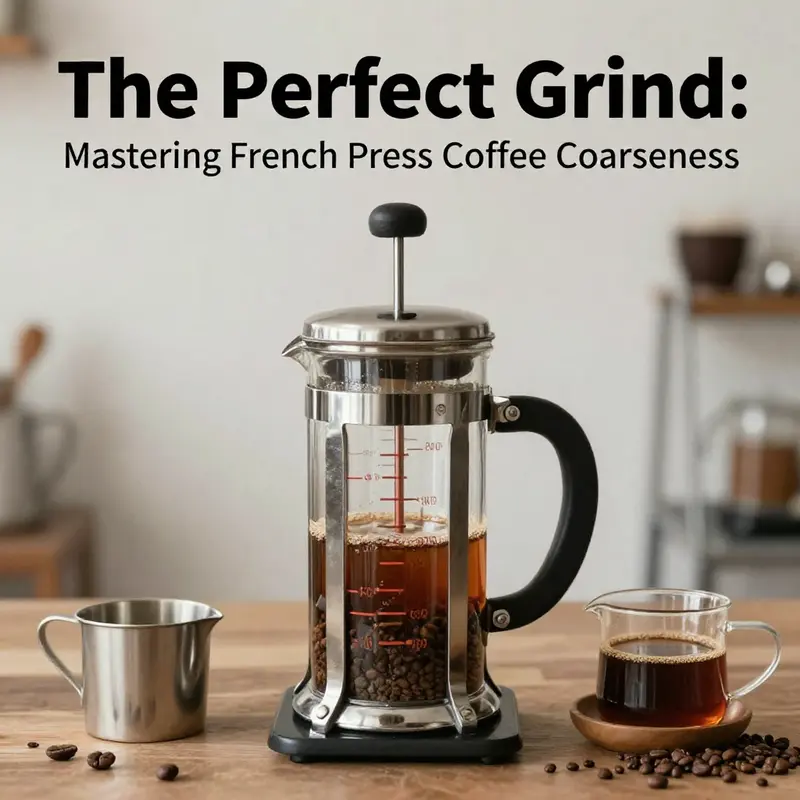
The texture of the coffee you brew matters nearly as much as the aroma you savor. In the quiet, deliberate ritual of a French press, grind coarseness is the quiet architect of flavor and mouthfeel. When the particles resemble sea salt in size and feel, the brew tends to emerge with balance, clarity, and a smooth finish. The coarse grind supports a clean separation from the grounds during pressing, allowing the water to extract what’s most desirable from the bean without dragging along the heavy, gritty sediment that can cling to the palate. This is not merely a matter of aesthetics. It is a fundamental control point in extraction chemistry, where particle size governs surface area, contact time, and the rate at which soluble compounds are dissolved and dispersed into the cup. Too fine a grind, and the water rushes into tiny particles, harvesting fines that slip through the mesh and contribute to a muddy brew. The result is a sensation of grit and an unbalanced flavor profile, often crossing into harshness as over-extracted components deliver bitter notes that mask delicate origin characteristics. The path to a clean, aromatic pour lies in deliberately coarse grinding, paired with a controlled immersion. The goal is to harness the benefits of full immersion without inviting the downsides of fines that bypass filtration and water that overextracts.
This foundational choice—grind coarseness—also serves as a reminder of the equipment we rely on to deliver consistency. A burr grinder, set to its coarsest suitable for immersion methods, is the instrument that substitutes variability with repeatable geometry. Blade grinders, by contrast, produce a wide spectrum of particle sizes, from powdery fines to large chunks, all mingling in the same brew. This inconsistency translates into uneven extraction: some portions of the batch become over-extracted and bitter, while others remain under-extracted and sour. The result is not simply a less pleasant cup; it is a brew whose overall balance drifts because the grind sizes fail to align with the water’s tempo and the contact time in the press. The science behind this is straightforward: broader particle size distribution accelerates some extraction routes while stalling others, so the final cup hints at a lack of coherence rather than a unified flavor.
With the grind settled, the next hinge on the door of brewing mastery is the ratio of coffee to water. The espresso-labeled precision of “one to one” does not apply here; instead, the French press benefits from ratios that emphasize body, sweetness, and the ability to tolerate a longer brew without becoming overpowering. The golden rule that many specialty coffee sources advocate is a ratio range of roughly 1:15 to 1:17 by weight. In practical terms, that means one gram of coffee for every 15 to 17 grams of water. This ratio reflects a balance between extraction efficiency and the body those extracted solubles deliver. It also aligns with the principle of immersion brewing: enough grounds to saturate evenly, enough water to carry soluble compounds into the cup, and enough restraint to prevent harshness from over-extraction.
To translate this into a concrete starting point, imagine a 400-gram batch of coffee, which yields about 400 milliliters of water. At a 1:15 ratio, you would use roughly 26.7 grams of coffee. At a 1:17 ratio, about 23.5 grams. These figures, while seemingly precise, should be treated as starting points rather than strict endpoints. Personal preference carves the final path. A 1:15 brew delivers a bolder, more concentrated cup that enthusiastically reveals the roast’s depth and weight. A 1:17 brew leans toward a cleaner cup, allowing subtler origin notes to come forward without sacrificing the perception of body. Some traditionalists and many modern tasters enjoy a slightly stronger profile, experimenting with a 1:13 ratio when they crave maximal intensity. Others favor lighter, more delicate profiles at 1:18 or 1:19. The key is to begin at 1:15 and adjust gradually, letting taste guide fine-tuning rather than chasing a preconceived notion of perfection.
Beyond the grind and the ratio, several brewing variables shape the final experience. Water temperature is a primary actor in extraction. The range of 195°F to 205°F (90°C to 96°C) is widely recommended for French press brewing because it stabilizes a thoughtful extraction window. Water that is cooler can yield under-extraction, causing the cup to taste weak, flat, or sour. Water that is too hot can over-extract, pulling harsher flavors and bitter compounds that overwhelm the more nuanced sweetness of the bean. The brew time, too, plays a decisive role. A four-minute steep after the initial pour is the standard cadence that supports balanced extraction. Pushing past five minutes increases the likelihood of over-extraction, extracting more bitter compounds than desirable and delivering a heavier mouthfeel that clings to the tongue long after the last sip.
Agitation, while optional in the sense that it is not mandatory, can help achieve even saturation of all the grounds. A gentle stir in the first 30 seconds of contact creates a rhythm for the water to permeate the bed of grounds, ensuring that every particle receives its share of water to awaken the flavor compounds contained within. The goal of agitation is not to churn the mixture into a froth but to break up any dry pockets that might resist full wetting. After this initial stir, it is wise to resist further disturbance; aggressive stirring can churn up fines and lift more particles through the filter. And the plunger itself, when used, must be pressed with care. A slow, steady, controlled press minimizes the chance that fines are forced through the mesh into the cup. Rushing the plunge invites sediment and a heavy mouthfeel that contradicts the refined balance you are seeking.
The practice of tasting thoughtfully accompanies the mechanics of grind and ratio. Each variable—grind size, water temperature, brew time, and coffee-to-water ratio—interacts with the others to sculpt the flavor profile. If the resulting cup tastes gritty or muddy, the likely culprit is too coarse a grind? Actually, gritty sediment most often points to too-fine grounds and over-agitation or insufficient filtration. More commonly, a muddy cup arises from fines that slip through the metal mesh, which points to not only grind size but the integrity of the filter and the speed at which you plunge. In these moments, the patient approach wins: adjust one thing at a time, listen to the palate’s verdict, and let the evidence of your taste buds guide adjustments rather than chasing a single universal prescription.
To anchor technique with practical guidance, many experts emphasize the value of weighing both coffee and water. Volume measurements are convenient but can be deceptive: different grounds settle and release air at varying rates, and scoops can vary in their actual weight. A digital scale provides a consistent, repeatable basis for your recipe, turning a good cup into a consistently good cup. The pro tip here is simple: weigh your ingredients and your yield. If you are aiming for a 400-gram batch at 1:15, you would target roughly 26.7 grams of coffee with 400 grams of water. If the brew seems too concentrated or too weak, adjust by small increments—not a full leap—until the cup sings with balance.
In a sense, the coarseness of your grind becomes the throughline of your brewing story. It determines how the water interfaces with the coffee, how quickly soluble compounds reach the surface, and how much sediment you concede to the final pour. The interplay of grind and ratio is not a one-size-fits-all recipe; it is a scaffold that supports personal expression. Some days you may want the cup to lean toward boldness, activating richer cocoa tones and deeper roasted notes. Other days, you may wish to highlight bright fruit acidity, floral aromatics, or a more polished sweetness. The controlled coarseness makes both possibilities accessible because it modulates extraction without the chaos that finer particles invite. The rest of the variables—the exact grind, the precise timing, the minute temperature adjustments—become levers you can pull as you refine your routine toward a brew that feels like it was crafted for that moment.
As you move through your experimentation, it can be tempting to cling to a single set of numbers. Yet the real reward lies in developing a sensibility for balance—the ability to recognize when a cup is not harmonious and to trace the imbalance to its source. If the cup is bitter, consider whether the grind is too fine, the brew time too long, the water too hot, or the ratio too tight. If the cup tastes flat or sour, consider whether the grind is too coarse, the time too short, or the water not hot enough. Small, methodical adjustments guided by taste will nudge you toward a recipe that feels almost tailor-made for your palate. The structure provided by coarse grind, measured ratios, and disciplined timing gives you the platform to explore with confidence rather than guesswork.
To connect these ideas to a broader framework of quality coffee, consider that the French press—when approached with discipline around coarseness and related variables—can reveal the essence of a bean’s character. The method is forgiving in some respects, allowing for generous extraction without the brittleness associated with finer brewing methods. Yet it requires a careful touch; the very feature that makes the press so approachable—the immersion that unlocks body and sweetness—also magnifies the impact of any miscalculation. Coarseness becomes not a mere preference but a responsible choice that guards against over-aggression in extraction and helps preserve the nuanced flavor notes that a careful roast may offer. This is why a standard recommendation emphasizes starting with a coarse grind and a measured 1:15 to 1:17 ratio, then letting your palate direct the journey toward a clean, aromatic cup.
The practical takeaway then is both simple and exacting. Begin with a coarse grind and a burr grinder ready for immersion. Use a 1:15 to 1:17 ratio as your compass, with a four-minute steep in water between 195°F and 205°F. Stir gently in the first phase to ensure even saturation, then plunge slowly and pour promptly to minimize downstream extraction. When your cup presents as bold yet balanced, you have achieved a practical harmony between technique and taste. If adjustments are necessary, proceed one at a time and observe how the change shifts the balance. In time, you will recognize a personal sweet spot—a reproducible recipe that yields a smooth, rich cup without the grit that lingers on the tongue.
If you want a concise reference to ratios while you read the broader exploration of grind coarseness, you can consult a focused guide on French-press coffee ratios. It offers a clear, compact framework to support your experiments with the same mindset described here, while integrating naturally with the principles of coarseness and immersion that define this brewing method. For a deeper dive into the numerical side of the practice, the links provided in this chapter point toward a wider set of resources that treat grinding, filtration, and extraction as interconnected components of a well-tempered coffee routine. The underlying message is straightforward: precision in grind and measurement, paired with patience in technique, yields the kind of cup that invites another, and then another round of careful refinement.
To close this thread, let the texture you choose—the coarse, sea-salt-like grind—be the first note in a coherent sensory composition. The rest of your approach—the ratio, the temperature, the brew time, the gentle agitation, the deliberate plunge—should harmonize with that initial choice. This is how you convert a simple press into a predictable source of depth and clarity, a reliable ritual that premieres a good bean’s best features rather than exposing its rough edges. And as you practice, you will find that the art of coarseness is less about chasing a perfect number and more about maintaining consistent conditions that unlock the coffee’s character in a way that feels natural, unforced, and deeply satisfying.
For readers pursuing a structured path to reliable results, a practical starting point is to adopt the following sequence: coarse grind, 1:15 ratio, four-minute steep, water at 195–205°F, gentle stir at the start, and a slow, steady plunge. Then taste and adjust with care, keeping one variable in play at a time. Over weeks of practice, your palate will map a personal preference onto a reliable technique, and the ritual will become less about hitting a number and more about delivering a cup that feels beautiful in its balance. In other words, the coarseness of your grind is the compass; the surrounding variables are the chart you follow to reach a destination where every cup is recognizably yours.
Internal link: To explore a concise, dedicated discussion on how the French-press ratio interacts with grind size, see the guide on French-press-coffee-ratios. French-press-coffee-ratio.
External resource: https://www.sca.coffee/learn/what-is-specialty-coffee
Final thoughts
Mastering the grind size for French press coffee is pivotal in the coffee industry. The coarseness of the coffee not only dictates the taste and clarity of the brew but also impacts the customer experience. By understanding the science of grind size, recognizing its importance, utilizing the right techniques, and applying proper brewing ratios, coffee business owners can ensure their offerings stand out in quality and flavor. This knowledge not only fosters customer satisfaction but also enhances the overall reputation of the coffee brand. A dedication to such nuances can turn an ordinary coffee experience into an exceptional one.