

A mobile coffee cart drinks water a stationary cafe rarely has to think about: hauled tanks, refilled jugs, whatever tap is nearby. The mineral content changes from stop to stop. Skip the right water softener and that shifting chemistry starts working on your espresso boiler.
A shop draws from one plumbed line, so a single treatment setup holds all year. A cart moves between cities, festivals, and parking lots, and a softener sized for one stop can be wrong at the next.
The failure is rarely dramatic. A softener that is missing, undersized, or mismatched lets dissolved calcium and magnesium pass straight into the machine. Heat drives those minerals out of solution, and they settle as scale, a hard crust that coats the boiler interior and gets thicker with every shot.
That crust does not go away on its own. It blocks heat transfer, raises energy use, and shortens the life of the most expensive part on the cart. Routine coffee maker cleaning helps, but cleaning treats the symptom, not the source.
The cost of that mistake shows up in the cup and on the repair bill. This piece covers where the damage comes from and how to size the fix so a mobile cart keeps brewing.
Why Mobile Cart Water Is Harder on Your Espresso Boiler
A fixed cafe usually has one reliable source. Turn the tap and the mineral profile stays roughly the same week after week. A cart drinks whatever you can carry, refill, or borrow, and that is what changes the math.
One day you are hooked to a municipal tap at a farmers market. The next, you are pouring from a refilled tank in the van. The day after, a venue hands you a garden hose. Each source carries a different mineral load, so the water hardness entering the boiler is a moving target.
In a fixed shop, stable water means one softener setting can be dialed in and tested once. On a cart, that setting can be perfect at one stop and wrong at the next. When incoming hard water spikes and the softener cannot keep pace, the minerals do not vanish. They end up in the boiler.
The chain looks like this:
- Variable hardness -> the source shifts without warning
- Inconsistent softening -> the filter or softener is calibrated for the wrong water
- Mineral deposition -> calcium and magnesium settle onto hot metal
- Boiler scaling -> deposits harden into an insulating crust
Once scaling takes hold, recovery slows, temperature control drifts, and descaling turns into a recurring chore. Many operators also run portable brewing gear alongside the main rig, and those small setups face the same unpredictable water. For equipment options, see this guide to the best portable travel coffee makers for great coffee on the go.
A cart’s boiler is not stressed by heavy use so much as by unpredictability. Plan for changing hardness and the machine keeps pulling steady shots.
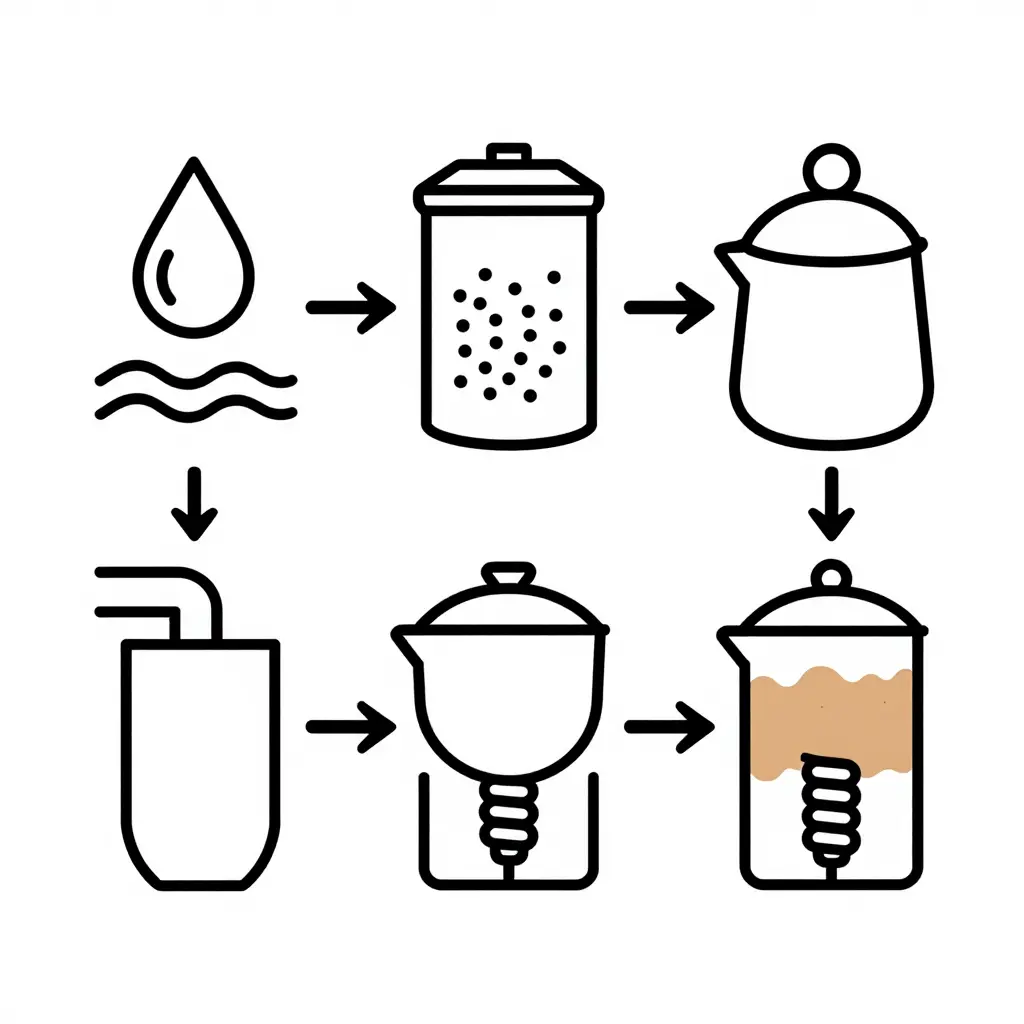
Source water enters the softener, moves into the espresso boiler, and leaves scale baked onto the heating element. Skip or misconfigure that middle step and the deposit builds where you cannot see it. High-volume owners get the payoff from staying ahead of maintenance, and this guide to keeping your brewing gear clean and reliable is a useful companion.
How Scale Buildup Damages the Espresso Boiler
Scale starts in the water. Calcium and magnesium dissolve into the supply and then settle on the hottest surface in the machine, the heating element in the espresso boiler. That deposit is what ends cart mornings early.
The mechanism is straightforward:
- Scale insulates the heating element. The mineral crust acts like a blanket, so heat moves into the water more slowly.
- Heating cycles stretch longer. The element runs hotter and longer just to reach the same target temperature.
- Energy use climbs. Every extra minute of heating burns more power and wears the element faster.
- Flow gets restricted. Deposits narrow the pathways and valves, so pressure turns erratic.
The result is a boiler that cannot hold brew temperature. It overshoots, then undershoots. Shots drift from sour to bitter, and no recipe change fixes it, because heat is no longer passing cleanly from metal to water.
Left alone, the crust thickens, cracks, and flakes. The flakes lodge in valves and can clog or seize them, and the element can finally burn out or rupture the boiler. That is not a slow day; it is a dead cart.
The numbers matter more on a cart. A 1 mm layer can stretch brew-temperature recovery from roughly 30 seconds to nearly a minute, so the machine falls behind on every order. Carts also run smaller boilers, with less water and less surface area to buffer heat, so a thin layer hurts a small boiler more than a large shop machine.
Downtime is the real cost. A cart cannot afford a week without service. A failed element or cracked boiler means cancelled events, lost income, and a repair bill that can run into hundreds of dollars. Scale turns a cheap water problem into an expensive machine problem.
Prevention starts with a water softener. It strips calcium and magnesium out before they reach the boiler. Pair that with a consistent descaling and cleaning routine and the heating surface stays clear.
The comparison below shows that only a true ion-exchange softener removes the calcium and magnesium that wreck an espresso boiler. Portable setups also perform best when they are fed properly softened water.
Water Treatment Options for Mobile Coffee Carts
| Treatment Type | What It Removes | Effect on Hardness | Best Use on a Mobile Cart | Maintenance Interval |
|---|---|---|---|---|
| Carbon filtration | Chlorine, odors, and sediment; leaves minerals behind | None; hardness stays the same | Pre-filter taste before softening | Replace cartridge every 1-3 months |
| Ion-exchange water softener | Calcium and magnesium ions | Removes hardness almost entirely | Dedicated protection for the espresso boiler | Regenerate with salt every 1-2 weeks |
| Reverse osmosis | Nearly all minerals, including hardness | Removes almost all hardness | High-volume carts wanting neutral water | Swap membranes every 6-12 months |
| Scale inhibitor/sequestration | Stops scale from sticking; keeps minerals present | Little to no change | Short-term fix when space is tight | Refill media every 2-4 months |
| Blended bypass systems | Nothing directly; blends hard and softened water | Adjusts hardness to a target | Dialing in ideal TDS after softening | Recalibrate every 3-6 months |
Carbon filters, inhibitors, and bypass systems manage flavor or slow the damage, but they leave dissolved hardness in the water. Only a dedicated softener removes the calcium and magnesium at the source, which is what keeps an espresso boiler scale-free, efficient, and reliable on every stop.
Warning Signs Your Mobile Cart Boiler Is Already Scaling
By the time a mobile boiler starts misbehaving, it has usually been giving warning for weeks. The signs:
- Longer heat-up times – mineral deposits insulate the heating element, so the boiler works harder to reach the same temperature.
- Knock-and-hiss noises – trapped scale flakes and steam pockets rattle inside the boiler, creating a percussive knocking.
- Fluctuating brew temperature – coated sensors misread the water, causing temperatures to swing from shot to shot.
- Reduced steam pressure – narrowed steam pathways starve the wand, slowing milk texturing to a crawl.
- White crust near the group head – dissolved calcium precipitates out of the water and hardens on exposed metal.
- Rising energy draw – the boiler runs longer and hotter to compensate, quietly inflating your power bill.
- Faster-than-expected descaling needs – each treatment clears only part of the layer, so you are back at it within weeks.
- Metallic or chalky taste in shots – scale leaches into the water, muddying the flavor you dialed in.
The frustrating part is timing. Scale accumulates for weeks or months before the boiler misbehaves, and by the time the layer is thick enough to choke heat transfer and water flow, descaling may never fully restore performance. Pitting, cracked elements, or a warped boiler can follow. That makes prevention the real fix, not reaction. Water treated through a softener sized to your daily volume and local hardness keeps minerals in solution before they reach the boiler. Add steady routine cleaning and maintenance, and you stop chasing symptoms.
What Scale Costs You in the Cup
Skip the softener and the damage does not arrive overnight. It builds one deposit at a time, coating the inside of the boiler like sediment in a kettle. The chart below maps two things you feel every shift: the extra energy the boiler burns, and the wait for brew temperature to recover after each shot.
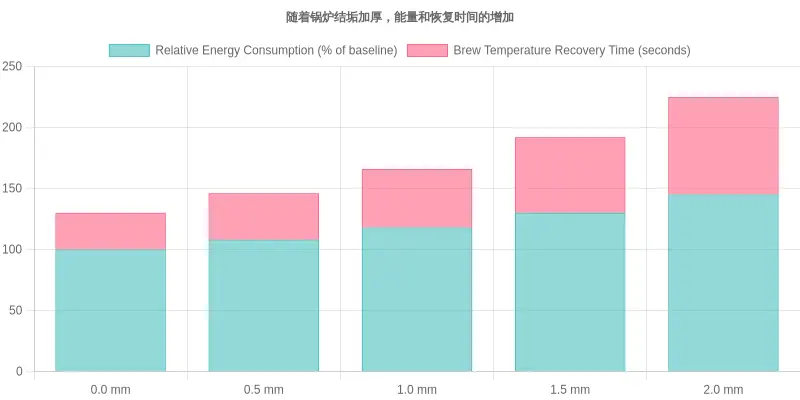
Reading the Bars
| Scale Thickness | Energy Use (% of baseline) | Recovery Time (seconds) |
|---|---|---|
| 0.0 mm | 100 | 30 |
| 0.5 mm | 108 | 38 |
| 1.0 mm | 118 | 48 |
| 1.5 mm | 130 | 62 |
| 2.0 mm | 145 | 80 |
Why the Curve Costs You Twice
Scale conducts heat poorly, so the boiler has to work harder and longer to push the same temperature into the water. That shows up in two places at once:
- Higher energy draw. At just 2.0 mm of scale, the boiler is consuming roughly 45% more energy to hit the same setpoint. On a battery-powered or generator-fed cart, that is runtime lost before the lunch rush.
- Slower recovery. The wait between shots stretches from 30 seconds to 80 seconds. That gap is where customers walk away, because a queue that used to move now stalls at the group head.
Every millimeter you prevent is money and minutes you keep. A softener is not an accessory; it is what stands between a healthy boiler and rising costs. A regular cleaning routine for a Bunn coffee maker is a good base for the rest of your maintenance habits.
Where This Fits
This data is one piece of the picture. Pair it with descaling intervals, water testing, and softener sizing for your cart, and the boiler stays protected from the inside out. Scale always collects its tax, one slow second and one extra watt at a time.
Setting Up the Right Water Softener for a Mobile Cart
A fixed cafe pulls from the same building supply day after day, so you size the softener once and largely leave it alone. A mobile cart may tap a different municipal line, a tank, or a borrowed spigot at every event, so incoming hard water can swing from soft to mineral-heavy overnight. That volatility is what quietly scales an espresso boiler. Getting the setup right starts with measurement, not guesswork. The steps:
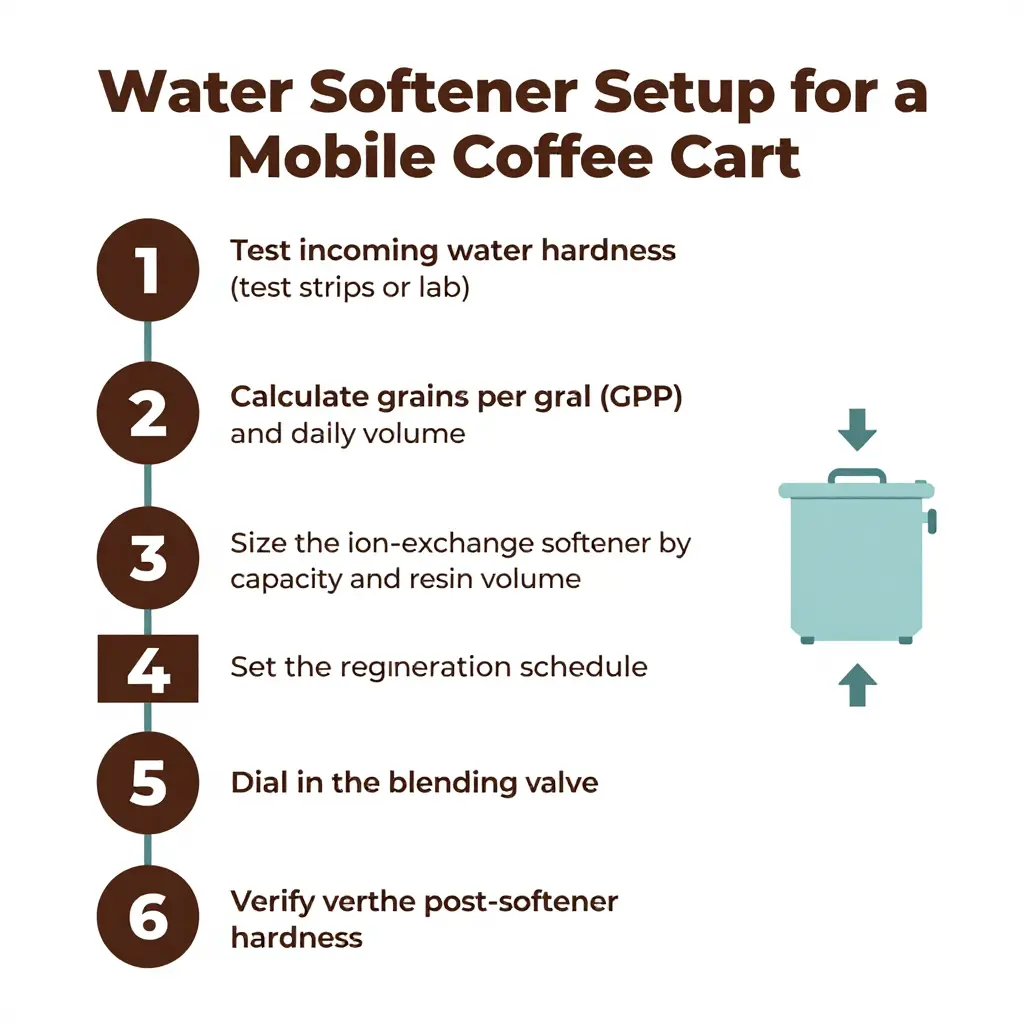
Step 1: Test the Incoming Water First
Before you buy any equipment, measure the water you actually brew with. Test strips give a fast read on hardness during a scouting trip. For real accuracy, send a sample to a lab so you know the exact grains per gallon (GPG), plus any chloride or silica the strips miss. Write the number down; you cannot size a softener without it.
Step 2: Size an Ion-Exchange Softener
With your GPG in hand, multiply it by your daily volume. A cart that uses roughly 25 gallons a day at 15 GPG needs far more resin than one at 5 GPG. Match the softener’s capacity (total grains it can remove before regenerating) to that number, and pick a resin volume that fits the cart without running dry mid-shift.
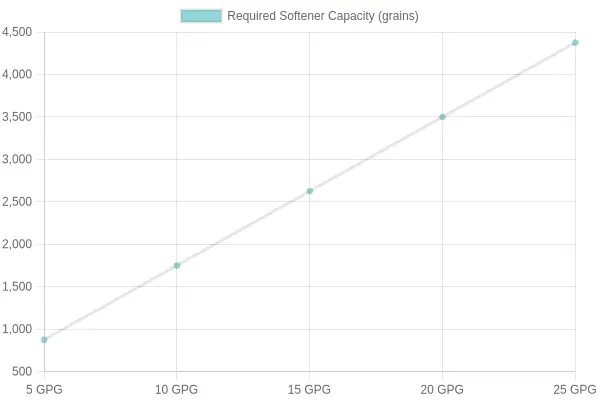
| Incoming Hardness | Required Capacity (25 gal/day, 7-day regen) |
|---|---|
| 5 GPG | 875 grains |
| 10 GPG | 1,750 grains |
| 15 GPG | 2,625 grains |
| 20 GPG | 3,500 grains |
| 25 GPG | 4,375 grains |
Step 3: Set the Regeneration Schedule
Plan regeneration around your busiest day, not your calmest. On a cart, daily or every-other-day regeneration is safer than waiting a full week, because you rarely know how much you will brew. Put salt or brine refills on the closing checklist.
Step 4: Dial In the Blending Valve
A blending valve mixes a little raw water back in so the espresso still extracts balanced flavor. Soften everything to zero and coffee can taste flat. Blend toward a target hardness of roughly 2-4 GPG for espresso.
Step 5: Confirm Post-Softener Hardness
Never trust the label. Test the water leaving the softener with the same method you used at the start. If it is still hard, the resin is channeled, exhausted, or bypassed. This check is what protects the espresso boiler from slow scale buildup.
Why Verification Matters More on a Cart
Source water changes with every event, so a setup that worked last weekend may underperform at the next stop. Check post-softener hardness at each new location, and keep a short maintenance routine for all your gear. For deeper guidance on keeping your equipment in top shape, this coffee equipment care resource is a solid reference. Treat verification as a habit, not a one-time task.
A Maintenance Schedule That Keeps Scale Out of the Boiler
A mobile cart runs hard, and mineral-rich water punishes it. When the softener drifts out of tune, scale starts building inside the boiler, and by the time shots taste flat you are facing a costly descale. The fix is a written schedule you actually follow.
Treat these timeframes as the backbone of the routine:
- Daily: Check water hardness with a titration kit before the first shot and log the reading in ppm or grains per gallon.
- Weekly: Test your water softener by checking regeneration salt levels or inspecting the resin bed for exhaustion, then regenerate or swap cartridges on schedule.
- Monthly: Run a post-softener water test at the grouphead to confirm softened water still reads within target – ideally under 3 grains per gallon.
- Quarterly: Inspect the espresso boiler for early scale buildup, check heating elements, and review your descaling history.
Logging every reading and descale does two things. It builds a record of when scale began, so you can catch a softener failure before it reaches the boiler. And the trend tells you something: a slow climb in hardness means the softener is losing efficiency, not that you need to descale more often.
Good records make a failing softener obvious. Pair the schedule with a dependable cleaning routine for your brewing gear, and keep the logbook on the cart where baristas can update it at close.
Frequently Asked Questions
Does a carbon filter soften water?
No. A carbon filter removes chlorine, odors, and some organic compounds, but it does not remove the dissolved calcium and magnesium that make water hard. If your source water is hard, you still need a dedicated water softener (an ion exchange resin) to prevent scale buildup inside your espresso boiler. Treat carbon filtration and softening as two separate jobs.
How often should a mobile cart regenerate its softener?
Regeneration frequency depends on your water hardness and daily volume, but most carts need to regenerate every few days to every two weeks. Test your output water with a hardness kit or TDS meter after each shift; when readings climb, it is time to regenerate or replace the resin. Never wait for visible scale buildup to appear, and pair softening with consistent cleaning habits such as those covered in this guide to cleaning a coffee maker.
Can I use softened water for espresso taste?
Yes, but avoid over-softening. Fully softened water can taste flat and may extract coffee too aggressively. Ideally, blend a small amount of hard water back in, or use a softener that leaves 2-4 grains per gallon (roughly 35-70 ppm) of hardness for balanced flavor. This keeps your espresso boiler protected while preserving sweetness, acidity, and body.
What hardness level is safe for an espresso boiler?
As a general rule, keep water entering the espresso boiler below about 3-4 grains per gallon (50-70 ppm). Above that threshold, scale buildup accelerates and shortens boiler life while raising energy costs. Use a test kit regularly and adjust your water softener settings accordingly.
Is reverse osmosis better than ion exchange on a cart?
Reverse osmosis removes nearly all minerals, producing very soft water that can taste empty and usually requires remineralization. Ion exchange is more practical on a mobile cart because it is compact, less expensive, and easier to regenerate on the go. For most operators, ion exchange paired with a carbon pre-filter offers the better balance between protection and flavor.
Quick Reference
| Question | Short Answer |
|---|---|
| Does carbon filtering soften water? | No, it only removes chlorine and odors |
| Softener regeneration | Every few days to two weeks |
| Softened water and taste | Fine if 2-4 gpg hardness remains |
| Safe boiler hardness | Keep below 3-4 gpg |
| Best cart option | Ion exchange with carbon pre-filter |
Protecting Your Boiler Starts With the Right Softener
Mobile cart water is never reliable. It changes with every fill station and every season, so you cannot assume it is safe for the machine.
Choose the wrong water softener, or run one that is only partly bypassed, and that variability goes straight into the espresso boiler. Minerals slip through and scale buildup begins coating the heating element and the boiler walls.
That scale raises energy use, slows recovery between shots, and shortens the working life of the boiler. A small shortcut becomes an expensive repair.
The fix is practical. Test the water first, then size and verify a proper ion-exchange water softener for your real volume and hardness. Once it is installed, maintain it on a schedule so it does not fail without warning.
A correctly sized, properly maintained softener protects the boiler, holds back scale, and keeps the cart pulling consistent shots day after day. If you want to go deeper into caring for your gear, our coffee equipment and brewing guides are a good next stop.
The boiler is the most expensive part of the cart. Treat its water accordingly and it will reward you with years of dependable service.