
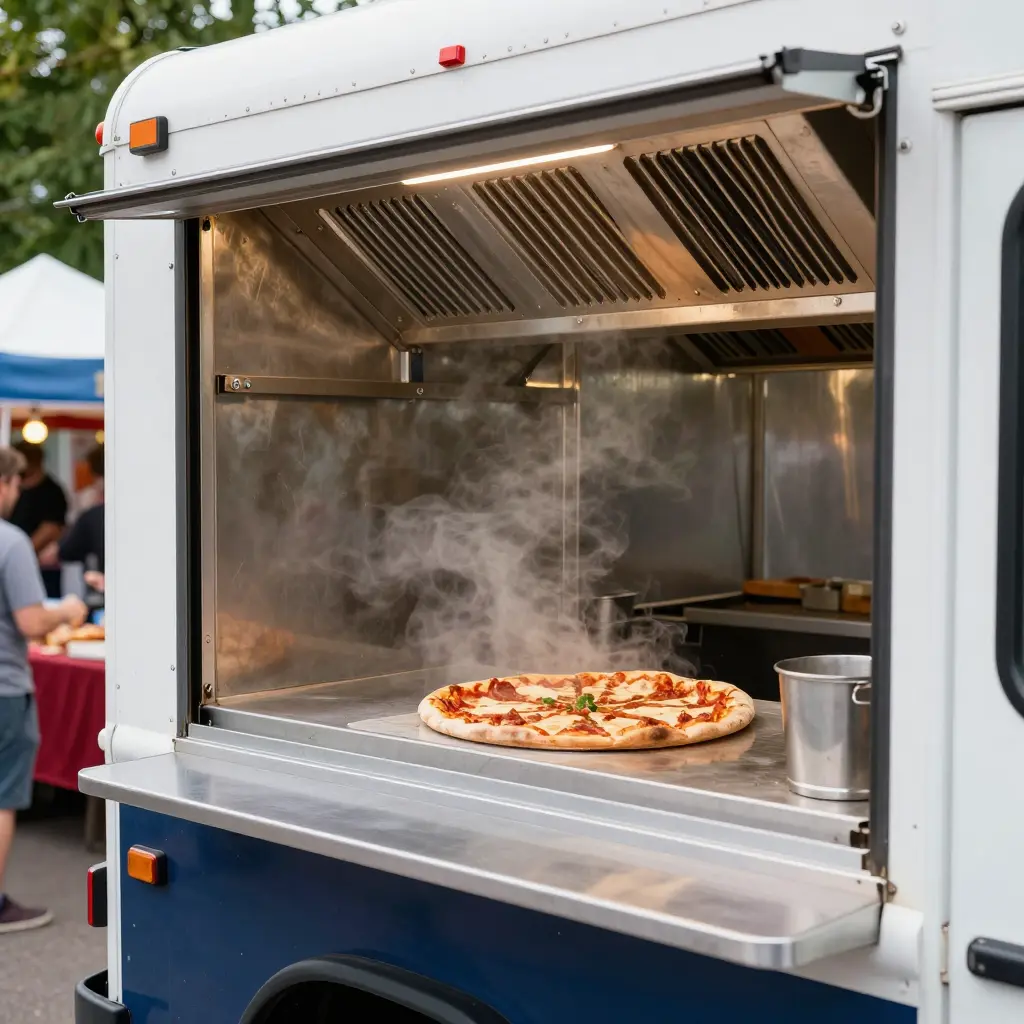
Why Pizza Truck Ventilation Is a Safety-Critical System
Hood capture that is undersized or mismatched to the oven is the single most common reason pizza trucks fail a health inspection. The problem hides until the exhaust volume can no longer keep pace with the grease, smoke, and heat a pizza oven produces, at which point contaminants escape into the cabin and settle on nearby surfaces. For a mobile operator, pizza truck ventilation and a correctly sized commercial kitchen hood are not optional upgrades. They are what protect the people cooking inside.
A pizza truck squeezes a full commercial kitchen into a few square feet. High-temperature ovens, proofers, and prep stations all generate heat and vapor inside a sealed, moving box with nowhere for smoke to drift. A commercial kitchen hood captures those byproducts at the source, filters out grease, and exhausts the rest through a duct and fan sized to the cooking load. When capture is too small, grease travels where it should not go: onto walls, wiring, and equipment.
That buildup is a real fire hazard. Grease inside a duct or on a canopy is one of the leading causes of commercial kitchen fires, and a food truck has no firewall or sprinkler buffer to slow the spread. Ventilation also determines air quality and worker safety, since carbon monoxide, airborne particulates, and cooking fumes have to be removed continuously, especially in the confined cabin where staff spend whole shifts.
What follows covers how capture is measured, how to size a hood and fan to your oven, the makeup air most operators overlook, and a checklist for staying compliant.
The Core Hood Mistake: A Hood That Can’t Capture What a Pizza Oven Produces
The mistake that sinks more pizza trucks than any other is a hood and exhaust fan that cannot capture the grease-laden vapors coming off a deck oven at full temperature. Owner-operators buy a compact residential-style hood, bolt it over the oven, and figure any fan pulling air upward is “good enough.” It almost never is.
A pizza oven runs hotter and longer than most cooking lines, and it releases a continuous plume of airborne grease. A hood that is too short, mounted too far from the cooking surface, or paired with an underpowered fan lets that plume escape into the box, where it condenses on walls, ceiling panels, and electrical components.
Why Undersizing Happens
The root cause is usually guesswork. Many operators buy ventilation by eye or by price, not by airflow math. They don’t calculate capture velocity, don’t account for the oven’s actual grease load, and don’t factor in makeup air, the replacement air a fan needs to keep pulling. Without balanced makeup air, even a correctly rated fan starves, chokes, and stops capturing altogether.
What Inspectors Actually Measure
During a food truck hood inspection, inspectors do not just glance at the hood. They measure and cite specifics:
- Capture velocity at the hood face, which must be strong enough to pull the grease plume in.
- Filter type and spacing, checking for baffle filters rated for grease service.
- Clearance between the hood and the cooking surface.
- Makeup air provisions that keep the kitchen under slight negative pressure without starving the exhaust.
Failures are written up against mechanical code and NFPA 96, which govern exhaust rates, fire-suppression coordination, and clearance requirements. A truck that fails these checks gets flagged for correction, and sometimes shut down on the spot.
What It Means for Operators
For a pizza truck owner, this is not a paperwork problem. A hood that cannot capture grease means grease buildup on surfaces, a real fire hazard, and a failed inspection that stops sales. The fix belongs upfront: size the hood to the oven, rate the fan to move enough cubic feet per minute, and design makeup air as part of the system instead of bolting it on after the first failed visit.
Keeping a pizza truck compliant is mostly about catching small failures before an inspector does. Run through this checklist to verify every part of your exhaust system is doing its job.
- Confirm your hood fully captures the plume. Position the hood so smoke and heat rise directly into it at the source; weak capture is the fastest way to fail a walkthrough.
- Match your grease filters to the cooking load. Baffle filters have to be correctly sized, seated, and angled so they trap grease before it reaches the ductwork.
- Inspect grease filters daily for buildup and damage. Clogged, warped, or loose filters choke airflow and raise the risk of a grease fire spreading through the system.
- Verify duct routing is short, sealed, and sloped upward. Continuous runs with as few bends as possible keep exhaust moving and prevent grease from pooling in low spots.
- Confirm your makeup air supply is properly balanced. A working makeup air system replaces the air your hood pulls out, so the fan does not starve and drag smoke back into the cabin.
- Follow a documented hood cleaning schedule. Regular professional cleaning keeps grease from piling up to dangerous levels and gives you dated proof for inspectors.
- Test the fire suppression system on schedule. Pull stations, nozzles, and fusible links must all operate, and the system should carry a tag showing the last service date.
- Keep written cleaning and service logs on board. Records of every cleaning, filter swap, and inspection prove compliance and help you spot problems before they become violations.
- Check airflow clearance around the truck. Park with enough space near the exhaust discharge that fumes vent away from windows, entrances, and nearby customers.
- Review all local food truck ventilation requirements. Municipal codes often demand specific hood heights, duct materials, and clearances beyond the basics.
A pizza truck that treats ventilation as an afterthought will eventually fail an inspection. One that checks these items routinely keeps cooking, selling, and passing with ease.
The table below contrasts the four most common pizza truck ventilation setups so you can match the right hood to your oven and menu before an inspector ever walks up.
| Configuration | Grease Capture Capability | Code-Compliance Risk | Best-Fit Use Case |
|---|---|---|---|
| Type I hood | High – engineered baffle filters capture grease-laden vapors at the source | Low when sized, ducted, and maintained per NFPA 96; missing one is the most common inspection failure | Gas, wood-fired, or deck ovens, griddles, and any cooking that releases grease smoke |
| Type II hood | Low to moderate – manages heat, steam, and odors but not grease | High if installed over grease-producing equipment; frequently flagged on walkthroughs | Steamers, dishwashers, and non-grease cooking zones only |
| Downdraft ventilation | Moderate – pulls vapors down near the cooking surface before they rise | Moderate to high; requires an engineer-approved design and balanced airflow to pass review | Compact trucks with low ceilings and little overhead clearance |
| Bare exhaust fan (no hood) | Very low – moves air but traps almost no grease | Very high; fails most grease-vapor inspections outright | Temporary setups or non-grease auxiliary airflow only |
The configuration you bolt over your oven is not a style choice; it is a legal one. A Type I hood is the only setup engineered to capture grease-laden vapors, which is exactly what pizza ovens, griddles, and dough-frying equipment produce. Swap in a Type II hood or a bare exhaust fan and you are ventilating heat and odors while grease quietly coats your ductwork, your roof, and eventually an inspector’s clipboard. Downdraft systems can work in tight trucks, but only when an engineer signs off on the airflow balance. Match the hood to the cooking, and you pass the walkthrough the first time.
Airflow and CFM: The Numbers That Decide Your Inspection
A pizza truck’s hood is only as good as the air moving through it. Pull too little and grease and smoke roll back into the truck and out onto the street, which is exactly the kind of thing an inspector writes down. The number that decides pass or fail is CFM, or cubic feet per minute. Getting CFM for food truck hood sizing right, and understanding how the makeup air supply behaves, keeps you out of trouble.
Capture Velocity: What the Hood Is Really Doing
A hood does not simply “suck up” smoke. It creates a current of moving air that carries smoke into the duct. That current is capture velocity, and for the hot, grease-heavy exhaust of a pizza oven you generally need roughly 100 feet per minute of air movement across the hood’s face, with more headroom under heavy grease loading. When capture velocity drops, smoke slips past the hood edges and into the cabin. The hood is there, but it is not actually capturing.
How Hood Length, Overhang, and Duct Diameter Affect Performance
Three physical details change how much air you truly pull:
- Hood length: More linear feet means a bigger face to cover, so required CFM climbs with the length of the hood.
- Overhang: The hood should extend about 6 inches past the cooking surface on every open side, so rising heat is caught before it spills into the room.
- Duct diameter: A smaller duct creates more friction and back pressure, so the same fan moves noticeably less air than it would through a larger duct.
A short, generous duct and a properly overhanging hood let a smaller, quieter fan do more useful work. A skinny duct paired with a barely covering hood forces you to oversize the fan just to keep up.
Why Unbalanced Makeup Air Starves the Exhaust
Every cubic foot of air you blow out must be replaced by air coming in. Without a dedicated makeup air supply, a closed truck goes into negative pressure. The exhaust fan ends up fighting the vacuum it created, so real airflow falls, doors get hard to open, and cooking odors drift where they should not. The fix is balance: bring in makeup air equal to roughly 80 to 90 percent of your exhaust CFM so the hood keeps pulling steadily instead of starving.
Your Rule of Thumb for Sizing
For a high-heat pizza oven, budget about 200 CFM per linear foot of hood, then round up. A 6-foot hood lands near 1,200 CFM, and a 10-foot hood near 2,000 CFM. Use the chart below as a quick starting point, then confirm against your fan’s rated airflow at the actual static pressure of your duct run.
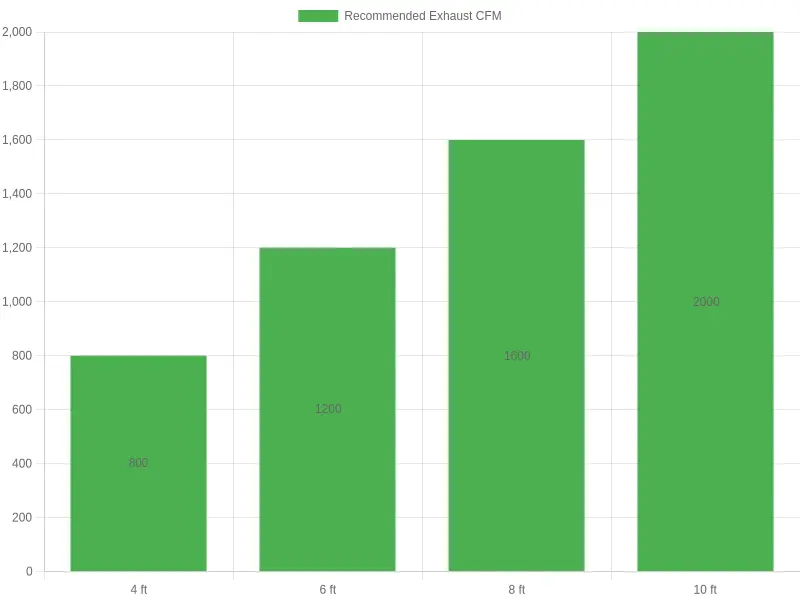
Match your makeup air to that number, keep your overhang and duct generous, and the hood will do its job when the inspector walks up.
The Data Behind Failed Ventilation Inspections
Ventilation is one of the first systems a health inspector scrutinizes in a pizza truck. The chart below ranks the ventilation violations cited most often, by the percentage of food truck inspections in which each was flagged.
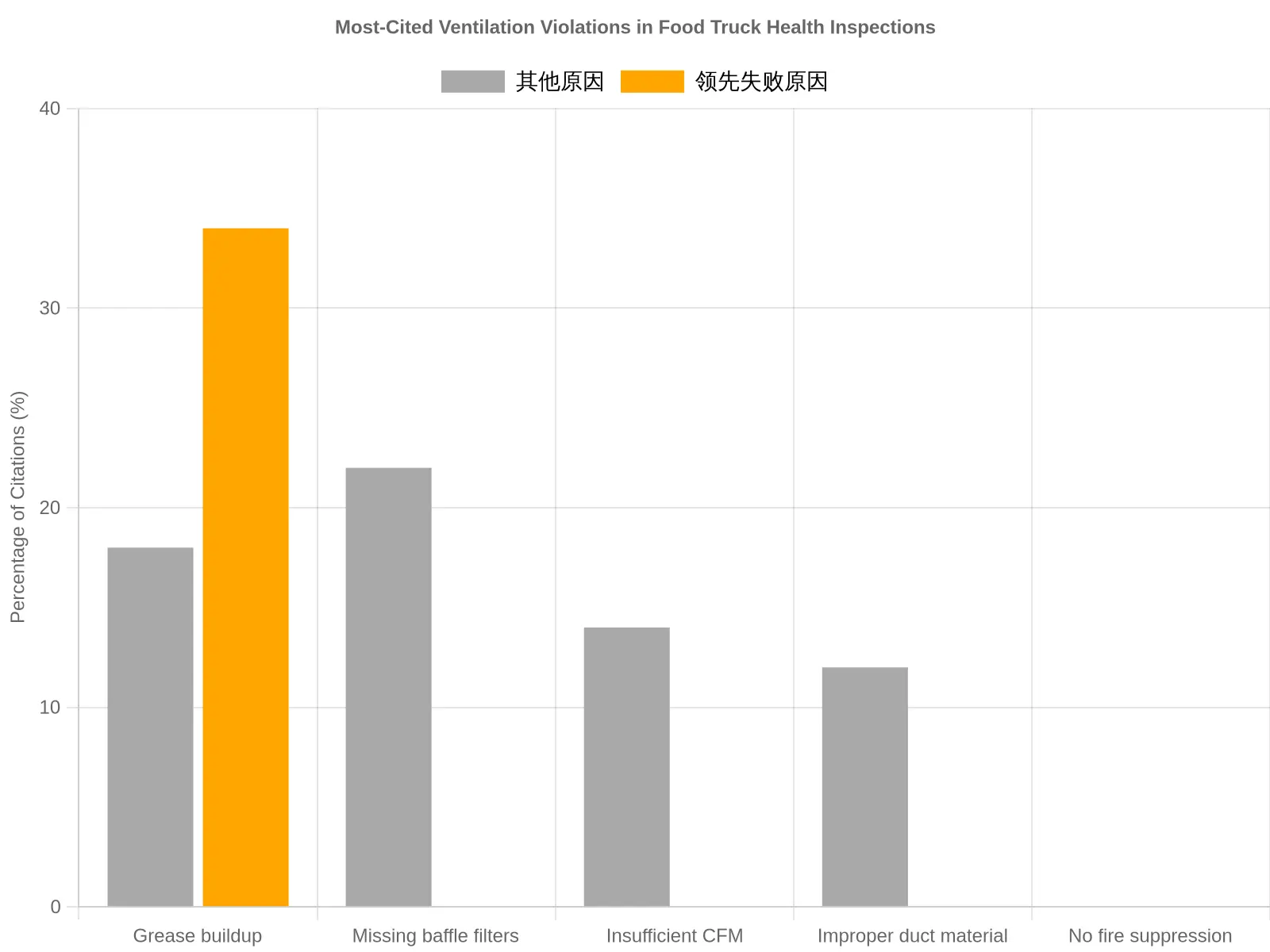
Insufficient CFM, the measure of how much air the hood actually moves, tops the list at roughly a third of all citations and dwarfs every other violation. The problem is rarely a missing part or a dirty filter. It is that the exhaust system cannot capture the smoke and grease a pizza oven throws off at full blast.
| Violation Category | Share of Citations (%) |
|---|---|
| Insufficient CFM (hood capture) | 34 |
| Missing baffle filters | 22 |
| Grease buildup | 18 |
| Improper duct material | 14 |
| No fire suppression | 12 |
The ranking points to one conclusion: undersized exhaust capacity causes more failed inspections than any other ventilation mistake. Paying for a properly calculated hood with enough CFM upfront costs far less than the citation, downtime, and rework that follow a failed inspection.
Grease Filters and the Cleaning Schedule That Keeps You Compliant
Most pizza truck owners learn this the hard way: an exhaust hood performs only as well as the filters inside it and the cleaning schedule behind them. A perfectly sized hood stuffed with clogged or missing filters captures almost nothing, and an inspector spots it the moment the canopy comes open.
Choose Baffle Grease Filters That Actually Fit Your Hood
Baffle grease filters force hot, greasy air to change direction again and again as it snakes through zig-zag metal blades. The grease cannot follow those turns, so it condenses on the steel and drains away instead of coating your ductwork and roof.
Skip mesh or flimsy disposable pads. Order stainless steel baffle grease filters sized to your hood’s exact opening, and buy enough to fill the entire filter bank edge to edge. Keeping one spare set on the truck lets you swap in clean filters mid-shift without ever cooking with a gap.
Place the Filters So They Seat Flush
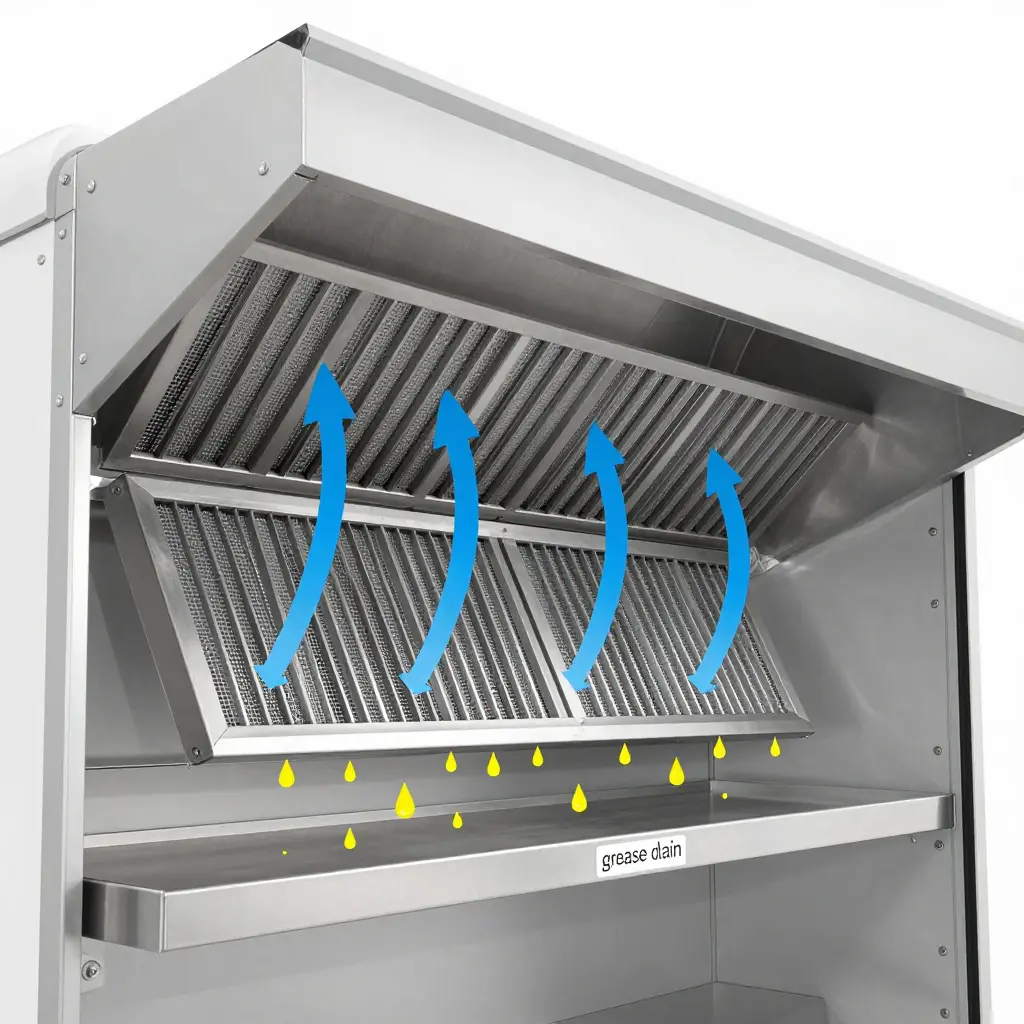
Filters sit at a slight angle inside the hood, slotted into the rails so they lean into the airflow rather than standing flat. Push each baffle until it locks, and confirm there are no gaps at the edges or between neighboring filters. The first row of baffles catches the most grease, so inspect that bank first every shift.
How Often Should You Clean? Your Hood Cleaning Frequency
NFPA 96 sets the baseline, and it ties your hood cleaning frequency to cooking volume and the fuel you burn. Baffle filters themselves need cleaning far more often than the whole system, because grease builds up on the blades meal after meal.
| Cooking Operation | Baffle Filter Cleaning | Full Hood, Fan & Duct Cleaning |
|---|---|---|
| High volume, solid fuel (wood or charcoal pizza ovens) | Daily | Monthly |
| High volume, gas or electric | Daily to every 2 days | Quarterly |
| Moderate volume | Every 2 to 3 days | Semi-annually |
Treat the filter row as a daily task, not a weekly one. Pull the baffles, soak them in degreaser, scrub the blades, dry them fully, and log the date. Documented cleaning is your best defense when an inspector asks for records.
Why Clogged or Missing Filters Fail Inspections
A clogged filter chokes airflow, and a missing filter lets grease sail straight past the hood. Both cripple your capture velocity, the speed of air pulling smoke and vapor out of the cooking zone. When capture drops, grease lands on the underside of the canopy, the fan, and the duct run, where it becomes fuel.
Under NFPA 96, that grease-laden buildup is exactly what inspectors look for, and it is a leading cause of failed hood inspections and shutdown orders. A greasy duct is not just a citation. It is a real fire hazard in a space as small as a pizza truck.
Your Operator Checklist
- Verify every baffle grease filter is stainless steel, correctly sized, and seated flush.
- Clean the filter bank daily and keep a spare set ready to swap.
- Track your hood cleaning frequency against NFPA 96 and book professional duct cleaning on schedule.
- Keep a written log of every cleaning so you can prove compliance on demand.
Equipment owners who like a repeatable maintenance rhythm can see how simple documented cleaning keeps gear running longer in this guide to how to clean a Bunn coffee maker. Get the filters right, clean them on time, and the hood mistake that fails inspections becomes one problem you never have to worry about again.
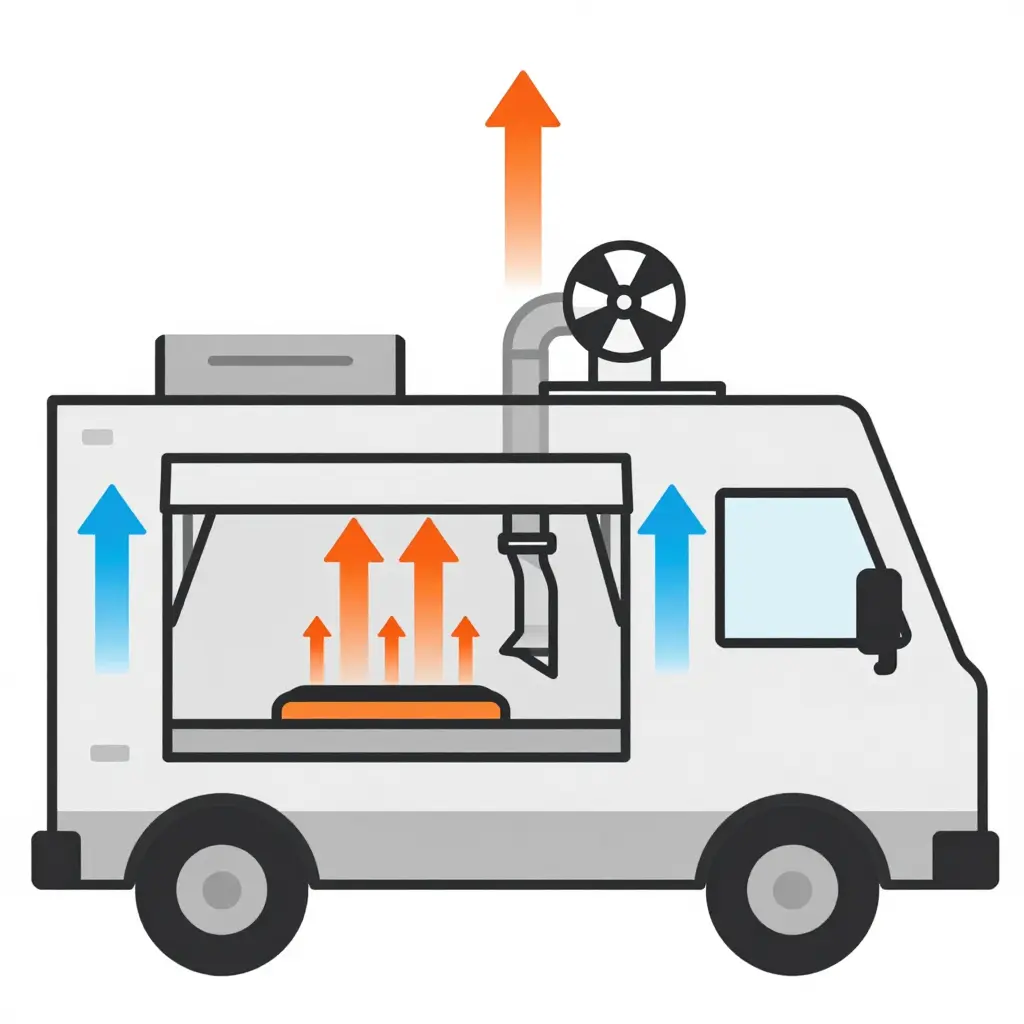
The diagram above maps the full air loop inspectors look for. Warm arrows trace grease-laden air rising from the oven deck, caught by the hood, then traveling up the duct to the roof fan. Cool arrows show makeup air flowing in through a dedicated vent so the system can push exhaust out instead of stalling. When any single link in this chain is missing or mismatched, the airflow balance breaks and the inspection fails.
Fire Suppression Systems: The Silent Partner of Your Pizza Truck Hood
Why Mandatory Suppression Belts Your Hood Together
A pizza truck hood pulls grease-laden air all day long, and grease is fuel. That is why the law treats a food truck fire suppression system as non-negotiable.
NFPA 17A, along with most local fire codes, requires any commercial cooking hood to carry a listed wet-chemical system with automatic detection mounted over the cooking surface. The nozzles thread up into the hood plenum, so the hood shell and the suppression unit are engineered as a single assembly. When flame or heat melts the fusible link, the agent floods the hood, the duct run, and the appliance below within seconds.
When that link is missing, expired, or never serviced, a hood inspection fails on the spot. Inspectors look for a current certification tag, clean nozzle caps, and a documented semiannual service record. Grease-clogged nozzles and an out-of-date tag are two of the most common reasons a cart gets red-tagged before it ever rolls.
Owners who try to save money by mounting a bare hood without suppression, or who skip regular service, are repeating the same underlying mistake that sinks inspections in the first place.
Getting Your Pizza Truck Ventilation Inspection-Ready
Most pizza truck ventilation failures during a health inspection do not come from a worn-out fan or a cracked belt. They come from the gap between what an operator assumes is clean and what an inspector can actually see, measure, and verify on the spot. Closing that gap starts well before anyone walks up to the service window.
What Inspectors Scrutinize First
A food truck hood inspection rarely begins at the hood itself. It begins with paperwork. Inspectors want a current cleaning certificate, service records from a certified hood-cleaning company, and a maintenance log noting when filters were last changed. Missing records suggest a system nobody is tracking, even when the metal still looks acceptable.
Once the clipboard is set aside, the eyes take over. Inspectors examine the hood canopy, the visible duct interior, and the roof exhaust for grease buildup. A thin, even film is expected. Thick, dripping deposits are an immediate red flag. That is why visible grease condition is treated as the strongest single indicator of whether a pizza truck ventilation system is genuinely maintained.
Filter condition comes next. Grease filters must be present, undamaged, and correctly seated. Bent baffles, missing clips, or filters jammed in backward reduce capture efficiency and signal neglect. Confirm each filter sits flush before service, because a poorly seated filter lets grease slip past into the ductwork.
Fan operation and makeup air verification round out the evaluation. The exhaust fan should run at full speed without unusual noise or vibration; a sluggish fan cannot pull enough air, and inspectors may time the draw or listen for strain. Every exhaust also needs replacement air, so blocked or undersized makeup air intakes will starve the hood, leave smoke lingering, and drag the whole system below standard.
Together these five areas describe a system that is documented, visible, and breathing correctly. Operators who treat them as ongoing habits instead of last-minute fixes tend to pass without drama.
Frequently Asked Questions: Pizza Truck Ventilation and Hood Inspections
How many CFM does my pizza truck ventilation system actually need?
There is no single magic number, but most inspectors expect a commercial kitchen hood to pull roughly 100 CFM per square foot of hood opening for light-duty cooking, and closer to 200-300 CFM for heavy-duty or solid-fuel pizza ovens. The real yardstick is capture velocity: grease-laden vapors must be drawn into the hood instead of drifting into your prep area. A qualified installer should calculate your CFM from oven type, hood dimensions, and duct run before you schedule an inspection.
How often should I clean my commercial kitchen hood?
Hood cleaning frequency depends on how hard the kitchen works. For a pizza truck running a wood or gas oven daily, most fire codes call for professional cleaning every one to three months. Solid fuel such as wood or charcoal means monthly service, because creosote and grease build up fast in a tight mobile space.
Is a Type II hood ever acceptable over a pizza oven?
Rarely, and it is the mistake that sinks many inspections. A Type II hood only filters heat, steam, and odors; it cannot handle the grease-laden vapors a pizza oven produces. Most jurisdictions require a Type I hood with stainless-steel baffle filters and a grease-rated exhaust fan over any commercial cooking appliance that generates grease. Choosing a Type II to save money almost always ends in a failed inspection.
Do I need makeup air in my pizza truck?
Yes. Every cubic foot of air your exhaust fan throws out must be replaced, or the hood will starve and lose capture efficiency. Makeup air units, screened openings, or dedicated supply fans keep the balance steady and prevent negative pressure from pulling cooking fumes into the cab. Undersized makeup air is a hidden but common cause of weak airflow.
What are the most common reasons pizza truck ventilation fails inspection?
The usual culprits are missing or overdue hood cleaning records, undersized exhaust fans, inadequate makeup air, missing fire-suppression coverage, and grease accumulations exceeding 0.078 inches. Inspectors also flag ducts that are too short, too long, or lacking access panels for cleaning. Organized documentation resolves many of these before they become violations.
Does a pizza truck need a hood if it only uses a gas oven?
In most cases, yes. NFPA 96 and local health codes treat gas-fired pizza ovens as grease-producing appliances, so a Type I commercial kitchen hood is generally required. The few exceptions involve electric countertop ovens specifically approved for ventless operation. Always confirm with your local fire marshal, because the rules shift from city to city.
Can poor pizza truck ventilation hurt my business beyond failed inspections?
Absolutely. Weak pizza truck ventilation lets grease coat your roof, nearby walls, and even neighboring parked vehicles, creating fire risks and complaints. Poor airflow also traps heat and smoke, making the team miserable and slowing service during a rush. Fixing airflow early protects your permit, your food quality, and your margins.
Conclusion: The Hood Mistake That Fails Inspections
The mistake at the heart of most failed pizza truck inspections is not the pizza. It is the hood. Too many builds install a residential-style range hood or an undersized commercial unit that cannot capture grease-laden vapor fast enough. The result is a capture failure: smoke, steam, and airborne grease escape into the cabin, coat the walls and ceiling, and draw an automatic citation on the first walkthrough.
Operator Takeaways
The fixes are non-negotiable, and each one carries its own inspection risk:
- Capture: The hood must match your oven’s output and geometry, pulling vapor away before it reaches a cook’s breathing zone.
- Makeup air: Every cubic foot the exhaust removes must be replaced, or the hood starves and loses suction the moment the cabin door opens.
- Filters: Baffle filters must be the correct type, cleaned on schedule, and never allowed to clog with grease.
- Fire suppression: The system must be sized to your appliances, with accessible manual pull stations and current inspection tags.
Failing an inspection is expensive. A shutdown order costs a full day of sales, a re-inspection fee, and the trust of a lunch crowd that only gives you one chance. Correcting a hood after the fact costs far more than engineering your pizza truck ventilation properly in the first place.
If you want a build that passes on the very first visit, invest in correctly engineered ventilation. Connect with truckpizza.net to design a high-quality pizza truck with a hood, makeup air, filters, and fire suppression that work as one system, and keep your business cooking.