
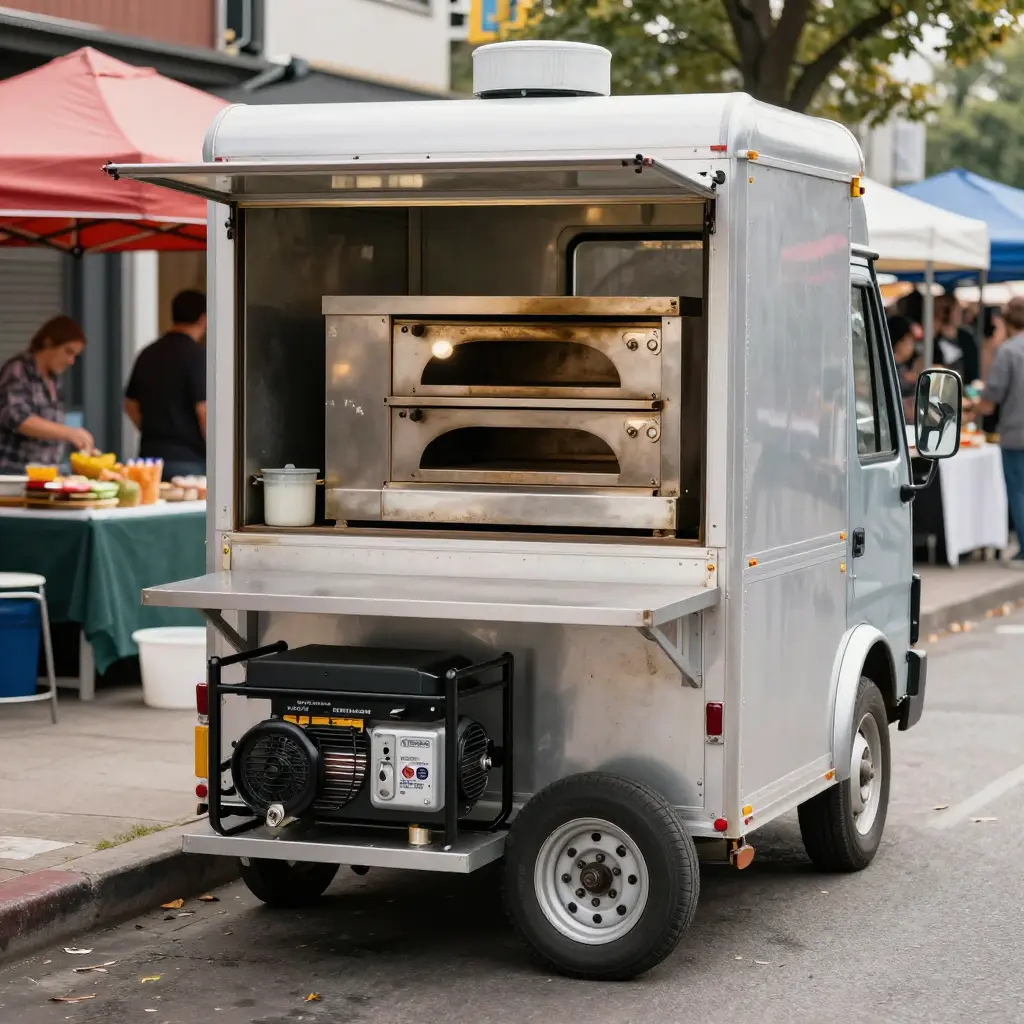
Sizing a generator for a mobile pizza operation usually comes down to one appliance: the deck oven. Get its startup demand right and the oven, the refrigerators, the lights, and the POS keep running through a lunch rush. Get it wrong and the breaker trips at the worst possible moment.
A deck oven does not draw a flat load. At ignition the heating elements are still cold, and cold metal has lower resistance than hot metal, so the elements pull harder in those first seconds than they do once the oven reaches temperature. The blower motors add locked-rotor current on top of that. The steady draw is measured in running watts; the brief peak is measured in starting watts. Size a generator against running watts alone and the startup surge can exceed what the unit delivers, which shows up as a tripped breaker or a shutdown during service.
This guide covers how to find the real startup surge figure for a deck oven, how to add up starting watts and running watts for the whole truck, and how to choose a generator with enough headroom for both.
What Is a Deck Oven Startup Surge?
A deck oven startup surge is the spike in current a deck oven draws the moment it switches on. Flipping the switch energizes heating elements that are still cold and blower motors that are not yet turning, so the oven asks for noticeably more power than it needs once it settles into a baking rhythm.
Two terms cover this. Inrush current is the momentary rush when motors and heating elements first energize, and on a motor it can run several times the normal running load. Surge wattage is the peak power the oven needs to cover that moment. Same event, described from two directions.
Steady Draw vs. the Ignition Spike
Once the oven is hot, its draw drops to a much steadier figure, and the spike itself lasts only a few seconds. It repeats, though. Fire a second or third deck, or let the thermostats cycle during a busy lunch, and the surge comes back each time.
That is what makes the surge matter on a truck. The generator has to carry the peak, not the average, and an undersized unit trips breakers or dies mid-order. If you serve drinks as well, portable brewing gear for mobile setups adds load to the same budget.

Starting Watts vs. Running Watts: Why Your Pizza Truck Needs Both
Two numbers on the generator label matter more than the rest. Running watts are the steady draw during normal operation: the deck oven holding temperature, the fridge cycling, the lights on. Starting watts, also called surge watts, are the spike when a motor or heating element kicks on.
That spike is short, usually a fraction of a second, but on a motor it can be two to three times the running load. A generator has to cover both numbers, not the larger of the two.
How Spec Sheets Present Both Ratings
Spec sheets list a continuous (running) rating and a peak (surge) rating side by side. The continuous rating is what the unit produces hour after hour. The surge rating is a ceiling it can touch only briefly.
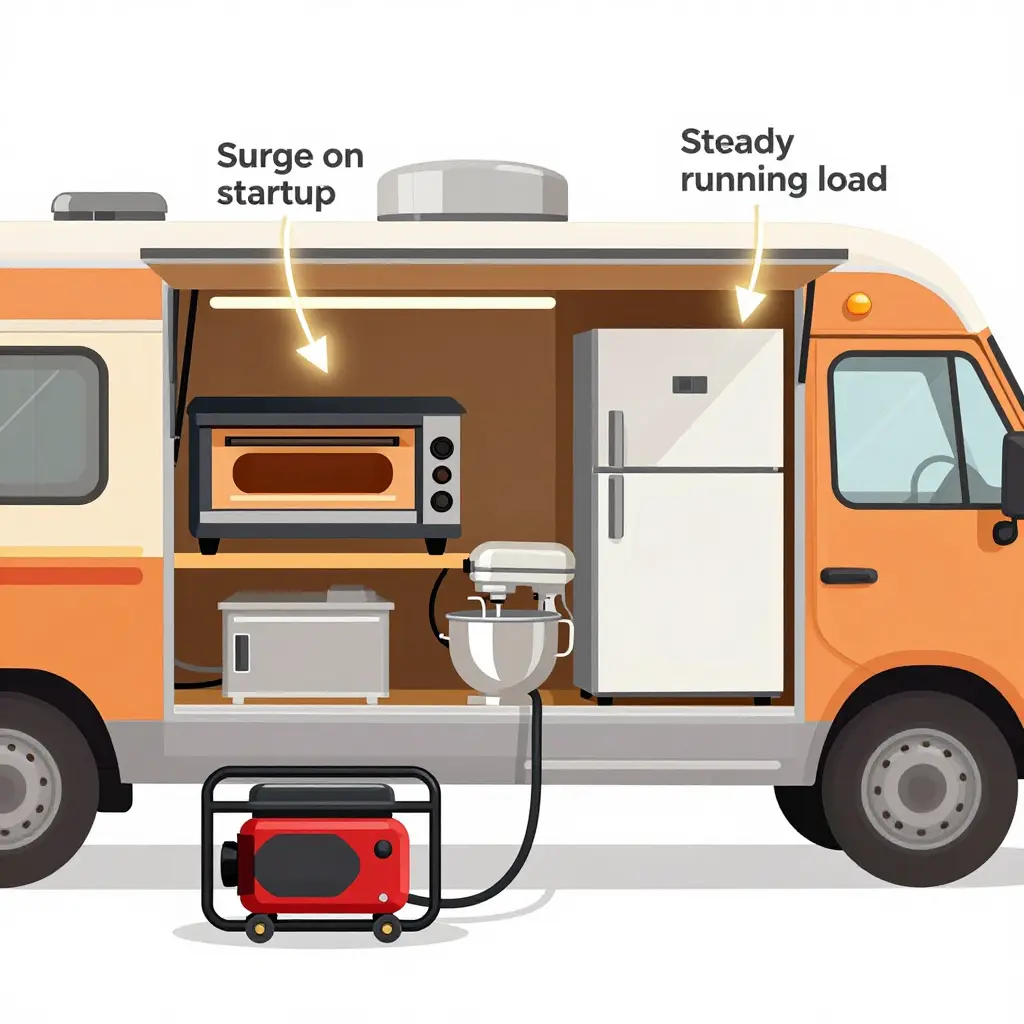
Sizing therefore takes two passes. Add up the running watts of everything you expect to run at once — that becomes your baseline. Then find the single largest starting watts surge in the lineup, usually the deck oven or a compressor, and confirm the generator can absorb it while still carrying the total running load.
Typical figures for common truck equipment look like this:
| Appliance | Running Watts | Starting Watts |
|---|---|---|
| Deck Oven | 3,500 | 5,000 |
| Commercial Fridge | 2,000 | 3,000 |
| Convection Oven | 4,000 | 5,000 |
| Blender | 500 | 1,200 |
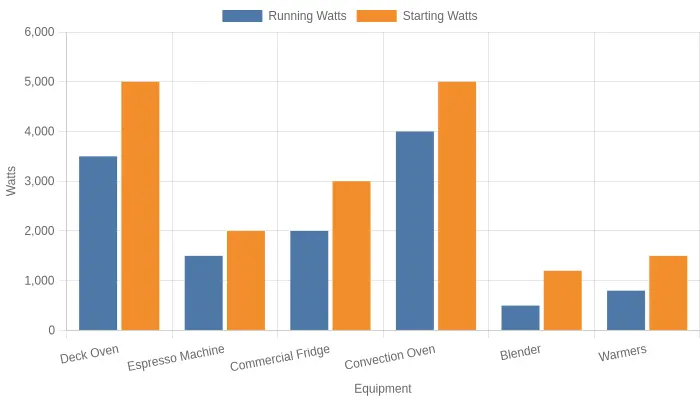
Skip that second pass and everything looks fine on paper until the oven fires mid-service and trips the generator. Smaller appliances on board deserve the same attention, much like picking the right Black+Decker coffee makers for a tight power budget. Cover the biggest surge, sustain the steady load, and the truck keeps rolling through the dinner rush.
Deck Oven Power and Surge Reference for Pizza Trucks
The reference table below goes deeper on deck ovens, where the startup surge — not the running figure — drives the final generator size.
| Oven type and size | Running watts | Startup surge watts | Suggested minimum generator running watts | Notes |
|---|---|---|---|---|
| Single-deck electric oven (2 pans, 240 V) | 3,000 | 9,000 | 6,500 | Surge peaks at roughly 3x running watts for 2 to 4 seconds during heat-up. |
| Double-deck electric oven (two stacked 240 V decks) | 6,000 | 18,000 | 12,000 | Both decks cycling together can stack surge; stagger startup where possible. |
| Gas-assisted oven with electric blowers (1 deck) | 800 | 2,400 | 2,000 | Gas supplies most of the heat; electric load is blowers, controls, and ignition only. |
| High-output large-deck oven (4 pans, 240 V) | 7,500 | 22,500 | 15,000 | Highest surge of the group; needs a generator with strong peak headroom. |
| Compact countertop deck oven (1 pan, 120 V) | 1,800 | 5,400 | 4,000 | Small footprint, but the load still roughly triples at startup. |
Factors That Shape Your Pizza Truck Generator Sizing
No single number on a spec sheet settles generator sizing for a pizza truck. These factors stack on each other, and missing one is enough to have the deck oven tripping the breaker mid-service.
- Deck oven startup surge. A deck oven draws its heaviest current in the first seconds, when the elements are cold and the blower motor is starting, often several times its running wattage.
- Simultaneous startup of other appliances. If the dough mixer, the refrigerator compressor, and the lighting all cycle on at once, their surges add together instead of arriving one at a time.
- Total connected running load. Add the continuous wattage of every device running at peak service, not just the oven.
- Altitude and temperature derating. A generator loses roughly 3 percent of its rated output per 1,000 feet of elevation, and more in high ambient heat, so you may need extra capacity to compensate.
- Fuel type and runtime. Gasoline, propane, and diesel units differ in power density and in how long they run between refuels.
- Voltage drop over long cables. Long or undersized extension runs lose voltage and can starve equipment.
- Continuous versus peak ratings. The surge rating covers brief bursts only; the continuous rating is what the unit safely sustains hour after hour.
Together these factors set the smallest generator that can absorb the deck oven’s startup surge and keep everything else running through a full shift.
Deck Oven Running Watts vs. Startup Surge Watts
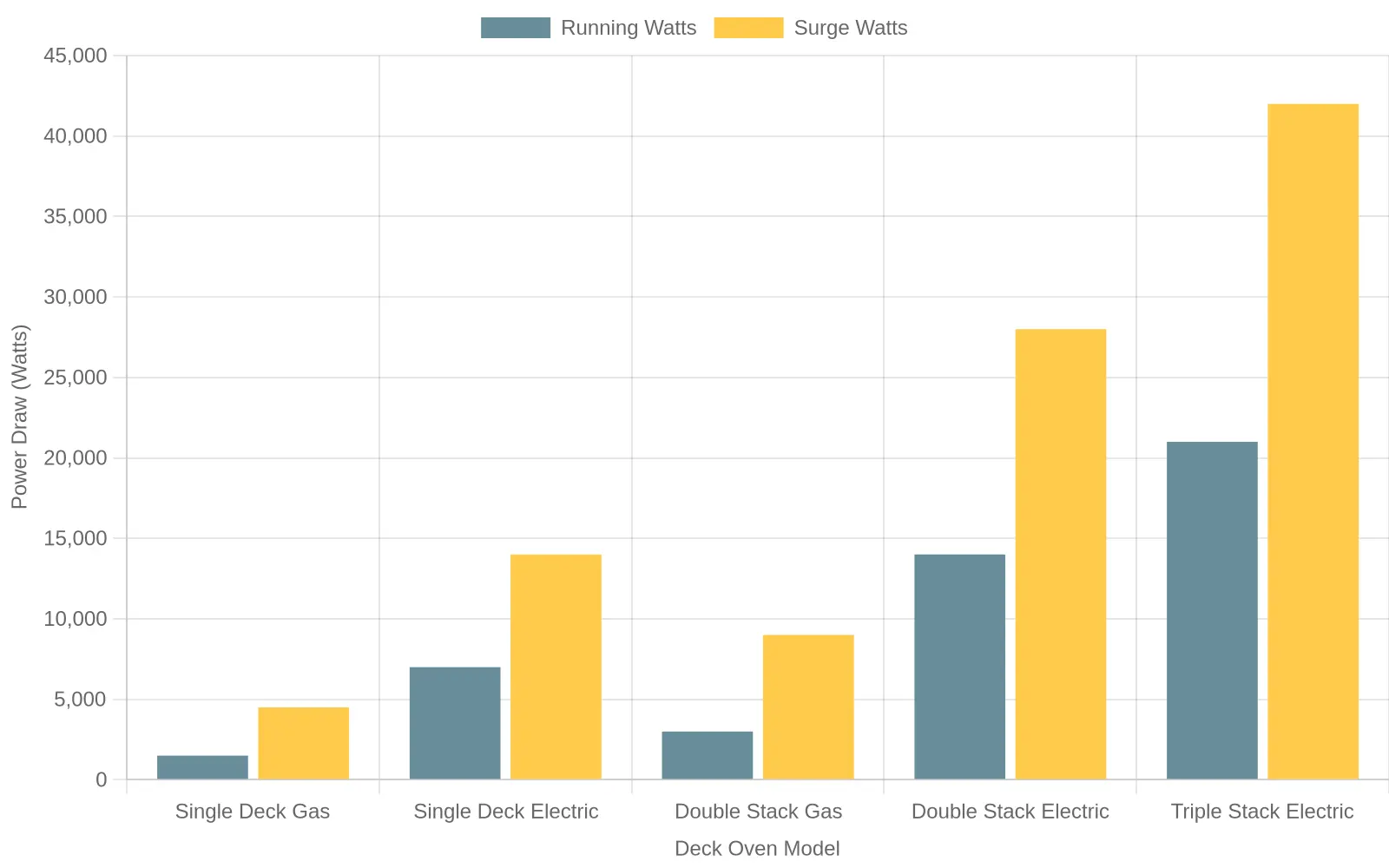
The chart above makes the point the hard way: the number an oven pulls while it is baking is not the number to size a generator around. Every deck oven spikes on ignition — the surge watts — and that spike is what trips breakers or stalls an undersized generator.
The gap between the two bars widens as you stack more decks. A single gas deck draws very little, while a triple-stack electric rig can demand twice its running load the instant the elements kick on. Misreading that label is the trap most pizza truck builders fall into.
What the Numbers Tell You
| Deck Oven Model | Running Watts | Surge Watts |
|---|---|---|
| Single Deck Gas | 1,500 | 4,500 |
| Single Deck Electric | 7,000 | 14,000 |
| Double Stack Gas | 3,000 | 9,000 |
| Double Stack Electric | 14,000 | 28,000 |
| Triple Stack Electric | 21,000 | 42,000 |
A quick rule of thumb: most electric deck ovens surge to about twice their running load, and larger decks can reach three times. Gas-assisted models spike to roughly three times a much smaller running draw, because ignition and the blower motor do most of the work. When you match a generator to a cooking line, build the math on the surge column — never the running column.
Common Generator Sizing Mistakes That Sink Pizza Trucks
Most breakdowns trace back to a handful of avoidable errors. These four cost the most.
Sizing by Running Watts Only
The most common mistake. A deck oven pulls 6,000 running watts, so the owner buys a 7,000-watt unit. Then the deck oven startup surge lands at two or three times that draw, and the oven fails to ignite while customers wait. Size the generator around the surge, not the steady number.
Ignoring Simultaneous Startup
The oven rarely starts alone. Fridges, lights, mixers, and a POS system are already running, and when several compressors kick on together their surges stack. The result is nuisance tripping: the breaker pops mid-service, the oven resets, and a batch of dough is lost. Adding only the biggest load while ignoring the rest guarantees an undersized machine.
Skipping Altitude and Temperature Derating
Generators lose output in thin, hot air. At high elevation or in a 100°F summer, a unit rated for 8,000 watts may deliver considerably less. Run the engine near its ceiling and you get fouled plugs, overheating, and shortened generator life well before the warranty runs out.
Overvaluing Peak Ratings
Peak (surge) watts are meant for seconds, not sustained cooking. Buyers see a big peak number and assume it is continuous. Roast with the deck oven for hours and the generator runs past its true capacity, fails early, and costs a season of service.
Treat running watts as a floor, not a target, and size for surges, stacked loads, and the conditions you actually work in.
Calculating Total Load: A Step-by-Step Walkthrough
Sizing around a deck oven is a two-part problem: add up the steady draw, then cover the one large surge that arrives when the oven first fires. Here is the arithmetic.
Step 1: List every appliance
Write down everything on the truck – deck oven, dough mixer, refrigerated prep, interior lights, POS terminal, exhaust fan, and any auxiliary beverage gear such as a coffee maker or warming station. A missing item is the fastest route to an undersized generator.
Step 2: Note each unit’s running watts
Running watts are the steady draw once a device is already operating. Read the data plate on each appliance, or its spec sheet, and record the number.
Step 3: Identify the largest startup surge
Startup surge (also called inrush) is the brief spike when a motor or heating element kicks on. On a pizza truck this is almost always the deck oven, which can surge to roughly two to three times its running watts. Everything else surges too, but in practice you plan the generator around the single largest one.
Step 4: Add the largest surge, then the rest, then a margin
Use this formula:
Generator size = (largest startup surge) + (sum of running watts of all other appliances) + safety margin
A quick example makes it concrete:
| Appliance | Running Watts | Startup Surge (W) |
|---|---|---|
| Deck oven | 3,000 | 9,000 |
| Dough mixer | 800 | 2,400 |
| Refrigerated prep | 700 | 2,100 |
| Coffee maker | 900 | – |
| POS + lights | 500 | – |
Sum of other running watts: 800 + 700 + 900 + 500 = 2,900 W
Add the deck oven surge: 2,900 + 9,000 = 11,900 W
Add a 20% safety margin: 11,900 x 1.20 = 14,280 W
That result points you to a 15 kW generator.
A word on the beverage corner
A brewing setup that tolerates surges matters as much as the size of the unit itself. Keeping your Bunn coffee maker clean protects its heating element, dependable Black+Decker coffee makers give you a predictable draw, and a portable travel coffee maker can cover overflow service without adding much to your total. With those steady draws accounted for, the only real variable left is the deck oven surge.
Matching Generator Types to Deck Oven Startup Surge
A deck oven is the hungriest appliance on your truck. Its heating elements and blower motor pull a brief but heavy inrush current – often two to three times the running wattage – the instant it kicks on. That split-second decides whether your lights flicker, your fridge trips, or the whole operation shuts down. Getting pizza truck generator sizing right means matching the generator’s surge rating, not just its running watts, to the oven.
Conventional vs. inverter. Conventional (fixed-speed) generators turn at a constant 3,600 RPM and can dump a large burst of current into a starting motor, which makes them forgiving of deck oven surges. They are also loud, heavy, and thirsty. Inverter generators convert power electronically: quieter, thriftier at light loads, clean voltage – but most cap surge near double their running watts, so a single-deck electric oven can overwhelm one.
Single-phase vs. multi-phase. Single-phase 120/240V output runs almost every deck oven and is the practical choice for a food truck. Three-phase output spreads current across more conductors and eases strain on large commercial equipment, but most pizza ovens are not built for it, so it only helps when your gear matches.
Diesel vs. gasoline vs. propane. Diesel delivers long runtimes and strong torque for heavy continuous loads, at the cost of weight and fumes. Gasoline generators are lighter and cheaper up front and surge well in conventional form, though they need frequent refueling and run loud. Propane burns clean and quiet with easy fuel storage, which suits gas-assisted ovens whose electric blowers draw very little.
| Generator Type | Surge Handling | Continuous Load | Runtime | Best For |
|---|---|---|---|---|
| Conventional, single-phase, diesel | Excellent | High | Longest | Fully electric deck ovens |
| Conventional, single-phase, gasoline | Strong | Medium-High | Medium | Electric deck ovens, backup |
| Inverter, single-phase, gasoline | Limited (~2x) | Low-Medium | Long at light load | Gas-assisted ovens, blowers |
| Inverter, single-phase, propane | Limited | Low | Tank-dependent | Gas-assisted ovens, quiet sites |
| Multi-phase, diesel | Excellent | Very High | Longest | Large multi-oven rigs |
For a fully electric deck oven, a conventional single-phase diesel or gasoline generator with generous surge headroom is the safest bet. For a gas-assisted oven with an electric blower, a compact inverter or propane generator easily covers the small continuous load. Mobile vendors who also serve drinks often pair their power setup with compact brewing gear, such as portable coffee makers built for life on the road.
FAQ: Deck Oven Startup Surge and Generator Sizing
How much surge wattage does a deck oven typically need?
A deck oven’s startup surge, also called inrush current, generally runs two to three times its rated running wattage. A single-deck electric oven that draws 3,000 watts while running can demand 6,000 to 9,000 watts in the first second, before the elements reach temperature and the blower comes up to speed. A double-stack electric deck may pull 12,000 watts or more at startup. Check the oven’s nameplate and spec sheet for the exact figure, since the surge lasts only a fraction of a second before the load settles to its steady running draw.
Can an inverter generator run a deck oven?
An inverter generator can run a deck oven, but only if its surge rating covers the startup load. Inverter models deliver clean, stable power, which suits sensitive oven controls, yet many consumer units have limited surge capacity even when their running wattage looks adequate. Match the generator’s peak (surge) wattage to the oven’s inrush requirement, not just its continuous rating, and remember that anything else running at that moment reduces the wattage available for the surge.
Does a gas-assisted oven reduce generator requirements?
Yes, substantially. A gas-assisted deck oven uses propane or natural gas for the primary heat and electricity only for controls, ignition, and convection fans, so the electrical load drops to a few hundred watts and a much smaller generator will do. The fan motor’s startup surge still has to be covered, but overall generator size shrinks dramatically compared with an all-electric deck.
How much headroom should I add above the total running load?
At least 20 to 30 percent above the combined running load, with the largest motor’s surge verified separately. Headroom covers occasional spikes, voltage sag, and the extra draw when several appliances start close together. Undersizing is far more common than oversizing, so when in doubt take the next size up rather than risk tripping breakers mid-service.
Can two smaller generators be paralleled to cover a surge?
Yes. Many inverter generators support parallel operation through a manufacturer-approved kit that links two identical units, combining both their running and surge output so the load spreads across two lighter machines. Both units must be the same model and rated for parallel use, connected with the correct cable kit; mismatched or improperly linked generators will not synchronize safely.
Conclusion and Recommendations
Across every calculation, the deck oven’s startup surge is what decides the generator size. Electric deck ovens draw their heaviest current in the first seconds, when the elements are cold and the blower is starting, and that peak can reach two to three times the running draw. A generator that cannot cover it leaves you with an oven that trips breakers, heats unevenly, or never reaches temperature during service.
The working rules are simple. Starting watts must exceed the largest single surge in the equipment lineup, which is almost always the deck oven. Continuous capacity must cover the running load of every appliance, plus a margin for simultaneous use and future additions.
Guessing costs money in both directions. Oversizing wastes capital and fuel; undersizing leaves you with an oven that never performs. Real appliance data – nameplate ratings, measured startup readings, documented duty cycles – replaces assumptions with verifiable facts, and a few minutes with a clamp meter often changes the entire specification.
To match generator, oven, and daily operation properly, work with the mobile culinary specialists at truckpizza.net. They can turn your measured loads into the right generator, so the oven fires reliably on the busiest day.